
Catalogue Search | MBRL


Are you sure you want to remove the book from the shelf?

{{itemTitle}}
134
result(s) for
"Mathematische Logik"
Sort by:
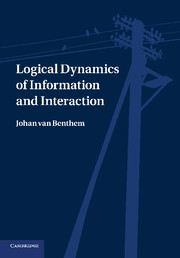
Logical Dynamics of Information and Interaction
This book develops a view of logic as a theory of information-driven agency and intelligent interaction between many agents - with conversation, argumentation and games as guiding examples. It provides one uniform account of dynamic logics for acts of inference, observation, questions and communication, that can handle both update of knowledge and revision of beliefs. It then extends the dynamic style of analysis to include changing preferences and goals, temporal processes, group action and strategic interaction in games. Throughout, the book develops a mathematical theory unifying all these systems, and positioning them at the interface of logic, philosophy, computer science and game theory. A series of further chapters explores repercussions of the 'dynamic stance' for these areas, as well as cognitive science.
eBook
The Foundations of Frege's Logic
No detailed description available for \"The Foundations of Frege's Logic\".
eBook

Molecular logic and computing
Molecular substrates can be viewed as computational devices that process physical or chemical 'inputs' to generate 'outputs' based on a set of logical operators. By recognizing this conceptual crossover between chemistry and computation, it can be argued that the success of life itself is founded on a much longer-term revolution in information handling when compared with the modern semiconductor computing industry. Many of the simpler logic operations can be identified within chemical reactions and phenomena, as well as being produced in specifically designed systems. Some degree of integration can also be arranged, leading, in some instances, to arithmetic processing. These molecular logic systems can also lend themselves to convenient reconfiguring. Their clearest application area is in the life sciences, where their small size is a distinct advantage over conventional semiconductor counterparts. Molecular logic designs aid chemical (especially intracellular) sensing, small object recognition and intelligent diagnostics.
Journal Article
Logic with Trees
First published in 1997. Routledge is an imprint of Taylor & Francis, an informa company.
eBook
Logical pluralism
Consequence is at the heart of logic; an account of consequence, of what follows from what, offers a vital tool in the evaluation of arguments. Since philosophy itself proceeds by way of argument and inference, a clear view of what logical consequence amounts to is of central importance to the whole discipline of philosophy. This book presents and defends what it calls logical pluralism, arguing that the notion of logical consequence does not pin down one deductive consequence relation; it allows for many of them. In particular, the book argues that broadly classical, intuitionistic, and relevant accounts of deductive logic are genuine logical consequence relations; we should not search for one true logic, since there are many. The book's conclusions have profound implications for many linguists as well as for philosophers.
eBook

A Valid Scheme to Evaluate Fuzzy Definite Integrals by Applying the CADNA Library
The aim of this paper is to estimate the value of a fuzzy integral and to find the optimal step size and nodes via the stochastic arithmetic. For this purpose, the fuzzy Romberg integration rule is considered as an integration rule, then the CESTAC (Controle et Estimation Stochastique des Arrondis de Calculs) method is applied which is a method to describe the discrete stochastic arithmetic. Also, in order to implement this method, the CADNA (Control of Accuracy and Debugging for Numerical Applications) is applied which is a library to perform the CESTAC method automatically. A theorem is proved to show the accuracy of the results by means of the concept of common significant digits. Then, an algorithm is given to perform the proposed idea on sample fuzzy integrals by computing the Hausdorff distance between two fuzzy sequential results which is considered to be an informatical zero in the termination criterion. Three sample fuzzy integrals are evaluated based on the proposed algorithm to find the optimal number of points and validate the results.
Journal Article

The Oxford Handbook of Philosophy of Mathematics and Logic
Mathematics and logic have been central topics of concern since the dawn of philosophy. Since logic is the study of correct reasoning, it is a fundamental branch of epistemology and a priority in any philosophical system. Philosophers have focused on mathematics as a case study for generalphilosophical issues and for its role in overall knowledge- gathering. Today, philosophy of mathematics and logic remain central disciplines in contemporary philosophy, as evidenced by the regular appearance of articles on these topics in the best mainstream philosophical journals; in fact, the lastdecade has seen an explosion of scholarly work in these areas.This volume covers these disciplines in a comprehensive and accessible manner, giving the reader an overview of the major problems, positions, and battle lines. The 26 contributed chapters are by established experts in the field, and their articles contain both exposition and criticism as well assubstantial development of their own positions. The essays, which are substantially self-contained, serve both to introduce the reader to the subject and to engage in it at its frontiers. Certain major positions are represented by two chapters--one supportive and one critical.The Oxford Handbook of Philosophy of Math and Logic is a ground-breaking reference like no other in its field. It is a central resource to those wishing to learn about the philosophy of mathematics and the philosophy of logic, or some aspect thereof, and to those who actively engage in thediscipline, from advanced undergraduates to professional philosophers, mathematicians, and historians.
eBook

The Origin of the Logic of Symbolic Mathematics
Burt C. Hopkins presents the first in-depth study of the work of Edmund Husserl and Jacob Klein on the philosophical foundations of the logic of modern symbolic mathematics. Accounts of the philosophical origins of formalized concepts-especially mathematical concepts and the process of mathematical abstraction that generates them-have been paramount to the development of phenomenology. Both Husserl and Klein independently concluded that it is impossible to separate the historical origin of the thought that generates the basic concepts of mathematics from their philosophical meanings. Hopkins explores how Husserl and Klein arrived at their conclusion and its philosophical implications for the modern project of formalizing all knowledge.
eBook

Mad families, splitting families and large continuum
Let κ < λ be regular uncountable cardinals. Using a finite support iteration (in fact a matrix iteration) of ccc posets we obtain the consistency of b = a = κ < s = λ. If μ is a measurable cardinal and μ < κ < λ, then using similar techniques we obtain the consistency of b = κ < a = s = λ.
Journal Article