
Catalogue Search | MBRL


Are you sure you want to remove the book from the shelf?

{{itemTitle}}
91
result(s) for
"Mayan languages Grammar."
Sort by:

A historical grammar of the Maya language of Yucatan : 1557-2000
\"Victoria Bricker's painstaking work is based on almost one thousand provenienced notarial documents and letters written by native speakers of Yucatec Maya from the colonial times to the modern day. Because the documents are dated and also specify the town where they were written, Bricker was able to determine when and where grammatical changes first appeared in the language and the trajectory of their movement across the Yucatan peninsula. This exemplary grammar of Yucatec Maya includes examples and careful explanations of the phonological, morphological, and syntactic structures of the language. Bricker's research is distinguished in its treatment of seemingly aberrant spellings of Maya words as clues to the way they were actually pronounced at different times in the past. Her chapters include topics seldom covered, such as deictic particles, affects, and reduplication. Of special interest is a poetic form of reduplication composed of couplets (or triplets) found in documents from each of the centuries, indicating the continuity of this genre from the Colonial to the Modern version of this language\"--Provided by publisher.
Book
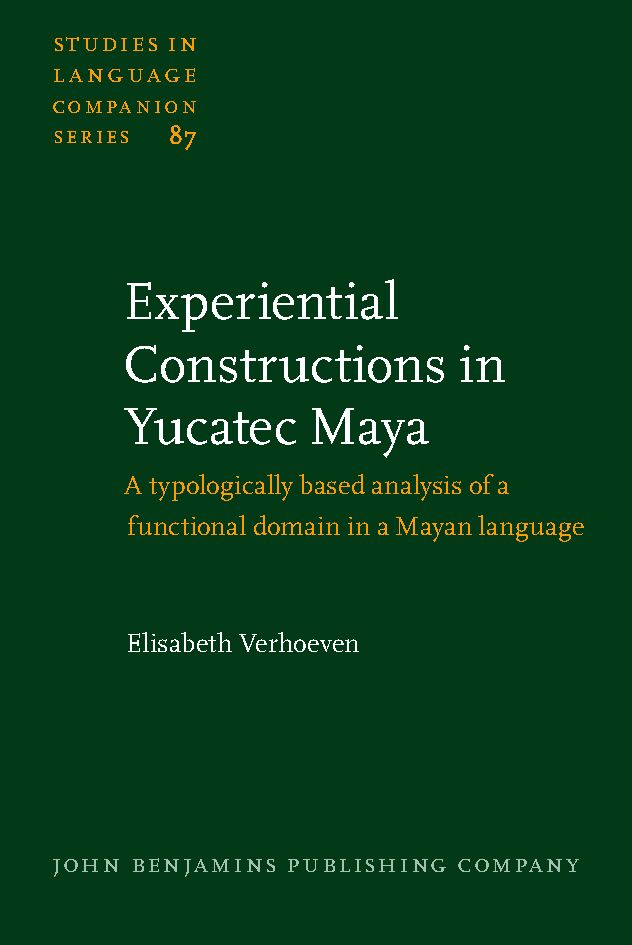
Experiential constructions in Yucatec Maya : a typologically based analysis of a functional domain in a Mayan language
This book combines a fieldwork-based language-specific analysis with a typological investigation. It offers a detailed and comprehensive analysis of the form and semantics of experiencer constructions in Yucatec, the Mayan language of the Yucatecan peninsula in Mexico. Since the linguistic expression of experience is not restricted to a specific grammatical area the study touches a great variety of grammatical fields in the language such as argument structure, grammatical relations, possessive constructions, subordinate constructions, etc. The empirical analysis of the Yucatec data is preceded by a thorough examination of the functional domain and the cross-linguistic coding of experience which until now could not be found in the literature. This study will be of interest to scholars working in the fields of typology and Native American linguistics, and especially to those interested in argument structure and the syntax-semantics interface.
eBook

Germination, early development, and creativity in the acquisition of the Yucatec Maya deictic system
The Yucatec Maya language has a highly complex deictic system with interesting typological differences that in addition to demonstratives and locative adverbs also includes ostensive evidentials and modal adverbs. Given that deictic words are among the first that children produce, the aim of this study is to identify the early acquisition that Yucatec Mayan children follow to map out each deictic form. Deictic words taken from spontaneous, longitudinal, transversal corpora and Gaskins's (1990) field work annotations were labeled and analyzed. The results show that children begin by uttering protoforms mapped with prototypical functions of locative and modal adverbs, but the functions of both demonstratives and ostensive evidentials are expressed mostly with the same protoform, which is similar to the deictic organizations of other languages. When children become productive, they overextend functions, which demonstrates a reanalysis of the system before acquisition is complete.
Journal Article

Anti-locality and optimality in Kaqchikel Agent Focus
Many Mayan languages show a syntactically ergative extraction asymmetry whereby the A-extraction of subjects of transitive verbs requires special verbal morphology, known as Agent Focus. In this paper I investigate the syntax of Agent Focus in Kaqchikel, a Mayan language spoken in Guatemala. I argue that this extraction asymmetry in Kaqchikel is the result of a particular anti-locality constraint which bans movement that is too close. Support for this claim comes from new data on the distribution of Agent Focus in Kaqchikel that show this locality-sensitivity. The distribution and realization of Agent Focus will then be modeled using a system of ranked, violable constraints operating over competing derivations. This theoretical choice will be supported by details in the pattern of agreement in Agent Focus. I will then show how rerankings of the proposed constraints can model the attested distribution of Agent Focus in a number of other Mayan languages. I also discuss extensions of this approach to other patterns of anti-agreement.
Journal Article

Language Diversity and Social Action
The classic version of the linguistic relativity principle, formulated by Boas and developed especially in the work of Whorf, suggests that the particular lexicogrammatical patterns of a given language can influence the thought of its speakers. A second version of the argument emerged in the 1970s and shifted the focus to the indexical aspect of language: any given language includes a particular set of indexical signs, and these essentially shape the contexts produced in speaking that language. In this article, we propose a third locus of linguistic relativity. Our argument is based on recent work in conversation analysis that has shown how the resources of a given language provide the tools for accomplishing basic actions in interaction. To develop our argument, we consider the way in which the resources of three different languages (Caribbean English Creole, Finnish, and Lao) are deployed by speakers to agree with a prior assessment while at the same time claiming greater epistemic authority over the matter assessed. Our case study indicates that the language-specific tools used to accomplish this action (the lexicogrammatical resources) introduce collateral effects and in this way give the action a local spin or inflection.
Journal Article
Early lexical acquisition in the Wichi language
This research brings new evidence on early lexical acquisition in Wichi, an under-studied indigenous language in which verbs occupy a privileged position in the input and in conjunction with nouns are characterized by a complex and rich morphology. Focusing on infants ranging from one- to three-year-olds, we analyzed the parental report of infants’ vocabulary (Study 1) and naturalistic speech samples of children and their caregivers (Study 2). Results reveal that: (1) although verbs predominate in the linguistic input, children's lexicons favor nouns over verbs; (2) children's early noun-advantage decreases, coming into closer alignment with the patterns in the linguistic input at a MLU of 1.5; and (3) this early transition is temporally related to children's increasing productive command over the grammatical categories that characterize the morphology of both nouns and verbs. These findings emphasize the early effects of language-specific properties of the input, broadening the vantage point from which to view the lexical acquisition process.
Journal Article

Classifiers can be for numerals or nouns: Two strategies for numeral modification
This paper compares two families of theories for numeral classifiers drawing on fieldwork data from two languages, Ch’ol (Mayan, Mexico) and Shan (Kra-Dai, Myanmar). We discuss classifier-for-numeral theories and classifier-for-noun theories, which we argue make different predictions based on the syntactic position and semantic contribution of the classifier in each set of theories. We argue that Ch’ol is a classifier-for-numeral language and Shan is a classifier-for-noun language. This analysis attributes the distinction between classifier-for-numeral and classifier-for-noun languages to cross-linguistic variation in the strategies for numeral modification. The proposed diagnostics are based on the semantic role of the classifier in numeral modification and can be used to distinguish between the two types of numeral classifiers across other languages.
Journal Article
The development of possession in the L1 acquisition of Northern East Cree
This study presents the first investigation of the development of possessive constructions in Northern East Cree, a polysynthetic language indigenous to Canada. It examines transcripts from naturalistic recording sessions involving one adult and one child, from age 2;01.12 to 3;08.24. Findings reveal that, despite the frequency of possessive inflection in child-directed speech, the child overwhelmingly produces a possessive construction that circumvents this morphology. This construction, named here the equational possessive strategy (EPS), is largely undescribed in existing literature but is the primary mechanism for the child to express possession. These findings have potential implications for the cross-linguistic acquisition of possessive morphology and the connections between child-directed speech and child language production.
Journal Article

Clothing, Gender, and Sociophonetic Perceptions of Mayan-Accented Spanish in Guatemala
Perceptual sociophonetic work on Guatemalan Spanish has demonstrated that listeners are more likely to link male voices with traditional Maya clothing, the traje típico, when their speech includes features of Mayan-accented Spanish. However, as Maya women are more likely than men to wear the traje típico, this matched-guise study investigates native Guatemalans’ perceptions of Mayan-accented Spanish produced by female voices. The results demonstrate that guises with features of Mayan-accented Spanish were more likely to have traje típico as a response than guises without these features. When compared to the previous studies with male-voiced guises, the findings suggest an interaction between gender and Mayan-accented Spanish. Traje típico responses were more common for female-voiced guises than male-voiced guises and occurred at the highest rate among female-voiced guises with features of Mayan-accented Spanish. Thus, gendered and cultural practices are reflected in the indexical fields of Mayan-accented Spanish in Guatemala, regardless of the gender or ethnicity of the listener. That is, the visual body–language link is significantly more essentialized for the identity of a woman than for the identity of a man in Guatemala, suggesting that gendered stereotypes, language ideologies, and embodied practices mutually reinforce one another in the collective consciousness of the region.
Journal Article
Early Emergence of Agreement in Yucatec Maya Sign Language
In many sign languages, space is used to express grammatical features. However, verb agreement in space is noticeably slow to appear in emerging sign languages. Many reasons have been proposed to explain this delay or even absence: the reduced size of the community, the recent creation of the sign language and the lack of exposure to a fully formed language. To examine the way space is used to express agreement in Yucatec Maya Sign Language (YMSL), a new signed language from the peninsula of Yucatán (Mexico), a task was conducted using video stimuli created to elicit ditransitive constructions showing transfer events, such as events of giving or taking. Results show that agreement is present early in YMSL, even from the first generation of deaf signers. While many signers used single agreement constructions, the second generation of deaf children systematically employed double agreement constructions, placing them on the high end of the evolutionary path proposed for verb agreement in sign languages. I argue that cultural habits of the surrounding community, namely the preference for a geocentric frame of reference among Yucatec Maya speakers, is what facilitates the early emergence of the use of space to express agreement in YMSL.
Journal Article