
Catalogue Search | MBRL


Are you sure you want to remove the book from the shelf?

{{itemTitle}}
1,525
result(s) for
"McCullers, Carson"
Sort by:

Carson McCullers : stories, plays & other writings
Celebrated worldwide for her masterly novels, Carson McCullers was equally accomplished, and equally moving, when writing in shorter forms. This Library of America volume brings together for the first time her twenty extraordinary stories, along with plays, essays, memoirs, and poems. Here are the indelible tales \"Madame Zilensky and the King of Finland\" and \"A Tree. A Rock. A Cloud.\" as well as her previously uncollected story about the civil rights movement, \"The March\"; her award- winning Broadway play The Member of the Wedding and the unpublished teleplay The Sojourner; twenty-two essays; and the revealing unfinished memoir Illumination and Night Glare. This wide-ranging gathering of shorter works reveals new depths and dimensions of the writer whom V.S. Pritchett praised for her \"courageous imagination -- one that is bold enough to consider the terrible in human nature without loss of nerve, calm, dignity, or love.\" From the Hardcover edition.
BOOK

Strange bodies : gender and identity in the novels of Carson McCullers
Adapts Mikhail Bakhtin's theory of the grotesque, as well as the latest in gender and psychoanalytic theory, to the major works of acclaimed southern writer Carson McCullers.
This innovative reconsideration of the themes of Carson McCullers's fiction argues that her work has heretofore suffered under the pall of narrow gothic interpretations, obscuring a more subversive agenda. By examining McCullers's major novels—The Heart is a Lonely Hunter, Reflections in a Golden Eye, The Member of the Wedding, and The Ballad of the Sad Cafe—Gleeson-White locates a radical and specific form of the grotesque in the author's fiction: the liberating and redemptive possibilities of errant gender roles and shifting sexuality. She does this by employing Bakhtin's theory of the grotesque, which is both affirming and revolutionary, and thereby moves McCullers's texts beyond the 'gloom and doom' with which they have been charged for over fifty years.
The first chapter explores female adolescence by focusing on McCullers's tomboys in the context of oppressive southern womanhood. The second chapter analyzes McCullers's fascinating struggle to depict homosexual desire outside of traditional stereotypes. Gleeson-White then examines McCullers's portrayals of feminine and masculine gender through the tropes of cross-dressing, transvestism, and masquerade. The final chapter takes issue with earlier readings of androgyny in the texts to suggest a more useful concept McCullers herself called the hybrid. Underpinning the whole study is the idea of a provocative, dynamic form of the grotesque that challenges traditional categories of normal and abnormal.
Because the characters and themes of McCullers's fiction were created in the 1940s and 1950s, a time of tension between the changing status of women and the southern ideal of womanhood, they are particularly fertile ground for a modern reexamination of this nature. Gleeson-White's study will be valued by scholars of American literature and gender and queer studies, by students of psychology, by academic libraries, and by readers of Carson McCullers. Strange Bodies is a thoughtful, highly credible analysis that adds dimension to the study of southern literature.
Sarah Gleeson-White is an independent scholar living in Sydney, Australia.
eBook

Making Sense of \Cornsilk\: Identifying Intertexts in Randall Kenan's Short Story
[...]in one of his shorter works, \"Cornsilk,\" Kenan engages in an open conversation with a certain European literary antecedent - Fyodor Dostoevsky's Notes from Underground (1864) - while simultaneously acknowledging and embracing the African American literary tradition from which the story arose. When a centennial anniversary edition of The Souls of Black Folk by W.E.B. Du Bois was published by Signet Classics in 1995, an introduction by Randall Kenan was included.2 In hindsight, the selection of this introductory material makes perfect sense, because Kenan was able to write an essay that demonstrates a deep appreciation for and scholarly engagement with Du Bois s text. Included in Kenans collection Let the Dead Bury Their Dead (1992) and published separately in the winter 1992 edition of BOMB, \"Cornsilk\" is a confessional monologue wherein we hear the life story of a man who had a two-year, sexual relationship with his half-sister, and his admission that memories of the smell and taste of her menstrual blood are still central to his erotic arousal.4 Perhaps the subject matter has contributed to the critical silence about this story and suppressed scholarly engagement with it, but there is a long tradition in Western culture of exploring the taboo of incest - Sophocles, Sigmund Freud, Thomas Mann, and Toni Morrison being just a few examples. Surprisingly, an obscure, relatively unknown text, an essay by Carson McCullers, posits a comparison between Russian literature and Southern Gothic writing, and this notion can function as a starting point in tracking the antecedents to Kenan's story.
Journal Article


Clay
[...]its tending to us so often in such isolation, as though any intervention here, at this bedside, might not widen with consequence—onto other persons, other life, and to the substance of a planet that keeps us. Because we are, of course, connected, and the fact of a virus shows it. Human head sculpted in clay, preparing to apply the skin/Heather Spears, photography ICandy/Wellcome Collection Attribution 4.0 International (CC BY 4.0) Its complete reliance on other organisms for survival may lead us to see a virus as not itself truly alive—but as Paul Nurse, a biologist, reminds us: this is a reliance we share. Surely it incites attention—to all persons, all life, and as Carson McCullers asks, firstly to “a tree, a rock, a cloud”.
Journal Article

Freak Temporality
ABSTRACTIn this article I will explore the repeated depiction of freak show performers and their relation to adolescent, tomboyish female protagonists in the novels of Carson McCullers. In a surprisingly recurrent trope across McCullers’s work, young girls believe that they will grow uncontrollably, as tall as the “nine foot tall” woman at the fair on the outskirts of town. Serving as a link between their rapidly developing bodies and their emergent sense of their own queerness, freakishness threatens to divert them from the normative futures of womanhood. I investigate this intersection of freak studies, a sub-discipline of disability studies, and queer theories of temporality, arguing for an extension of queer time through crip time, one which is necessitated by a consideration of freakishness in relation to youth and development. The figure of the freak across McCullers’s work calls for a reassessment of girlhood’s complex relationship to embodiment, place, sexuality, and temporality.
Journal Article

'He smelled like a sour little rose': Olfactory Discourse and Transgressive Smell in The Heart is a Lonely Hunter and The Member of the Wedding
Sight and hearing predominate in McCullers criticism, while olfaction hardly receives critical attention, though her masterpieces The Heart Is a Lonely Hunter and The Member of the Wedding are situated in the nexus of smell and broad ideological agendas. Reconsidering McCullers's novels through the lens of olfaction is conducive to unraveling how smell is interlocked with power and how one's olfactory identity is manipulated and manufactured. In this process, olfactory discourses naturalize the association between some odor and one's intrinsic quality, thus reinforcing the biological and social distinctions between the odorless Self and the odorous Other. Ostensibly inanimate smells are nevertheless likely to exert their agency and showcase the potential for transgression, interrogating the conceptualization of gender, race, and class in the south while displaying an affective potency that evokes McCullers's ambivalence towards her southern hometown.
Journal Article
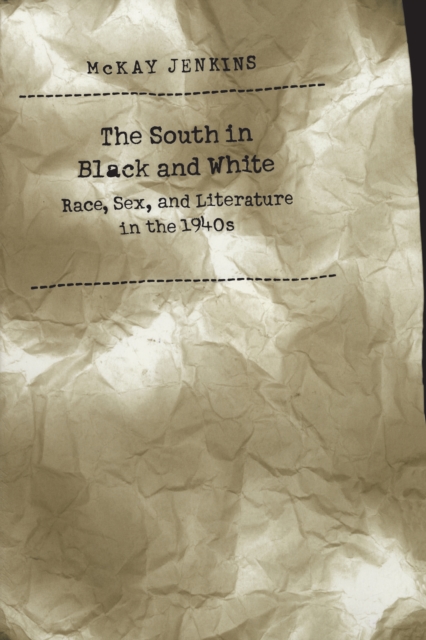
The South in Black and white : race, sex, and literature in the 1940s
If the nation as a whole during the 1940s was halfway between the Great Depression of the 1930s and the postwar prosperity of the 1950s, the South found itself struggling through an additional transition, one bound up in an often violent reworking of its own sense of history and regional identity. Examining the changing nature of racial politics in the 1940s, McKay Jenkins measures its impact on white Southern literature, history, and culture.
Jenkins focuses on four white Southern writers--W. J. Cash, William Alexander Percy, Lillian Smith, and Carson McCullers--to show how they constructed images of race and race relations within works that professed to have little, if anything, to do with race. Sexual isolation further complicated these authors' struggles with issues of identity and repression, he argues, allowing them to occupy a space between the privilege of whiteness and the alienation of blackness. Although their views on race varied tremendously, these Southern writers' uneasy relationship with their own dominant racial group belies the idea that \"whiteness\" was an unchallenged, monolithic racial identity in the region.
eBook
A Tree, a Rock, a Butterfly
This word journey explores flaws in our approach to cultivating environmental ethics and caring for biodiversity, especially among youths, through the lens of Carson McCullers’ classic story about the tragic but common failure of so many to achieve love between human beings.
Journal Article
