Catalogue Search | MBRL


Are you sure you want to remove the book from the shelf?

{{itemTitle}}
172
result(s) for
"Mecca (Saudi Arabia)"
Sort by:


Eunuchs and sacred boundaries in Islamic society
In this thought-provoking interdisciplinary work, Shaun Marmon describes how eunuchs, as a category of people who embodied ambiguity, both defined and mediated critical thresholds of moral and physical space in the household, in the palace and in the tomb of pre-modern Islamic society. The author's central focus is on the sacred society of eunuchs who guarded the tomb of the Prophet Muhammad in Medina for over six centuries and whose last representatives still perform many of their time honored rituals to this day. Through Marmon's account, the \"sacred\" eunuchs of Medina become historical guides into uncharted dimensions of Islamic ritual, political symbolism, social order, gender and time.
eBook

Russian Hajj
In the late nineteenth century, as a consequence of imperial conquest and a mobility revolution, Russia became a crossroads of the hajj, the annual Muslim pilgrimage to Mecca. The first book in any language on the hajj under tsarist and Soviet rule, Russian Hajj tells the story of how tsarist officials struggled to control and co-opt Russia's mass hajj traffic, seeing it as not only a liability but also an opportunity. To support the hajj as a matter of state surveillance and control was controversial, given the preeminent position of the Orthodox Church. But nor could the hajj be ignored, or banned, due to Russia's policy of toleration of Islam. As a cross-border, migratory phenomenon, the hajj stoked officials' fears of infectious disease, Islamic revolt, and interethnic conflict, but Eileen Kane innovatively argues that it also generated new thinking within the government about the utility of the empire's Muslims and their global networks.
eBook


Methanolic Fenugreek Seed Extract Induces p53-Dependent Mitotic Catastrophe in Breast Cancer Cells, Leading to Apoptosis
The plant
, well-known as fenugreek, has been shown to control type-2 diabetes, the level of cholesterol, inflammation of wounds, disorders related to gastrointestinal tracts, and cancer as well. The present study aimed to evaluate the anti-cancer potential of methanolic fenugreek seed extract (FSE) and its possible molecular mechanism of action in breast cancer cells.
The anticancer potential of FSE was evaluated in MCF-7 and SK-BR3 breast cancer cells through various cellular assays after selecting the IC
, IC
, IC
, and IC
doses by the cell cytotoxicity assay. Furthermore, the oral acute toxicity of FSE was examined in mice, according to the guidelines of the Organization for Economic Co-operation and Development (OECD).
FSE exhibited dose-dependent cytotoxicity, as the IC
was found to be 150 and 40 μg/mL for MCF-7 and SK-BR3 breast cancer cells, respectively. The cytological observations showed the typical apoptotic morphology in both of the breast cancer cells upon treatment with FSE, as it inhibited the migration and adhesion, in a dose-dependent manner. The flow cytometry analysis revealed that FSE induced a significant shift from G
/M, and polyploidy (>G) at higher concentrations that suggested the activation of p53-mediated mitotic catastrophe, consequently leading to apoptosis. FSE induced a significant increase in the mitochondrial depolarization, ROS as well as a Bax/Bcl-2 ratio, and also exhibited the mitochondrial associated p53 signaling pathway. The in vivo acute toxicity data revealed that the oral administration of FSE did not induce any toxic effect in mice.
This study, for the first time, reports the mechanistic details of the anti-cancer potential of FSE. It requires a detailed analysis to understand the effect of FSE to induce the apoptosis through the multiple signaling pathways at varying concentrations. The nontoxic effect of FSE in mice suggests to utilize it safely for pharmaceutical formulations in different cancer systems.
Journal Article
Mekka
Christiaan Snouck Hurgronje (1857-1936) was a Dutch scholar of Oriental cultures and languages and Advisor on Native Affairs to the colonial government of the Netherlands East Indies.
Rare Book
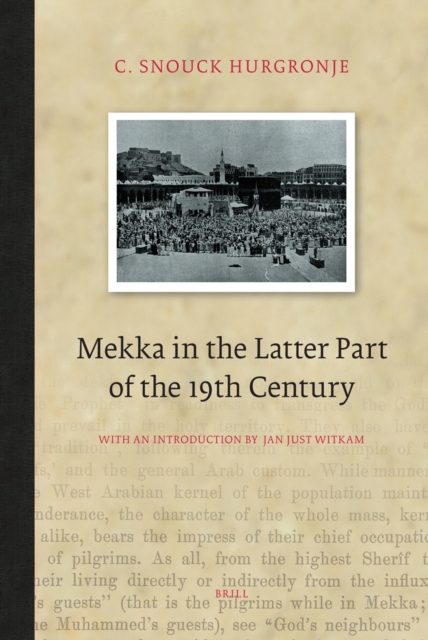
Mekka in the Latter Part of the 19th Century
From 1884-1885, Christiaan Snouck Hurgronje stayed in Mecca. He became intimately acquainted with the daily life of the Meccans and the thousands of pilgrims from all over the world. This volume deals with social and family life, funeral customs and marriage. It is a unique insight in one the most important places in islamic culture.With a new foreword by Jan Just Witkam.
eBook