
Catalogue Search | MBRL


Are you sure you want to remove the book from the shelf?

{{itemTitle}}
10,531
result(s) for
"Medical care Data processing."
Sort by:
Healthcare analytics : from data to knowledge to healthcare improvement
Features of statistical and operational research methods and tools being used to improve the healthcare industry With a focus on cutting-edge approaches to the quickly growing field of healthcare, Healthcare Analytics: From Data to Knowledge to Healthcare Improvement provides an integrated and comprehensive treatment on recent research.
eBook


Healthcare Analytics Made Simple
Machine learning and analytics have been widely utilized across the healthcare sector of late. This book will bridge the gap between practicing doctors and you as a data scientist. You will learn how to work with healthcare data and gain better insight from this data to improve healthcare outcomes.
eBook
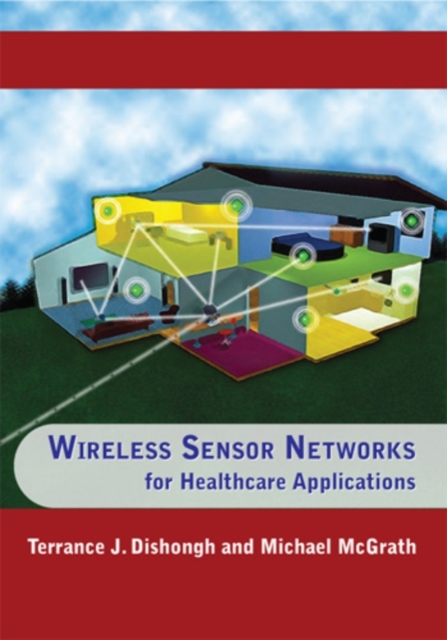
Wireless Sensor Networks for Healthcare Applications
Unlike other books on wireless sensors networks, this unique reference focuses on methods of application, validation and testing based on real deployments of sensor networks in the clinical and home environments. Key topics include healthcare and wireless sensors, sensor network applications, designs of experiments using sensors, data collection and decision making, clinical deployment of wireless sensor networks, contextual awareness medication prompting field trials in homes, social health monitoring, and the future of wireless sensor networks in healthcare.
eBook

Intelligent pervasive computing systems for smarter healthcare
\"This book describes the innovations in healthcare made possible by computing through bio-sensors. The reader learns how that goal is being pursued by the editors' examination of topics such as the design and development of pervasive healthcare technologies, data modeling and information management, wearable biosensors and their systems, and more. The pervasive computing paradigm offers tremendous advantages in diversified areas of healthcare research and technology. Pervasive computational support enables the optimization of medical assessment for a healthier, safer, and more productive society\"-- Provided by publisher.
Book

Current principles and practices of telemedicine and e-health
This book represents the most current development on the expanding and changing field of telemedicine and e-health, especially in the developing countries. Many things have changed since the publication of the first book in 2004 (Establishing Telemedicine in Developing Countries: From Inception to Implementation). Telemedicine has become more popular, and still continues to grow. While there are many good books and materials on telemedicine, this publication can be seen at the work of reference for all of those who want to practice telemedicine and e-health, particularly in developing countries. This publication deals with ways to establish telemedicine and e-health system, not only in the developing countries, but also in the developed world. Hopefully, this book will be a guide that reflects the status of telemedicine at the given time. It is dedicated to all future generations of telemedicine and e-health students which include healthcare practitioners, administrators, policy makers, technical professionals and others.
eBook

Healthcare analytics made simple : techniques in healthcare computing using machine learning and Python
In recent years, machine learning technologies and analytics have been widely utilized across the healthcare sector. Healthcare Analytics Made Simple bridges the gap between practising doctors and data scientists. It equips the data scientists' work with healthcare data and allows them to gain better insight from this data in order to improve healthcare outcomes. This book is a complete overview of machine learning for healthcare analytics, briefly describing the current healthcare landscape, machine learning algorithms, and Python and SQL programming languages. The step-by-step instructions teach you how to obtain real healthcare data and perform descriptive, predictive, and prescriptive analytics using popular Python packages such as pandas and scikit-learn. The latest research results in disease detection and healthcare image analysis are reviewed. By the end of this book, you will understand how to use Python for healthcare data analysis, how to import, collect, clean, and refine data from electronic health record (EHR) surveys, and how to make predictive models with this data through real-world algorithms and code examples.
Book
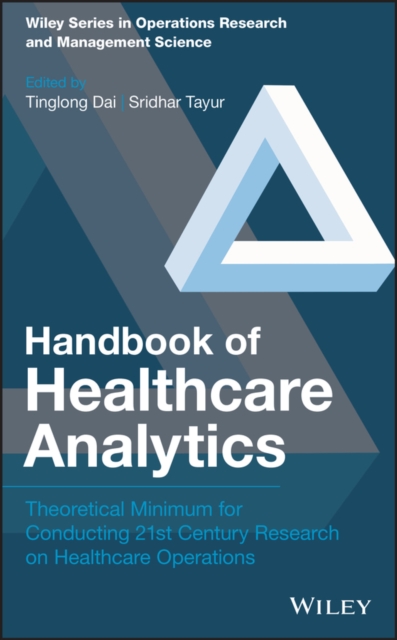
Handbook of Healthcare Analytics
How can analytics scholars and healthcare professionals access the most exciting and important healthcare topics and tools for the 21st century? Editors Tinglong Dai and Sridhar Tayur, aided by a team of internationally acclaimed experts, have curated this timely volume to help newcomers and seasoned researchers alike to rapidly comprehend a diverse set of thrusts and tools in this rapidly growing cross-disciplinary field. The Handbook covers a wide range of macro-, meso- and micro-level thrusts—such as market design, competing interests, global health, personalized medicine, residential care and concierge medicine, among others—and structures what has been a highly fragmented research area into a coherent scientific discipline. The handbook also provides an easy-to-comprehend introduction to five essential research tools—Markov decision process, game theory and information economics, queueing games, econometric methods, and data science—by illustrating their uses and applicability on examples from diverse healthcare settings, thus connecting tools with thrusts. The primary audience of the Handbook includes analytics scholars interested in healthcare and healthcare practitioners interested in analytics. This Handbook: * Instills analytics scholars with a way of thinking that incorporates behavioral, incentive, and policy considerations in various healthcare settings. This change in perspective—a shift in gaze away from narrow, local and one-off operational improvement efforts that do not replicate, scale or remain sustainable—can lead to new knowledge and innovative solutions that healthcare has been seeking so desperately. * Facilitates collaboration between healthcare experts and analytics scholar to frame and tackle their pressing concerns through appropriate modern mathematical tools designed for this very purpose. The handbook is designed to be accessible to the independent reader, and it may be used in a variety of settings, from a short lecture series on specific topics to a semester-long course.
eBook