
Catalogue Search | MBRL


Are you sure you want to remove the book from the shelf?

{{itemTitle}}
1,212
result(s) for
"Medical misconceptions."
Sort by:

Trust me I'm a doctor. Series 9, Episode 3
This long-running hit gets behind the hype and headlines to find the truth about what's good for your health. The team seek out the latest research and work with leading universities to run major experiments. Can eating less boost your memory? Can you cure a lifelong phobia in a few hours? What's the best way to calm a crying baby? Can food improve your mood? With expert presenters from the fields of genetics, psychiatry, paediatrics and general practice, this programme brings you the health advice you can trust, and takes you to the cutting edge of medical research.
Streaming Video
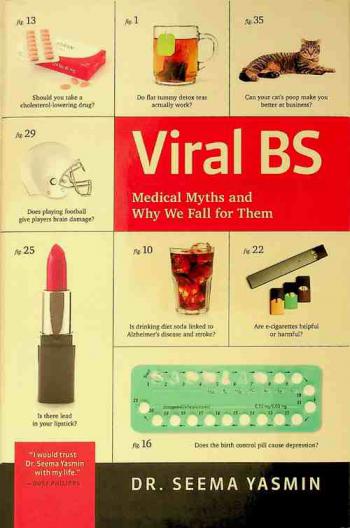
Viral BS : medical myths and why we fall for them
\"This book dissects medical myths and pseudoscience and explores how misinformation can spread faster than microbes. Yasmin debunks public health myths ranging from the spurious link between vaccines and autism to the truth about so-called chemtrails left behind by airplanes. In short chapters covering popular myths, Yasmin parses the science behind fearful rumors and models how to be a more informed consumer of health news\"-- Provided by publisher.
Trust me I'm a doctor. Series 9, Episode 1
This long-running hit gets behind the hype and headlines to find the truth about what's good for your health. The team seek out the latest research and work with leading universities to run major experiments. Can eating less boost your memory? Can you cure a lifelong phobia in a few hours? What's the best way to calm a crying baby? Can food improve your mood? With expert presenters from the fields of genetics, psychiatry, paediatrics and general practice, this programme brings you the health advice you can trust, and takes you to the cutting edge of medical research.
Streaming Video


The epic battle against coronavirus misinformation and conspiracy theories
Analysts are tracking false rumours about COVID-19 in hopes of curbing their spread.
Analysts are tracking false rumours about COVID-19 in hopes of curbing their spread.
Credit: Adam Waltz/ABC15 Arizona
Protesters rallying at the Arizona State Capitol calling on state leaders to reopen the economy.
Journal Article


Medical disinformation and the unviable nature of COVID-19 conspiracy theories
The coronavirus pandemic has seen a marked rise in medical disinformation across social media. A variety of claims have garnered considerable traction, including the assertion that COVID is a hoax or deliberately manufactured, that 5G frequency radiation causes coronavirus, and that the pandemic is a ruse by big pharmaceutical companies to profiteer off a vaccine. An estimated 30% of some populations subscribe some form of COVID medico-scientific conspiracy narratives, with detrimental impacts for themselves and others. Consequently, exposing the lack of veracity of these claims is of considerable importance. Previous work has demonstrated that historical medical and scientific conspiracies are highly unlikely to be sustainable. In this article, an expanded model for a hypothetical en masse COVID conspiracy is derived. Analysis suggests that even under ideal circumstances for conspirators, commonly encountered conspiratorial claims are highly unlikely to endure, and would quickly be exposed. This work also explores the spectrum of medico-scientific acceptance, motivations behind propagation of falsehoods, and the urgent need for the medical and scientific community to anticipate and counter the emergence of falsehoods.
Journal Article

Trust me I'm a doctor. Series 9, Episode 2
This long-running hit gets behind the hype and headlines to find the truth about what's good for your health. The team seek out the latest research and work with leading universities to run major experiments. Can eating less boost your memory? Can you cure a lifelong phobia in a few hours? What's the best way to calm a crying baby? Can food improve your mood? With expert presenters from the fields of genetics, psychiatry, paediatrics and general practice, this programme brings you the health advice you can trust, and takes you to the cutting edge of medical research.
Streaming Video