
Catalogue Search | MBRL


Are you sure you want to remove the book from the shelf?

{{itemTitle}}
180,710
result(s) for
"Medical safety"
Sort by:


Safety-I and safety-II
Much more than a technical book. Erik's work is a well documented journey into the multiple interactions between safety, work and human nature. A timely contribution to vindicate human beings and their variability from the one sided focus on the evils of human error. A groundbreaking look at 'the other story' that will certainly contribute to safer and more productive workplaces.
Dr Alejandro Morales, Mutual Seguridad, Chile
Safety needs a new maturity. We can no longer improve by simply doing what we have been doing, even by doing it better. DR Hollnagel brings forth new distinctions, interpretations, and narratives that will allow safety to progress to new unforeseen levels. Safety-II is more than just incident and accident prevention. A must read for every safety professional.
Tom McDaniel, Global Manager Zero Harm and Human Performance, Siemens Energy, Inc., USA
eBook

Improving Health Care Safety and Quality
Responding to the alarm caused by recent hospital scandals and accounts of unintended harm to patients, this author draws on her experience of analyzing the health care systems of over a dozen countries and examines whether greater regulation has increased patient safety and health care quality. It will be of key interest to government actors, health care professionals and medico-legal scholars.
eBook

Establishment of a Comprehensive Evaluation System on Medical Quality Based on Cross-examination of Departments within a Hospital
INTRODUCTION
The management of medical quality is the core element of hospital management, and it is reflected in every part and aspect of medical behavior. Strengthening the management on medical quality is crucial in ensuring medical safety, promoting the ability of clinical diagnoses and treatments as well as the increasing the efficiency of medical service, Oil this basis, the establishment and operation of a comprehensive evaluation system on medical quality is not only the foundation in ensuring the orderly operation of the medical behavior and medical safety but also an effective means in continuously improving the quality of medical management.
Journal Article

Human factors in healthcare : a field guide to continuous improvement
Have you ever experienced the burden of an adverse event or a near-miss in healthcare and wished there was a way to mitigate it? This book walks you through a classic adverse event as a case study and shows you how. It is a practical guide to continuously improving your healthcare environment, processes, tools, and ultimate outcomes, through the discipline of human factors. Using this book, you as a healthcare professional can improve patient safety and quality of care. Adverse events are a major concern in healthcare today. As the complexity of healthcare increases-with technological advances and information overload-the field of human factors offers practical approaches to understand the situation, mitigate risk, and improve outcomes. The first part of this book presents a human factors conceptual framework, and the second part offers a systematic, pragmatic approach. Both the framework and the approach are employed to analyze and understand healthcare situations, both proactively-for constant improvement-and reactively-learning from adverse events. This book guides healthcare professionals through the process of mapping the environmental and human factors; assessing them in relation to the tasks each person performs; recognizing how gaps in the fit between human capabilities and the demands of the task in the environment have a ripple effect that increases risk; and drawing conclusions about what types of changes facilitate improvement and mitigate risk, thereby contributing to improved healthcare outcomes.
Book
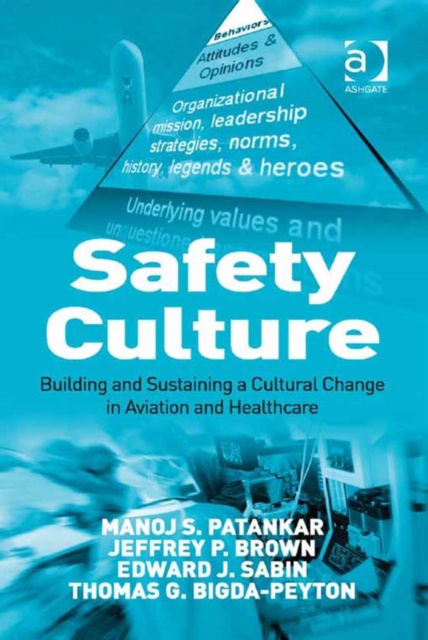
Safety culture : building and sustaining a cultural change in aviation and healthcare
In Safety Culture: Building and Sustaining a Cultural Change in Aviation and Healthcare, the four authors draw upon their extensive teaching, research and field experience from multiple industries to describe the dynamic nature of a culture-change process, particularly in safety-critical domains. They use a \"stories to numbers\" approach that starts with felt experiences and stories of certain change programs that they have documented, then proceed to describe the use of key measurement tools that can be used to analyze the state of a change program. The book concludes with a description of empirical models that illustrate the dynamic nature of change programs.
eBook

Radiation in Medicine
Does radiation medicine need more regulation or simply better-coordinated regulation? This book addresses this and other questions of critical importance to public health and safety. The issues involved are high on the nation's agenda: the impact of radiation on public safety, the balance between federal and state authority, and the cost-benefit ratio of regulation. Although incidents of misadministration are rare, a case in Pennsylvania resulting in the death of a patient and the inadvertent exposure of others to a high dose of radiation drew attention to issues concerning the regulation of ionizing radiation in medicine and the need to examine current regulatory practices. Written at the request from the Nuclear Regulatory Commission (NRC), Radiation in Medicine reviews the regulation of ionizing radiation in medicine, focusing on the NRC's Medical Use Program, which governs the use of reactor-generated byproduct materials. The committee recommends immediate action on enforcement and provides longer term proposals for reform of the regulatory system. The volume covers:
Sources of radiation and their use in medicine.
Levels of risk to patients, workers, and the public.
Current roles of the Nuclear Regulatory Commission, other federal agencies, and states.
Criticisms from the regulated community.
The committee explores alternative regulatory structures for radiation medicine and explains the rationale for the option it recommends in this volume. Based on extensive research, input from the regulated community, and the collaborative efforts of experts from a range of disciplines, Radiation in Medicine will be an important resource for federal and state policymakers and regulators, health professionals involved in radiation treatment, developers and producers of radiation equipment, insurance providers, and concerned laypersons.
eBook