
Catalogue Search | MBRL


Are you sure you want to remove the book from the shelf?

{{itemTitle}}
3,941
result(s) for
"Medicine, Arab"
Sort by:

An updated phytopharmacological review on medicinal plant of arab region: Apium graveolens Linn
Linn. (Karafs) is used in traditional medicine for the treatment of the various ailments. There is a need to explore and authenticate the pharmacological profile and medicinal importance of the Karafs. In this paper, the literature and the published work on Apium were collected using online resources \"Google scholar\", \"Web of science\", \"Scopus\" and \"PubMed\". Each of the pharmacological activity was searched individually using the keywords \"Apium/Karafs/
+ individual pharmacological activity\". We documented the most cited and most recent literatures. The current findings illuminate the importance Karafs in the traditional medicine and their impact in treating various diseases. This review strongly supports the fact that the Apium has emerged as a good source of medicine in treating various diseases. There is also a need to isolate the bioactive phytochemicals present in this plant.
Journal Article
Asian Medical Systems
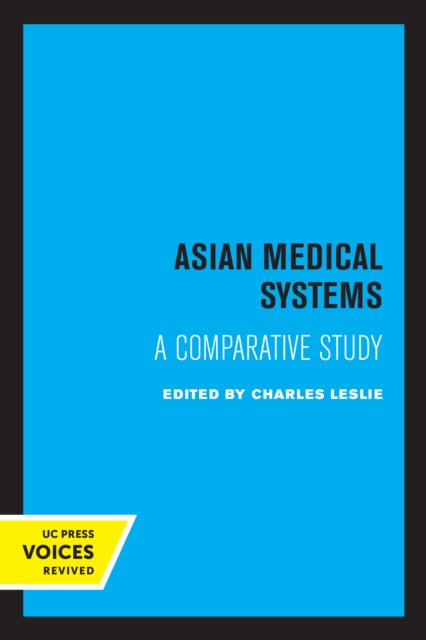
Asian Medical Systems: A Comparative Study explores the enduring relevance and evolution of traditional medical practices in Asia, emphasizing their interplay with modern cosmopolitan medicine. The book examines three major medical traditions--Chinese, South Asian (Ayurveda), and Mediterranean (Yunani)--that developed independently yet share foundational principles such as humoral theories of balance and equilibrium. These systems, formalized between the fifth century B.C. and the fifth century A.D., established authoritative texts, professional standards, and ethical codes that continue to influence contemporary practices. Despite the dominance of cosmopolitan medicine, rooted in scientific advancements like germ theory and modern surgery, traditional medicine in many Asian countries coexists with modern approaches, supported by educational institutions, research bodies, and professional organizations. This pluralism is particularly evident in nations like China and India, where both systems are often integrated into healthcare delivery. The book highlights the pluralistic and adaptive nature of Asian medical systems, which provide insights into how traditional and modern practices complement each other. It challenges the perception of cosmopolitan medicine as uniquely scientific, arguing that Chinese, Ayurvedic, and Yunani systems also exhibit rational, systematic methods grounded in empirical observation and theory. By framing cosmopolitan medicine as \"transcultural\" rather than exclusively Western, the study underscores its global integration while recognizing the cultural, ecological, and social dimensions of health in Asia. Through multidisciplinary analysis, the work illuminates how medical systems evolve and intersect, offering a nuanced perspective on their coexistence and their potential for addressing contemporary health needs. This
title is part of UC Press's Voices Revived program, which commemorates University of California Press's mission to seek out and cultivate the brightest minds and give them voice, reach, and impact. Drawing on a backlist dating to 1893, Voices Revived makes high-quality, peer-reviewed scholarship accessible once again using print-on-demand technology. This title was originally published in 1976. Many titles in the Voices Revived program are also newly available as ebooks, offered at a discounted price to support wider access to scholarly work.
eBook


Greco-Arab and Islamic herbal medicine : traditional system, ethics, safety, efficacy, and regulatory issues
This book presents a systematic review on traditional Arab herbal medicine including historical background, medical innovations introduced by Arab physicians, common roots of Arab medicine and western medicine, methodology of drug discovery and therapy in Arabic and Islamic medicine, a state-of-the-art description of traditional Arab herbal.
eBook

Medical Glossaries in the Hebrew Tradition: Shem Tov Ben Isaac, Sefer Almansur: With a Supplement on the Romance and Latin Terminology
The Sefer Almansur contains a pharmacopeia of about 250 medicinal ingredients with their Arabic names (in Hebrew characters), their Romance (Old Occitan) and occasionally Hebrew equivalents. The pharmacopeia, which describes the properties and therapeutical uses of simple drugs featured at the end of Book Three of the Sefer Almansur. This work was translated into Hebrew from the Arabic Kitab al-Mansuri (written by al-Razi) by Shem Tov ben Isaac of Tortosa, who worked in Marseille in the 13th century. Gerrit Bos, Guido Mensching and Julia Zwink supply a critical edition of the Hebrew text, an English translation and an analysis of the Romance and Latin terminology in Hebrew transcription. The authors show the pharmaceutical terminological innovation of Hebrew and of the vernacular, and give us proof of the important role of medieval Jews in preserving and transferring medical knowledge.
eBook

Arabic Medicine in China
The Huihui Yaofang was an encyclopaedia of Near Eastern medicine compiled under the Mongol Yuan Dynasty for the benefit of themselves and Chinese medical establishments. We translate the surviving material and context it in the history and ethnobiology of the medicine described.
eBook