
Catalogue Search | MBRL


Are you sure you want to remove the book from the shelf?

{{itemTitle}}
152
result(s) for
"Medicine, Greek and Roman History"
Sort by:
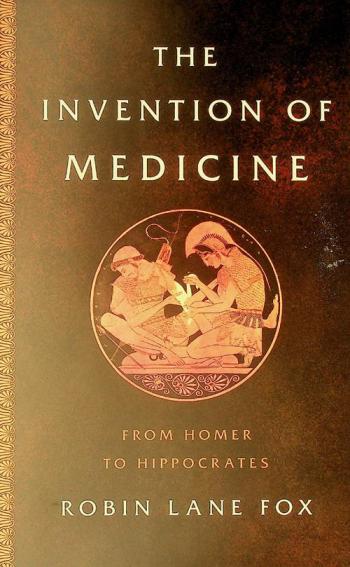
The invention of medicine : from Homer to Hippocrates
\"Medical thinking and observation were radically changed by the ancient Greeks, one of their great legacies to the world. In the fifth century BCE, a Greek doctor put forward his clinical observations of individual men, women, and children in a collection of case histories known as the Epidemics. Among his working principles was the famous maxim \"Do no harm.\" In The Invention of Medicine, acclaimed historian Robin Lane Fox puts these remarkable works in a wider context and upends our understanding of medical history by establishing that they were written much earlier than previously thought. Lane Fox endorses the ancient Greeks' view that their texts' author, not named, was none other than the father of medicine, the great Hippocrates himself. Lane Fox's argument changes our sense of the development of scientific and rational thinking in Western culture, and he explores the consequences for Greek artists, dramatists and the first writers of history. Hippocrates emerges as a key figure in the crucial change from an archaic to a classical world.\"-- Publisher description.

Pathological Realities
Grmek's writings address deep epistemological changes in historical conceptions of disease as well as advanacements in the life sciences.
Mirko D. Grmek (1924-2000) is one of the most significant figures in the history of medicine, and has long been considered a pioneer of the field. The singular trajectory that took Grmek from Yugoslavia to the academic culture of post-war France placed him at the crossroads of different intellectual trends and made him an influential figure during the second half of the twentieth century. Yet, scholars have rarely attempted to articulate his distinctive vision of the history of science and medicine with all its tensions, contradictions, and ambiguities. This volume brings together and publishes for the first time in English a range of Grmek's writings, providing a portrait of his entire career as a historian of science and an engaged intellectual figure.Pathological Realitiespieces together Grmek's scholarship that reveals the interconnections of diseases, societies, and medical theories.
Straddling the sciences and the humanities, Grmek crafted significant new concepts and methods to engage with contemporary social problems such as wars, genocides and pandemics. Uniting some major strands of his published work that are still dispersed or simply unknown, this volume covers the deep epistemological changes in historical conceptions of disease as well as major advances within the life sciences and their historiography. Opening with a classic essay - \"Preliminaries for a Historical Study of Diseases,\" this volume introduces Grmek's notions of \"pathocenosis\" and \"emerging infections,\" illustrating them with historical and contemporary cases.Pathological Realitiesalso showcases Grmek's pioneering approach to the history of science and medicine using laboratory notebooks as well as his original work on biological thought and the role of ideologies and myths in the history of science. The essays assembled here reveal Grmek's significant influence and continued relevance for current research in the history of medicine and biology, medical humanities, science studies, and the philosophy of science.
Writings offer a unique portrait of Grmek, who was both a physycian and a professor of the history of medicine.Articulates Grmek's distinctive vision of the history of science and medicine and their relation to contemporary social problems of war, pandemics, and genocide.
eBook


The Archaeology of Medicine in the Greco-Roman World
This book teaches students and scholars of Greco-Roman medical history how to use and critically assess archaeological materials. Ancient medicine is a subject dominated by textual sources, yet there is a wealth of archaeological remains that can be used to broaden our understanding of medicine in the past. In order to use the information properly, this book explains how to ask questions of an archaeological nature, how to access different types of archaeological materials, and how to overcome problems the researcher might face. It also acts as an introduction to the archaeology of medicine for archaeologists interested in this aspect of their subject. Although the focus is on the Greco-Roman period, the methods and theories explained within the text can be applied to other periods in history. The areas covered include text as material culture, images, artifacts, spaces of medicine, and science and archaeology.
eBook

Method of medicine
\"Galen of Pergamum (129-?199/216), physician to the court of the emperor Marcus Aurelius, was a philosopher, scientist, and medical historian, a theoretician and practitioner, who wrote forcefully and prolifically on an astonishing range of subjects and whose impact on later eras rivaled that of Aristotle. Galen synthesized the entirety of Greek medicine as a basis for his own doctrines and practice, which comprehensively embraced theory, practical knowledge, experiment, logic, and a deep understanding of human life and society. Method of Medicine, a systematic and comprehensive account of the principles of treating injury and disease and one of Galen's greatest and most influential works. Enlivening the detailed case studies are many theoretical and polemical discussions, acute social commentary, and personal reflections. The Loeb Method of medicine is in three volumes.\"--Book jacket.
BOOK

Greek Medicine from Hippocrates to Galen
This volume makes available in English translation a selection of Jacques Jouanna's papers on Greek and Roman medicine, ranging from the early beginnings of Greek medicine to late antiquity. Readership: Classicists, Ancient Historians, Historians of Medicine, Historians of Science, Historians of Philosophy, Medical Professionals.
eBook

The Cambridge companion to Hippocrates
\"Hippocrates is a towering figure in Greek medicine. Dubbed the 'father of medicine', he has inspired generations of physicians over millennia in both the East and West. Despite this, little is known about him, and scholars have long debated his relationship to the works attributed to him in the so-called 'Hippocratic Corpus', although it is undisputed that many of the works within it represent milestones in the development of Western medicine. In this Cambridge Companion, an international team of authors introduces major themes in Hippocratic studies, ranging from textual criticism and the 'Hippocratic Question' to problems such as aetiology, physiology and nosology. Emphasis is given to the afterlife of Hippocrates from Late Antiquity to the Modern period. Hippocrates had as much relevance in the fifth-century BC Greek world as in the medieval Islamic world, and he remains with us today in both medical and non-medical contexts\"-- Provided by publisher.
BOOK

Hippocrates in Context
This collection of papers studies the Hippocratic writings in their relationship to the intellectual, social, cultural and literary context in which they were written, as well as the impact and reception of Hippocratic thought in later antiquity and the early modern period.
eBook

Disabilities and the disabled in the Roman world : a social and cultural history
\"Almost fifteen percent of the world's population today experiences some form of mental or physical disability and society tries to accommodate their needs. But what was the situation in the Roman world? Was there a concept of disability? How were the disabled treated? How did they manage in their daily lives? What answers did medical doctors, philosophers and patristic writers give for their problems? This book, the first monograph on the subject in English, explores the medical and material contexts for disability in the ancient world, and discusses the chances of survival for those who were born with a handicap. It covers the various sorts of disability: mental problems, blindness, deafness and deaf-muteness, speech impairment and mobility impairment, and includes discussions of famous instances of disability from the ancient world, such as the madness of Emperor Caligula, the stuttering of Emperor Claudius and the blindness of Homer\"-- Provided by publisher.
Book

On Theriac to Piso, Attributed to Galen
Robert Leigh offers a critical edition with translation into English, commentary and introduction of the pharmacological treatise On Theriac to Piso traditionally attributed to Galen, and reviews the evidence as to the validity of the attribution to Galen.
eBook