
Catalogue Search | MBRL


Are you sure you want to remove the book from the shelf?

{{itemTitle}}
1,092
result(s) for
"Medieval influences"
Sort by:

Authenticity, medievalism, music
Essays tackling the difficult but essential question of how medievalism studies should look at the issue of what is and what is not \"authentic\".-- Publisher's website.
Book

The Arabic Role in Medieval Literary History
Arabic culture was a central and shaping phenomenon in medieval Europe, yet its influence on medieval literature has been ignored or marginalized for the last two centuries. In this ground-breaking book, now returned to print with a new afterword by the author, María Rosa Menocal argues that major modifications of the medieval canon and its literary history are necessary.Menocal reviews the Arabic cultural presence in a variety of key settings, including the courts of William of Aquitaine and Frederick II, the universities in London, Paris, and Bologna, and Cluny under Peter the Venerable, and she examines how our perception of specific texts including the courtly love lyric and the works of Dante and Boccaccio would be altered by an acknowledgment of the Arabic cultural component.
eBook

A sea of languages : rethinking the Arabic role in medieval literary history
Medieval European literature was once thought to have been isolationist in its nature, but recent scholarship has revealed the ways in which Spanish and Italian authors including Cervantes and Marco Polo were influenced by Arabic poetry, music, and philosophy. 'A sea of languages' brings together some of the most influential scholars working in Muslim-Christian-Jewish cultural communications today to discuss the convergence of the literary, social, and economic histories of the medieval Mediterranean. This volume takes as a starting point María Rosa Menocal's groundbreaking work The Arabic Role in Medieval Literary History, a major catalyst in the reconsideration of prevailing assumptions regarding the insularity of medieval European literature. Reframing ongoing debates within literary studies in dynamic new ways, 'A sea of languages' will become a critical resource and reference point for a new generation of scholars and students on the intersection of Arabic and European literature.
Book

A Sea of Languages
Reframing ongoing debates within literary studies in dynamic new ways,A Sea of Languageswill become a critical resource and reference point for a new generation of scholars and students on the intersection of Arabic and European literature.
eBook


Shakespeare and the Middle Ages
Shakespeare and the Middle Ages brings together a distinguished, multidisciplinary group of scholars to rethink the medieval origins of modernity. Shakespeare provides them with the perfect focus, since his works turn back to the Middle Ages as decisively as they anticipate the modern world: almost all of the histories depict events during the Hundred Years War, and King John glances even further back to the thirteenth-century Angevins; several of the comedies, tragedies, and romances rest on medieval sources; and there are important medieval antecedents for some of the poetic modes in which he worked as well. Several of the essays reread Shakespeare by recovering aspects of his works that are derived from medieval traditions and whose significance has been obscured by the desire to read Shakespeare as the origin of the modern. These essays, taken cumulatively, challenge the idea of any decisive break between the medieval period and early modernity by demonstrating continuities of form and imagination that clearly bridge the gap. Other essays explore the ways in which Shakespeare and his contemporaries constructed or imagined relationships between past and present. Attending to the way these writers thought about their relationship to the past makes it possible, in turn, to read against the grain of our own teleological investment in the idea of early modernity. A third group of essays reads texts by Shakespeare and his contemporaries as documents participating in social-cultural transformation from within. This means attending to the way they themselves grapples with the problem of change, attempting to respond to new conditions and pressures while holding onto customary habits of thought and imagination. Taken together, the essays in this volume revisit the very idea of transition in a refreshingly non-teleological way.
eBook

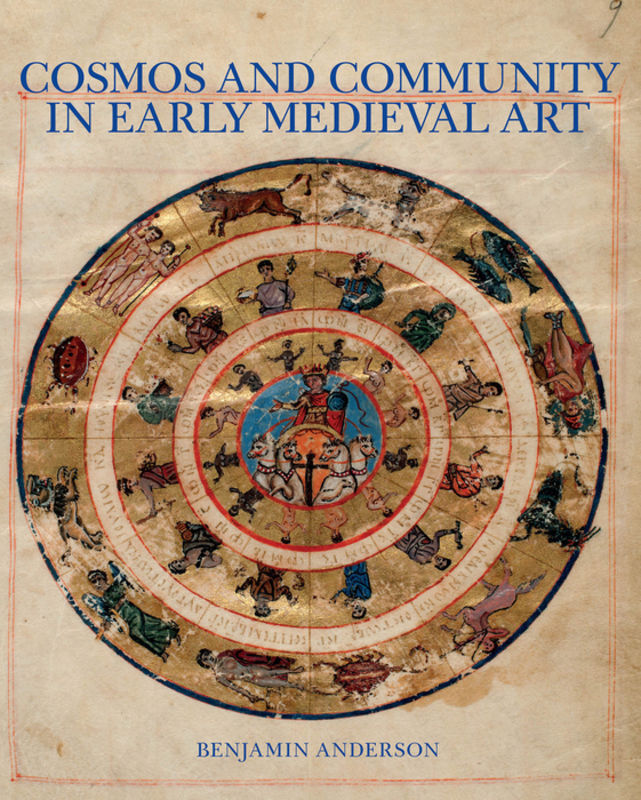
Cosmos and community in early medieval art
In the rapidly changing world of the early Middle Ages, depictions of the cosmos represented a consistent point of reference across the three dominant states-the Frankish, Byzantine, and Islamic Empires. As these empires diverged from their Greco-Roman roots between 700 and 1000 A.D. and established distinctive medieval artistic traditions, cosmic imagery created a web of visual continuity, though local meanings of these images varied greatly. Benjamin Anderson uses thrones, tables, mantles, frescoes, and manuscripts to show how cosmological motifs informed relationships between individuals, especially the ruling elite, and communities, demonstrating how domestic and global politics informed the production and reception of these depictions. The first book to consider such imagery across the dramatically diverse cultures of Western Europe, Byzantium, and the Islamic Middle East, Cosmos and Community in Early Medieval Art illuminates the distinctions between the cosmological art of these three cultural spheres, and reasserts the centrality of astronomical imagery to the study of art history.
eBook

The medieval presence in the modernist aesthetic : unattended moments
In The Medieval Presence in the Modernist Aesthetic: Unattended Moments, editors Simone Celine Marshall and Carole M. Cusack have assembled a collection of studies on Modernist authors that are original, thought-provoking and often delightful.
eBook