
Catalogue Search | MBRL


Are you sure you want to remove the book from the shelf?

{{itemTitle}}
28,503
result(s) for
"Member services"
Sort by:

Archaeology and Bioarchaeology of Anatomical Dissection at a Nineteenth-Century Army Hospital in San Francisco
An archaeological site that tells a story of structural
violence in medical research
In 2010, a pit containing over 4,000 human skeletal elements was
discovered at the site of the former Army hospital at Point San
Jose in San Francisco . Local archaeologists determined that the
bones, which were found alongside medical waste artifacts from the
hospital, were remains from anatomical dissections conducted in the
1870s. As no records of these dissections exist, this volume turns
to historical, archaeological, and bioarchaeological analysis to
understand the function of the pit and the identities of the people
represented in it. In these essays, contributors show how the
remains discovered are postmortem manifestations of social
inequality, evidence that nineteenth-century surgical and
anatomical research benefited from and perpetuated structural
violence against marginalized individuals.
A volume in the series Bioarchaeological Interpretations of the
Human Past: Local, Regional, and Global Perspectives, edited by
Clark Spencer Larsen
eBook

Clinical Virtual Reality tools to advance the prevention, assessment, and treatment of PTSD
Numerous reports indicate that the incidence of posttraumatic stress disorder (PTSD) in Operation Enduring Freedom/Operation Iraqi Freedom/Operation New Dawn (OEF/OIF/OND) military personnel has created a significant behavioural healthcare challenge. These findings have served to motivate research on how to better develop and disseminate evidence-based treatments for PTSD. The current article presents the use of Virtual Reality (VR) as a clinical tool to address the assessment, prevention, and treatment of PTSD, based on the VR projects that were evolved at the University of Southern California Institute for Creative Technologies since 2004. A brief discussion of the definition and rationale for the clinical use of VR is followed by a description of a VR application designed for the delivery of prolonged exposure (PE) for treating Service Members (SMs) and Veterans with combat- and sexual assault-related PTSD. The expansion of the virtual treatment simulations of Iraq and Afghanistan for PTSD assessment and prevention is then presented. This is followed by a forward-looking discussion that details early efforts to develop virtual human agent systems that serve the role of virtual patients for training the next generation of clinical providers, as healthcare guides that can be used to support anonymous access to trauma-relevant behavioural healthcare information, and as clinical interviewers capable of automated behaviour analysis of users to infer psychological state. The paper will conclude with a discussion of VR as a tool for breaking down barriers to care in addition to its direct application in assessment and intervention.
Journal Article

Soldiering Under Occupation
Often, violent behavior or harassment from a soldier is dismissed by the military as unacceptable acts by individuals termed, \"rotten apples.\" In this study, the author argues that this dismissal is unsatisfactory and that there is an urgent need to look at the (mis)behavior of soldiers from a structural point of view. When soldiers serve as an occupational force, they find themselves in a particular situation influenced by structural circumstances that heavily influence their behavior and moral decision-making. This study focuses on young Israeli men and their experiences as combat soldiers in the Israeli Defense Forces (IDF), particularly those who served in the \"Occupied Palestinian Territories\" (OPT) during the \"Al AqsaIntifada,\" which broke out in 2000. In describing the soldiers' circumstances, especially focusing on space, the study shows how processes of numbing on different levels influence the (moral) behavior of these soldiers.
eBook

Invisible Scars
Invisible Scars explores the treatment of psychological casualties during the Korean War and the long-term repercussions for former soldiers living with trauma.
eBook

Treatment for Posttraumatic Stress Disorder in Military and Veteran Populations
Prior to the military conflicts in Iraq and Afghanistan, wars and conflicts have been characterized by such injuries as infectious diseases and catastrophic gunshot wounds. However, the signature injuries sustained by United States military personnel in these most recent conflicts are blast wounds and the psychiatric consequences to combat, particularly posttraumatic stress disorder (PTSD), which affects an estimated 13 to 20 percent of U.S. service members who have fought in Iraq or Afghanistan since 2001. PTSD is triggered by a specific traumatic event - including combat - which leads to symptoms such as persistent re-experiencing of the event; emotional numbing or avoidance of thoughts, feelings, conversations, or places associated with the trauma; and hyperarousal, such as exaggerated startle responses or difficulty concentrating.
As the U.S. reduces its military involvement in the Middle East, the Departments of Defense (DoD) and Veterans Affairs (VA) anticipate that increasing numbers of returning veterans will need PTSD services. As a result, Congress asked the DoD, in consultation with the VA, to sponsor an IOM study to assess both departments' PTSD treatment programs and services. Treatment for Posttraumatic Stress Disorder in Military and Veteran Populations: Initial Assessment is the first of two mandated reports examines some of the available programs to prevent, diagnose, treat, and rehabilitate those who have PTSD and encourages further research that can help to improve PTSD care.
eBook

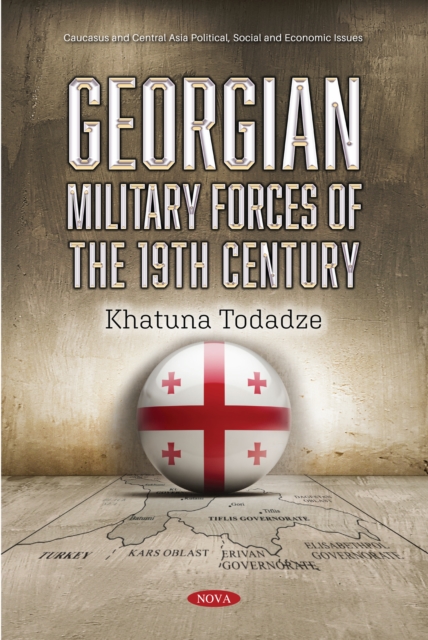
Georgian Military Forces Of 19th Century
In December 1800, Emperor Paul I signed the statement on abolition of Kartl-Kakheti Kingdom and its inclusion into the composition of Russia. In March 1801, Paul I was murdered by the conspirators. Though newly enthroned Emperor Alexander I disagreed in almost everything with his father, on 12 September 1801 he signed a new statement eliminating Kartl-Kakheti Kingdom and declaring it as the province of Russia. Since 1802 Kartl-Kakheti was subject to Russian rule. From the outset Russia desired to annex entire Georgia. This desire and its rule in Kartl-Kakheti caused dissatisfaction of the neighboring Moslem states. Russia engaged in war with Iran, Turkey and Dagestan. In such situation, the issue of use of Georgian military potential was put on agenda. Manifest on integration of Georgia to Russia provided for exemption of Georgian people from military duties. Russia attempted to avoid further irritation of already dissatisfied people. Therefore, there was need to involve Georgians into the wars of Russia Empire in a form acceptable for Georgians and the imperial government found that militia would be such form. Russian government, in particular, initially P. Tsitsianov, in 1803-1806 used King Erekle's principle of the watch unit . The difference was that while the watch unit of Erekle II served to the interests of Kartl-Kakheti, militia had to satisfy the imperial ambitions of Russia in Caucasus and Near East. Russia attempted to establish gradually the form of regular military service in Georgia to fully take advantage of Georgian military potential. Therefore, participation of Kartl-Kakheti population was frequently forced. And Georgian soldiers responded adequately. Up to present, events in Eastern Georgia in 1829 were known as rebellion of the peasants . As a result of studying of documentary materials it would be reasonable to conclude that the driving force of this commotion was Georgian nobility and this was anti-Russian rebellion. Georgians could not accept servicing in Russian army but they have never refused to fight for their native land. Georgian military forces had the most significant role in regaining of Georgian lands. In the 19th century Russian army has not been engaged in any significant battle where at least few Georgians have not participated. Sons of Georgian people have participated in each and every battle at the Caucasian front. Georgian riders and commanders have continued the traditions of their forefathers with dignity and demonstrated, once more, military talent and combat capabilities of the Georgians to both, the enemies and supporters. Let this work be a humble input to immortalizing their memory.
eBook

Treatment of Posttraumatic Stress Disorder
Mental disorders, including posttraumatic stress disorder (PTSD), constitute an important health care need of veterans, especially those recently separated from service. Treatment of Posttraumatic Stress Disorder: An Assessment of the Evidence takes a systematic look the efficacy of pharmacologic and psychological treatment modalities for PTSD on behalf of the Department of Veterans Affairs. By reviewing existing studies in order to draw conclusions about the strength of evidence on several types of treatment, the Committee on the Treatment of Posttraumatic Stress Disorder found that many of these studies were faulty in design and performance, and that relatively few of these studies have been conducted in populations of veterans, despite suggestions that civilian and veteran populations respond differently to various types of treatment. The committee also notes that the evidence is scarce on the acceptability, efficacy, or generalizability of treatment in ethnic and cultural minorities, as few studies stratified results by ethnic background.
Despite challenges in the consistency, quality, and depth of research, the committee found the evidence sufficient to conclude the efficacy of exposure therapies in treating PTSD. The committee found the evidence inadequate to determine efficacy of different types of pharmacotherapies, of three different psychotherapy modalities, and of psychotherapy delivered in group formats. The committee also made eight critical recommendations, some in response to the VA's questions related to recovery and the length and timing of PTSD treatment, and others addressing research methodology, gaps in evidence and funding issues.
eBook

As Told by the Boys Who Fed Me Apples
Sandy was the only Australian War Horse to return home from World War I.This is his poignant and fragmented war story.Through Sandy we experience the lives of three men who fought in the war.Major General Sir William Throsby Bridges is mortally wounded at Gallipoli, and Sandy is his charger.
eBook

Managing Sex in the U.S. Military
The U.S. military is a massive institution, and its policies on
sex, gender, and sexuality have shaped the experiences of tens of
millions of Americans, sometimes in life-altering fashion. The
essays in Managing Sex in the U.S. Military examine
historical and contemporary military policies and offer different
perspectives on the broad question: \"How does the U.S. military
attempt to manage sex?\" This collection focuses on the U.S.
military's historical and contemporary attempts to manage sex-a
term that is, in practice, slippery and indefinite, encompassing
gender and gender identity, sexuality and sexual orientation, and
sexual behaviors and practices, along with their outcomes. In each
chapter, the authors analyze the military's evolving definitions of
sex, sexuality, and gender, and the significance of those
definitions to both the military and American society.
eBook