
Catalogue Search | MBRL


Are you sure you want to remove the book from the shelf?

{{itemTitle}}
161
result(s) for
"Memory -- Social aspects -- Europe"
Sort by:


Memorylands
Memorylands is an original and fascinating investigation of the nature of heritage, memory and understandings of the past in Europe today. It looks at how Europe has become a 'memoryland' - littered with material reminders of the past, such as museums, heritage sites and memorials; and at how this 'memory phenomenon' is related to the changing nature of identities - especially European, national and cosmopolitan. In doing so, it provides new insights into how memory and the past are being performed and reconfigured in Europe - and with what effects.
Drawing especially, though not exclusively, on cases, concepts and arguments from social and cultural anthropology, Memorylands argues for a deeper and more nuanced understanding of the cultural assumptions involved in relating to the past. It theorizes the various ways in which 'materializations' of identity work and relates these to different forms of identification within Europe. The book also addresses questions of methodology, including discussion of historical, ethnographic, interdisciplinary and innovative methods. Through a wide-range of case-studies from across Europe, Sharon Macdonald argues that Europe is home to a much greater range of ways of making the past present than is usually realized - and a greater range of forms of 'historical consciousness'. At the same time, however, she seeks to highlight what she calls 'the European memory complex' - a repertoire of prevalent patterns in forms of recollection and 'past presencing'.
The examples in Memorylands are drawn from both the margins and metropolitan centres, from the relatively small-scale and local, the national and the avant-garde. The book looks at pasts that are potentially identity-disrupting - or 'difficult' - as well as those that affirm identities or offer possibilities for transcending national identities or articulating more cosmopolitan futures. Topics covered include authenticity, temporalities,
eBook


European Cultural Memory Post-89
This volume is the first comprehensive mapping of how practices of cultural memory in post-communist countries and other late newcomers to the European Union have been affected due to the fall of the Berlin Wall and the collapse of communism. The essays cover Austria, the Czech Republic, Finland, the unified Germany, Hungary, Lithuania, Poland, Romania, Slovakia, Sweden as well as Europe's significant Other, Russia. The practices analysed range from films, novels and theatre to museums and state organizations such as memory institutes and pedagogical campaigns.
eBook

Memories of post-imperial nations : the aftermath of decolonization, 1945-2013
\"Brings together the varying perspectives with historians attempting to bind memory and its experience of different post-imperial nations -- Britain, Netherlands, France, Belgium, Italy, Portugal and Japan\"--Provided by publisher.
Book
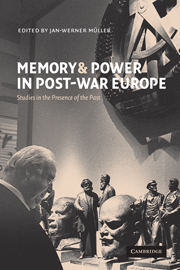
Memory and Power in Post-War Europe
How has memory - collective and individual - influenced European politics after the Second World War and after 1989 in particular? How has the past been used in domestic struggles for power, and how have 'historical lessons' been applied in foreign policy? While there is now a burgeoning field of social and cultural memory studies, mostly focused on commemorations and monuments, this volume is the first to examine the connection between memory and politics directly. It investigates how memory is officially recast, personally reworked and often violently re-instilled after wars, and, above all, the ways memory shapes present power constellations. The chapters combine theoretical innovation in their approach to the study of memory with deeply historical, empirically based case studies of major European countries. The volume concludes with reflections on the ethics of memory, and the politics of truth, justice and forgetting after 1945 and 1989.
eBook


Friction, Fragmentation, and Diversity
This collection focuses on difficult memories and diverse identities related to conflicts and localized politics of memories. It brings together methodological discussions from oral history research, cultural memory studies and the study of contemporary protest movements.
eBook

Remembering communism : private and public recollections of lived experience in Southeast Europe
\"The volume examines the formation and transformation of the memory of communism in the post-communist period. The majority of the articles focus on memory practices in the post-Stalinist era in Bulgaria and Romania, with occasional references to the cases of Poland and the GDR. Based on an interdisciplinary approach, including history, anthropology, cultural studies and sociology, the volume, examines the mechanisms and processes that influence, determine and mint the private and public memory of communism in the post-1989 era. Common denominator to all essays is the emphasis on the process of remembering in the present, and the modalities by means of which the present perspective shapes processes of remembering, including practices of commemoration and representation of the past. As a result, the analyses point at the sociopolitical factors and societal processes that help construct, transform, stabilize and finally canonize past memory. Due to its interdisciplinary character and the wide range of methodological and theoretical approaches presented, the volume offers a broad and varied kaleidoscope of memorial practices in a variety of milieus of post-communist societies, from school to the internet. The volume deals with eight major thematic blocks revisiting specific practices in communism such as popular culture and everyday life, childhood, labor, the secret police, the perception of 'the system' and others. The analyses highlight occasionally similarities and differences between the two principal case studies, resulting in the end effect in the observation of a significant divergence in the memory of communism between the two neighboring countries\"--Provided by publisher.
Book
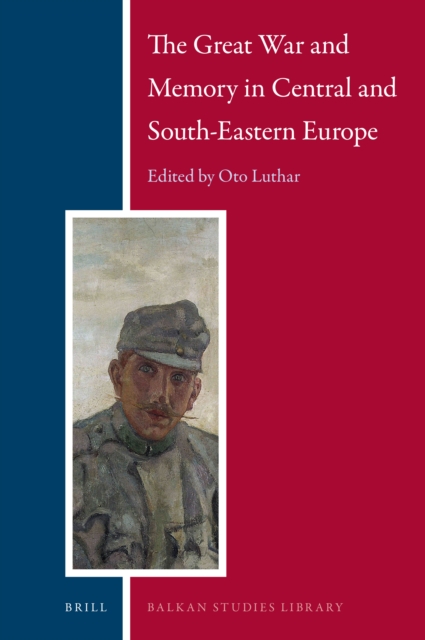
The Great War and Memory in Central and South-Eastern Europe
This volume presents a series of chapters about the Great War and memory in Central and South-Eastern Europe which will widen the insufficient and spotty representations of the Great War in that region. The contributors deliver an important addition to present-day scholarship on the more or less unknown war in the Balkans and at the Italian fronts. Although it might not completely fill the striking gap in the historical representations of the situation between the Slovene-Italian Soca-Isonzo river in the North-West and the Greek-Macedonian border mountains around Mount Kajmakcalan in the South-East, it will add significantly to the scholarship on the Balkan theatre of war and provide a much-needed account of the suffering of civilians, ideas, loyalties and cultural hegemonies, as well as memories and the post-war memorial landscape. The contributors are Vera Gudac Dodic, Silviu Hariton, Vijoleta Herman Kauric, Oto Luthar, Olga Manojlovic Pintar, Ahmed Pašic, Ignác Romsics, Daniela Schanes, Fabio Todero, Nikolai Vukov and Katharina Wesener.
eBook