
Catalogue Search | MBRL


Are you sure you want to remove the book from the shelf?

{{itemTitle}}
77
result(s) for
"Memory Northern Ireland."
Sort by:

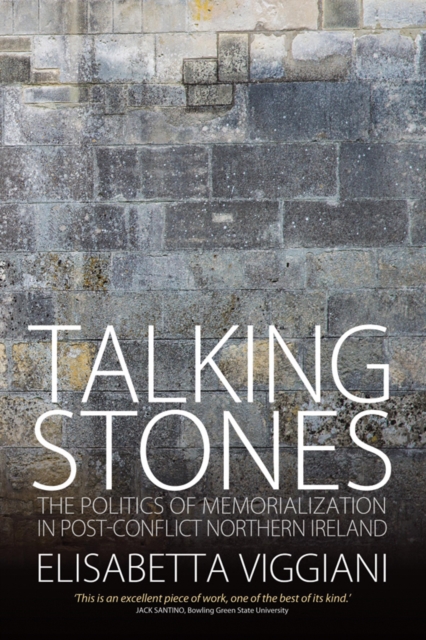
Talking stones
If memory was simply about past events, public authorities would never put their ever-shrinking budgets at its service. Rather, memory is actually about the present moment, as Pierre Nora puts it: \"Through the past, we venerate above all ourselves.\" This book examines how collective memory and material culture are used to support present political and ideological needs in contemporary society. Using the memorialization of the Troubles in contemporary Northern Ireland as a case study, this book investigates how non-state, often proscribed, organizations have filled a societal vacuum in the creation of public memorials. In particular, these groups have sifted through the past to propose \"official\" collective narratives of national identification, historical legitimation, and moral justifications for violence.
eBook


Recording Memories from Political Violence
This book combines written and audiovisual texts to describe and analyse the use of documentary filmmaking in recording experiences of political conflict. McLaughlin draws on the diverse fields of film and cultural studies in this informed, instructive contribution to documentary filmmaking and post-conflict studies.
eBook

Commemoration and Bloody Sunday : pathways of memory
\"In this wide-ranging study of the politics of memory in Northern Ireland, Brian Conway examines the 'career' of the commemoration of Bloody Sunday, and looks at how and why the way this historic event is remembered has undergone change over time. Drawing on original empirical data, he provides new insights into the debate on collective memory\"--Provided by publisher.
Book

In the shadow of Enoch Powell
Fifty years ago Enoch Powell made national headlines with his 'Rivers of Blood' speech, warning of an immigrant invasion in the once respectable streets of Wolverhampton. This local fixation brought the Black Country town into the national spotlight, yet Powell's unstable relationship with Wolverhampton has since been overlooked. Drawing from interviews and archival material, this book offers a rich local history through which to investigate the speech, bringing to life the racialised dynamics of space during a critical moment in British history. What was going on beneath the surface in Wolverhampton and how did Powell's constituents respond to this dramatic moment? The research traces the ways in which Powell's words reinvented the town and uncovers highly contested local responses. While Powell left Wolverhampton in 1974, the book returns to the city to explore the collective memories of the speech which continue to reverberate. In a contemporary period of new crisis and national divisions, revisiting the shadow of Powell allows us to reflect on racism and resistance from 1968 to today.
eBook


Visions and ruins
This book is a study of cultural memory in and of the British Middle Ages. It works with material drawn from across the medieval period – in Old English, Middle English and Latin, as well as material and visual culture – and explores modern translations, reworkings and appropriations of these texts to examine how images of the past have been created, adapted and shared. It interrogates how cultural memory formed, and was formed by, social identities in the Middle Ages and how ideas about the past intersected with ideas about the present and future. It also examines how the presence of the Middle Ages has been felt, understood and perpetuated in modernity and the cultural possibilities and transformations this has generated. The Middle Ages encountered in this book is a site of cultural potential, a means of imagining the future as well as imaging the past.The scope of this book is defined by the duration of cultural forms rather than traditional habits of historical periodization and it seeks to reveal connections across time, place and media to explore the temporal complexities of cultural production and subject formation. It reveals a transtemporal and transnational archive of the modern Middle Ages.
eBook

Remembering the Troubles : contesting the recent past in Northern Ireland
\"The historian A.T.Q. Stewart once remarked that in Ireland all history is applied history--that is, the study of the past prosecutes political conflict by other means. Indeed, nearly twenty years after the 1998 Belfast Agreement, 'dealing with the past' remains near the top of the political agenda in Northern Ireland. The essays in this volume, by leading experts in the fields of Irish and British history, politics, and international studies, explore the ways in which competing 'social' or 'collective memories' of the Northern Ireland 'Troubles' continue to shape the post-conflict political landscape. The contributors to this volume embrace a diversity of perspectives: the Provisional Republican version of events, as well as that of its Official Republican rival; Loyalist understandings of the recent past as well as the British Army's authorized for-the-record account; the importance of commemoration and memorialization to Irish Republican culture; and the individual memory of one of the noncombatants swept up in the conflict. Tightly specific, sharply focused, and rich in local detail, these essays make a significant contribution to the burgeoning literature of history and memory. The book will interest students and scholars of Irish studies, contemporary British history, memory studies, conflict resolution, and political science. Contributors: Jim Smyth, Ian McBride, Ruan O'Donnell, Aaron Edwards, James W. McAuley, Margaret O'Callaghan, John Mulqueen, and Cathal Goan\"-- Provided by publisher.
Book

Irish/ness Is All Around Us
Focusing on Irish speakers in Catholic West Belfast, this ethnography on Irish language and identity explores the complexities of changing, and contradictory, senses of Irishness and shifting practices of 'Irish culture' in the domains of language, music, dance and sports. The author's theoretical approach to ethnicity and ethnic revivals presents an expanded explanatory framework for the social (re)production of ethnicity, theorizing the mutual interrelations between representations and cultural practices regarding their combined capacity to engender ethnic revivals. Relevant not only to readers with an interest in the intricacies of the Northern Irish situation, this book also appeals to a broader readership in anthropology, sociology, cultural studies, history and political science concerned with the mechanisms behind ethnonational conflict and the politics of culture and identity in general.
eBook