
Catalogue Search | MBRL


Are you sure you want to remove the book from the shelf?

{{itemTitle}}
4,150
result(s) for
"Messianism"
Sort by:

Symbols of defeat in the construction of national identity
\"THis is the first book to camparatively examine nations that emphasize images of their own defeat in their mythology and sense of history. Cases include Serbia, Israel, France, Greece and Ghana. Through exploring this phenomenon, it offers new insights into current theories in the study of nations and nationalism, incorporating approaches from diverse disciplines such as sociology, antropology and the psychology of religion\"-- Provided by publisher.
Book
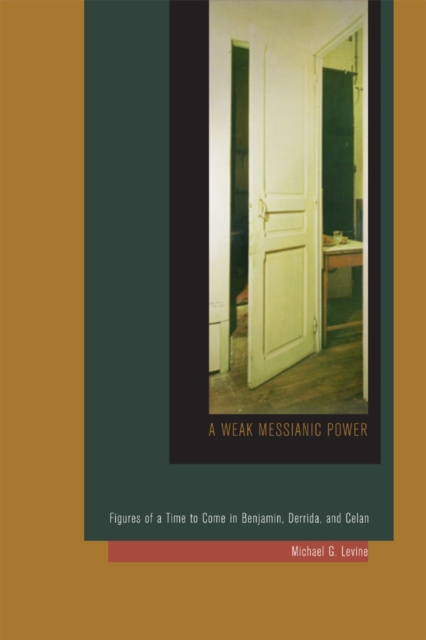
A weak Messianic power: figures of a time to come in Benjamin, Celan, and Derrida
In his famous theses on the philosophy of history, Benjamin writes: \"We have been endowed with a weak messianic power to which the past has a claim.\" This claim addresses us not just from the past but from what will have belonged to it only as a missed possibility and unrealized potential. For Benajmin, as for Celan and Derrida, what has never been actualized remains with us, not as a lingering echo but as a secretly insistent appeal. Because such appeals do not pass through normal channels of communication, they require a special attunement, perhaps even a mode of unconscious receptivity. Levine examines the ways in which this attunement is cultivated in Benjamin's philosophical, autobiographical, and photohistorical writings; Celan's poetry and poetological addresses; and Derrida's writings on Celan.
eBook


Le «non-présent vivant». Phénoménologie et déconstruction du messianisme chez Derrida
Dans une constellation de textes entourant Spectres de Marx, Derrida procède à un geste qui semble contraire à la «déconstruction» et qui paraît s’apparenter plutôt à la méthode phénoménologique. En érigeant la messianicité au statut de structure universelle indéconstructible, ces textes donnent lieu en effet à une radicalisation et une transcendantalisation de la temporalité propre aux messianismes historiques. Cet article entend d’abord mettre en évidence le caractère phénoménologique de cette approche et ensuite en questionner la légitimité et le sens à la lumière de textes ultérieurs, où Derrida analyse le rapport entre médias et christianisme.
Journal Article


A Weak Messianic Power: Figures of a Time to Come in Benjamin, Derrida, and Celan
In his famous theses on the philosophy of history, Benjamin writes: \"We have been endowed with a weak messianic power to which the past has a claim.\" This claim addresses us not just from the past but from what will have belonged to it only as a missed possibility and unrealized potential. For Benajmin, as for Celan and Derrida, what has never been actualized remains with us, not as a lingering echo but as a secretly insistent appeal. Because such appeals do not pass through normal channels of communication, they require a special attunement, perhaps even a mode of unconscious receptivity. Levine examines the ways in which this attunement is cultivated in Benjamin's philosophical, autobiographical, and photohistorical writings; Celan's poetry and poetological addresses; and Derrida's writings on Celan.
eBook

Symbols of Defeat in the Construction of National Identity
If nationalism is the assertion of legitimacy for a nation and its effectiveness as a political entity, why do many nations emphasize images of their own defeat in understanding their history? Using Israel, Serbia, France, Greece and Ghana as examples, the author argues that this phenomenon exposes the ambivalence that lurks behind the passions nationalism evokes. Symbols of defeat glorify a nation's ancient past, while reenacting the destruction of that past as a necessary step in constructing a functioning modern society. As a result, these symbols often assume a foundational role in national mythology. Threats to such symbols are perceived as threats to the nation itself and consequently are met with desperation difficult for outsiders to understand.
eBook
Messianic Expectation and the Exorcisms of Jesus, the Son of David, in Matthew's Gospel
In this thesis I establish that Matthew's presentation of Jesus's exorcisms fits with the Second Temple exorcistic messianic expectations. This thesis challenges the axiom that nobody expected the Messiah to cast out demons. Previous research has been either preoccupied with sharp definitions of titles, have had a narrow understanding of messianism, or have attempted to import non-Jewish explanations. I have taken a more conceptual approach and have focused on those ideas in the Jewish Scriptures that provide the seedbed for messianism in general, that is, the Promise (2 Sam 7) and the centrality of David and Solomon. I have focused specifically on those elements that make their rule distinctive and ideally secure their prevailing over their adversaries. I have then traced the development of these features in the Second Temple period towards explicitly exorcistic interpretations. In so doing I have established the contemporary landscape and demonological language against which Matthew's presentation of Jesus's exorcisms specifically as the Son of David takes a shape of prophetic fulfillment. I have, thus, shown that Matthew's account of Jesus the Son of David's exorcisms makes sense only if it is preceded by a contemporary expectation for an exorcistic Messiah.
Dissertation
Three parodic readings of the (de)construction of the nation / Tres lecturas paródicas de la (de) / construcción de la nación
In this paper, a brief review of three stories concerning the re-reading of \"national\" or “para-national\" or even “contra-national\" events points to the objective of observing the double value of the parodic reading, according to the different functions it can be attributed to , as something that depoliticizes readings (Jameson), or perhaps, in certain cases may politicize the representation (Hutcheon). The analyzed stories are firstly, \"La soberanía nacional\" within Historia Argentina (1991), by Rodrigo Fresán (Buenos Aires, 1963), which is told from three points of view -with its corresponding homodiegetic narrator- an episode of the Falklands war. Secondly, we analyse the tale \"Coyote\" (in La casa pierde , 1998), by John Villoro (Mexico D.F., 1956), where the initiatory rite of the protagonists, a group of friends that travel to the desert to search for a peyote, it is put into relation with the initiatic and mystical travel that Huichol take each year through the desert with the same purpose. Thirdly, Fernando Iwasaki (Lima, 1961) re-reads \"Taqui Ongoy\" a tale of Un milagro informal (2003), a marginal event in the history of Peru, greatly discussed historically but with resistant symbolic value, which appealed to the resurrection of all lashuacas (Andean deities), to oppose to the Spanish domination; in the story, through parallels with other current messianic movements, it is parodied and the resistant messianism is deactivated. Thus, the conclusions are open to reflection, but it could be said that the first story brings into play a parodic deactivation of the logic of national wars, while the second is a musing of the idealised coexistence as the image of the nation; lastly, the third assimilates the marginal image of the “other” possible nation with the irrationality of fanaticism.
Journal Article
