
Catalogue Search | MBRL


Are you sure you want to remove the book from the shelf?

{{itemTitle}}
1,023
result(s) for
"Metalanguage."
Sort by:
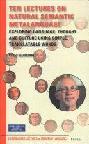
Ten lectures on natural semantic metalanguage : exploring language, thought and culture using simple, translatable words
This lively lecture series by a leading expert introduces the theory, practice and application of a versatile, rigorous and well-developed approach to cross-linguistic semantics: the NSM approach originated by Anna Wierzbicka. Topics include: history and philosophy of the study of meaning, semantic primes and molecules, emotions, evaluation, verbs and event structure, cultural key words and scripts. Case studies come from English, Chinese, Danish, and other languages. Applications in language teaching and intercultural education are also covered, along with comparisons between NSM and other leading approaches to linguistic semantics. The book will appeal to students and scholars of linguistics at all levels, communication and translation scholars, and anyone interested in a systematic and non Anglocentric approach to meaning, culture and cognition.
Book

The role of linguistic perspectives in the language description
The paper discusses the language of linguistic description (metalanguage), in particular the question of how the language of description can influence the language that is the object of the description. I approach the topic from the aspect of the use of linguistic terms and their personification. I summarize the results of my three previous case studies, in which I tracked the formulations associated with the selected terms. I focused on the actions that, according to the literal understanding of the formulations, are performed by the terms. Based on these case studies, I concluded that the more frequently a term is used, the more likely it is that it will “perform” an activity and, if this happens, the further away they go, the more their “competencies” expand, i.e. they perform progressively more complex acts. I have characterized this phenomenon as the perspective through which we view linguistic reality through terms (the perspective of the term), and in contrast to it, I have presented the speaker’s perspective, through which linguistic reality is perceived from the perspective of everyday speakers. I have pointed out that the perspective of the term can affect the description of language in a way that shifts the linguist’s attention from the real behaviour of speakers to the “behaviour” of abstract linguistic entities.
Journal Article

The metalinguistic dimension in instructed second language learning
The metalinguistic dimension refers to the way in which learners bring to bear knowledge about language into their learning of a second language, the 'L2'. This book brings together research on the metalinguistic dimension, given its increasing importance in the study of L2 acquisition.
Book

The Implementation of Visual Grammar in Slovene Classes to Mother Tongue Speakers
The discussion focuses on the implementation of visual grammar in the study program for primary school teachers in the course Slovene language 1 - basics of text. It points out the theoretical premises of the Systemic Functional and Visual Grammar as the basis for discussing the multimodal texts, and along with a case study (34 student exam solutions) and findings from practice, presents the more challenging areas of student acquisition of theory and metalanguage. It justifies the need and shows the possibility of teaching multimodal textual analysis in school education.
Journal Article


Language Reflection: Metatextual Analysis
The article deals with language reflection, verbalization through metatexts, and interpretation. The expression of language reflection is defined in the works of writers and poets. The research is directed at investigating the text, realizing the process of interpreting the works of great poet A. Kunanbayev from the point of linguistic consciousness, and determining the results. The poet conveys information by utilizing various language tools and constructs that prompt self-questioning. The definitions of concepts, classifications, and characteristics related to language reflection are given. The authors aimed to identify language reflection in A. Kunanbayev’s works, classify reflexives marking the language reflection of the author, modeling them using the G. Gibbs’ model, and comparing them with the psycholinguistic survey materials within the framework of reflexive linguistics. The authors agree that there are two classifications of reflexives, such as metatextual commentary and metalanguage interpretation. As a result of the study, the poet’s self-reflection consisted of 6 elements (Gibbs’ cycle), through the lexico-semantic analysis of the reflexives the poet’s language units were classified as metatextual commentary and the respondents' answers as metalanguage interpretation. The syntactic structures of the language reflexives were determined, and it was found that they are often in interrogative and negative forms. According to the purpose of the article, the reflexives in the poet's poem were identified and classified into four groups (Describing the poet or providing additional information; Working on yourself; Working with character; Positive assessment) by the semantic nature of the respondents' interpretation of the work as a result of the psycholinguistic experiment.
Journal Article

Teledescante nº1: polyphony in time of plague
This report contemplates an instrumental composition as a project for audiovisual production in social isolation, during the Covid-19 pandemic. Based on the problematization of the impact of the pandemic in music making, solutions were sought that were not only viable as an artistic result but that could also be projected in a purposeful and prospective way in times of humanitarian crisis, of dismal symmetry between capitalist neoliberalism and programmed neglect in public health policies. After a description of the research on the use of art in past pandemics as a guiding principle in the choice of materials, the audiovisual production is detailed. The piece was written in April 2020 as a result of the analysis of a Renaissance motet, which, in turn, was conceived as a tribute to a composer who had perished from the plague and as a palliative against the disease.
Journal Article

Enhancing Existential Graphs: Peirce s Late Improvements
Charles Peirce developed Existential Graphs as a diagrammatic syntax for representing and reasoning about propositions, with three parts: Alpha for propositional logic, Beta for first-order predicate logic, and Gamma for aspects of modal logic, second-order logic, and metalanguage. He made several adjustments between 1909 and 1911 that merit further consideration: using heavy lines to denote possible states of things in which attached propositions would be true, drawing a red line just inside the edge of a page and writing postulates in the resulting margin, shading oddly enclosed areas instead of drawing thin lines as their boundaries, and using multiple sheets of paper to represent different subjects within the overall universe of discourse. These modifications can be combined to constitute a plausible candidate for Delta, a fourth part that Peirce intended to add but never spelled out. It implements modern formal systems of modal propositional logic in accordance with a version of possible worlds semantics in which the laws for the actual state of things are facts in every possible state of things.
Journal Article

The Characterization of Concepts in a Metalanguage for Lexicographic Semantics
A successful lexicographic semantic description characterizes the concepts that occur in establishing the meaning of a listeme by modelling what the competent native-like speaker of the language knows. Because concepts can only be identified to another human through the medium of a natural language, the metalanguage used in the semantic definition of a natural language expression in the object language will always be equivalent to the natural language expression through which that metalanguage is interpreted. The metalanguage of a semantic theory is a demonstrably rational abstract model developed by applying the analyst’s experience and intuitions to inferences drawn from occurrences of actual speech events. Each sense of a listeme is characterized by a description of the salient properties of its typical denotatum. To most effectively implement this project in conceptual engineering is to capture every possible sense of the listeme using metalanguage that is at the same time precise, comprehensive, and succinct. A review of several proposed lexicon/dictionary entries for the listeme cup reveals lacunae that are rectified in a decision procedure whose output characterizes the relevant sense of the input listeme using natural language and the procedural constructs/commands &, XOR, IF, ELSE, ELIF, GOTO, OUTPUT, TENABLE, NEXT ITEM. The resulting lexicographic semantic description satisfies the specified success condition. Establishing the characteristics of metalanguage is crucial to the proper investigation of conceptual engineering.
Journal Article

Discovering Disciplinary Linguistic Knowledge With English Learners and Their Teachers: Applying Systemic Functional Linguistics Concepts Through Design-Based Research
A focus on how language varies in its forms and meanings can help English learners (ELs) in K-12 classrooms engage in disciplinary discourses that enable them to learn both language and content. Systemic functional linguistics (SFL) offers promising ways of talking about language in support of disciplinary learning. SFL's meaning-based metalanguage offers analytical tools for making sense of text, but its description of complex systems in language is not readily accessible to teachers and students. This article offers a case study of how a design-based research (DBR) process yielded findings, materials, and instructional theory over a 3-year project to develop SFLbased approaches to engaging ELs in talk about language. In this study, conducted in an urban school district in the midwestern United States, the authors worked collaboratively with teachers and literacy coaches at six schools with high proportions of ELs, supporting them in using SFL metalanguage to talk about language and meaning as they engaged in grade-appropriate literacy activities: reading and responding to texts and writing subject-specific arguments. This article shares both what the authors learned about the implementation of SFL pedagogies and the affordances of DBR methodology for learning to apply a complex theory to support ELs.
Journal Article