
Catalogue Search | MBRL


Are you sure you want to remove the book from the shelf?

{{itemTitle}}
84
result(s) for
"Metaphysics Congresses."
Sort by:

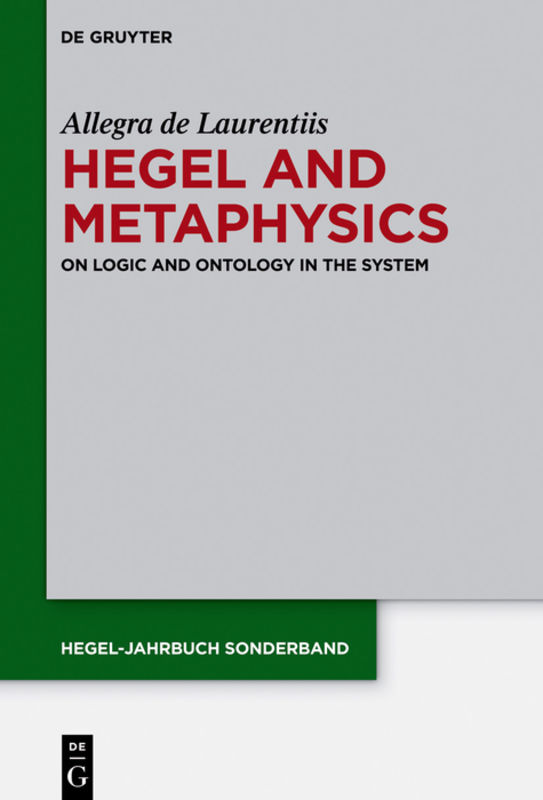
Hegel and Metaphysics
The collective focus of the essays here presented consists of the attempt to overcome the deadlock between metaphysical and non- (or anti-) metaphysical Hegel interpretations. There is no doubt that Hegel rejects traditional and influential forms of metaphysical thought. There is also no doubt that he grounds his philosophical system on a metaphysical theory of thought and reality. The question asked by the contributors in this volume is therefore: what kind of metaphysics does Hegel reject, and what kind does he embrace? Some of the papers address the issue in general and comprehensive terms, but from different, even opposite perspectives: Hegel's claim of a 'unity' of logic and metaphysics; his potentially deflationary understanding of metaphysics; his overt metaphysical commitments; his subject-less notion of logical thought; and his criticism of Kant's critique of metaphysics. Other contributors discuss the same topics in view of very specific subject-matter in Hegel's corpus, to wit: the philosophy of self-consciousness; practical philosophy; teleology and holism; a particular brand of naturalism; language's relation to thought; 'true' and 'spurious' infinity as pivotal in philosophic thinking; and Hegel's conception of human agency and action.
eBook
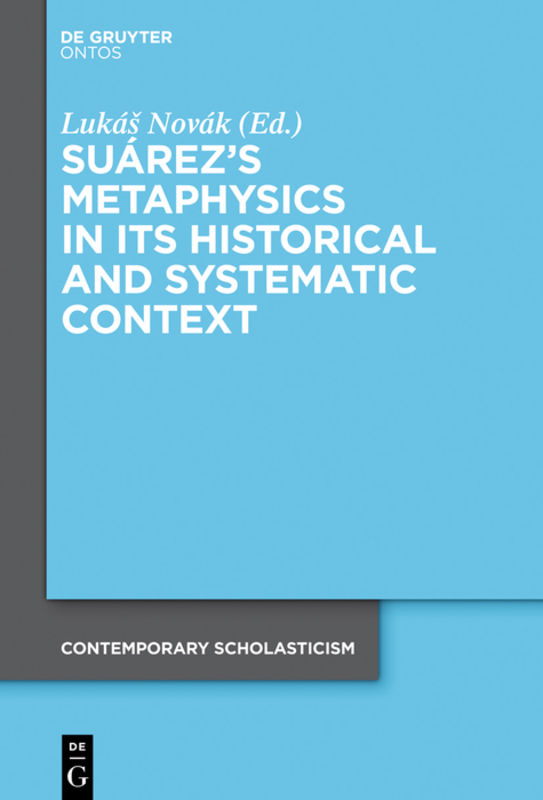
Suárez's Metaphysics in Its Historical and Systematic Context
Although the importance of Francisco Suárez has been, for some time already, generally recognized even outside the circles of historians of scholasticism, the wider context of his thought – i.e., the rich and diverse Renaissance and Baroque scholasticism – remains largely unexplored. This book is an attempt to contribute to the quest of putting Suárez’s metaphysics (a mere fragment of the whole of his intellectual legacy) into context, historical and systematic. Being the fruit of an international conference held in Prague in October 2008, it puts together a systematically ordered selection of papers devoted to general and specific topics of Suárezian metaphysics, with special respect to its sources and further impact. Part One explores in the first place the notion of being and the nature of metaphysics in general; Part Two then deals with more specific metaphysical topics such as the problem of universals, causality, relations, and God. The book will be of value not just to Suárez-scholars, but to anyone interested in the history of ideas in general and in the the intricacies of metaphysical thought at the verge of modernity in particular.
eBook

Metametaphysics : new essays on the foundations of ontology
Metaphysics asks questions about existence: for example, do numbers really exist? Metametaphysics asks questions about metaphysics: for example, do its questions have determinate answers? If so, are these answers deep and important, or are they merely a matter of how we use words? What is the proper methodology for their resolution? These questions have received a heightened degree of attention lately with new varieties of ontological deflationism and pluralism challenging the kind of realism that has become orthodoxy in contemporary analytic metaphysics. This volume concerns the status and ambitions of metaphysics as a discipline. It brings together many of the central figures in the debate with their most recent work on the semantics, epistemology, and methodology of metaphysics.
eBook

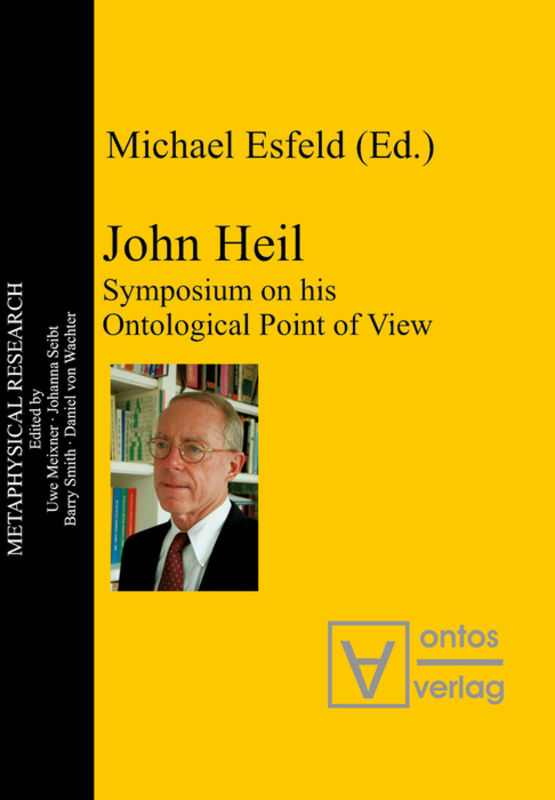
John Heil
Fifty years after Willard Van Orman Quine published From a logical point of view (1953), John Heil brought out his book 'From an ontological point of view' (2003). The title expresses the shift in contemporary philosophy from logical and epistemological concerns to metaphysics. The papers of this symposium discuss that shift, focussing on what John Heil calls 'ontological seriousness', truth-making, levels of being, properties, powers, and reductionism. Each paper is followed by a comment from John Heil. The volume covers a number of the most hotly debated issues in today's metaphysics and moves the discussion on in several important aspects. 'It would be difficult to imagine a collection of more astute, penetrating, and philosophically hard-hitting discussions of the kind of metaphysical realism articulated in 'From an Ontological Point of View'. Symposium participants deploy an impressive range of analytical skills in a way that illuminates connections among metaphysical positions that too often escape notice.' (John Heil)
eBook

Metaphysics and Truthmakers
The essays collected in this volume concern the general question of truthmaking. Most of them also bear upon the metaphysical nature of truthmakers (moments, tropes, property-instances, Aristotelian substances, states of affairs, meanings or essences ? ). Taking as their starting point a famous seminal paper by K. Mulligan, P. Simons and B. Smith, as well as D. Armstrong's outstanding contribution to the subject, they offer a fresh assay of the main concepts involved, in order to assess the explanatory value of truthmakers and truthmaker necessitarianism, and explore such delicate issues as contingent truth, bare possibility, tensed propositions, the ontological irreducibility of relations, the subsistence of facts and the epistemic role of negative truths. The collection as a whole provides a comprehensive and thought-provoking survey of the current debate about truthmaking theory and deserves to be read carefully by anyone interested in the relationship between language, thought and reality.
With contributions from David ARMSTRONG, Stefano CAPUTO, François CLEMENTZ, Pascal ENGEL, Herbert HOCHBERG, Philipp KELLER, Jonathan LOWE, Jean-Maurice MONNOYER, Kevin MULLIGAN, Stephen MUMFORD, Frederic NEF, Peter SIMONS, Barry SMITH, Jonathan SIMON
eBook
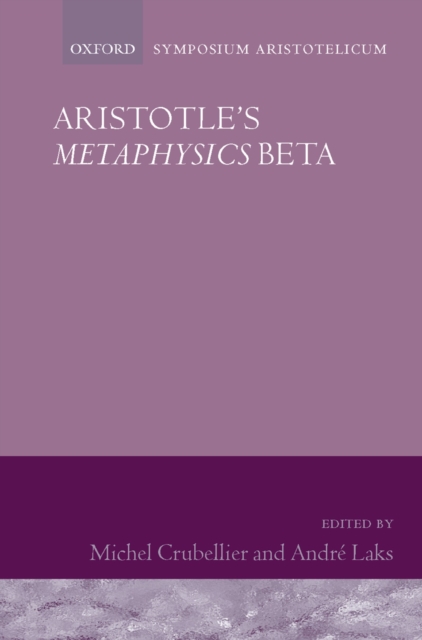
Aristotle's Metaphysics Beta
Nine leading scholars of ancient philosophy offer a systematic study of Book Beta of Aristotle's Metaphysics. They work through the series of problems which Aristotle presents, discussing such topics as causation, substance, constitution, properties, predicates, and generally the ontology of both the perishable and the imperishable world.
eBook

Modular Ontologies
Modularity has been and continues to be one of the central research topics in ontology engineering, still catching up with 40 years of related research in software engineering. The workshops on Modular Ontologies (WoMO) bring together researchers from different disciplines who study the problem of modularity in ontologies at a fundamental level, develop design tools for distributed ontology engineering, and apply modularity to different use cases and application scenarios.The contributions in this volume are of interest to researchers, students, and practitioners interested in foundations of ontology engineering, ontology languages and tools, and specifically, to research groups working on ontology modularization and integration problems and developing tool support. They should also be of interest to the broader communities of knowledge representation & reasoning, information integration, description logics and ontology languages, distributed systems, to the Semantic Web community, and to the emerging application domains for ontologies such as life sciences, robotics, e-business, ambient intelligence.
eBook