
Catalogue Search | MBRL


Are you sure you want to remove the book from the shelf?

{{itemTitle}}
1,299
result(s) for
"Metaverse"
Sort by:

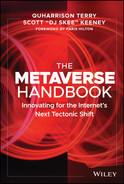
The Metaverse Handbook
The metaverse is here. Are you ready? In The Metaverse Handbook: Innovating for the Internet's Next Tectonic Shift, a duo of experienced tech and culture experts delivers a can't-miss guide to participating in the most promising new technology since the advent of the web. Through dozens of metaverse creator case studies and concise, actionable insights, you'll walk away from this book understanding how to explore and implement the latest metaverse tech emerging from blockchain, XR, and web3. In The Metaverse Handbook, you'll discover: What the metaverse is, why you should care about it, and how to build your metaverse strategy The history of the metaverse and primers on critical technologies driving the metaverse, including non-fungible tokens, XR, the blockchain, and web3 How to unearth unique metaverse opportunities in digital communities, commerce, and immersive experiences As the metaverse has rapidly become the technology platform and marketing buzzword of the future, this new reality for companies, creators, and consumers is not easily understood at the surface level. Those who aim to be at the forefront of this exciting new arena must first understand the foundations and central technologies of the metaverse. An essential resource for digital professionals, creators, and business leaders in the vanguard of the coming technology revolution, The Metaverse Handbook provides the go-to roadmap for your journey into the metaverse.
eBook

The future of metaverse in the virtual era and physical world
This book is divided into three parts. The first part discusses the Metaverse's basics, development, and optional applications such as 3D virtual dressing room-based user-friendly Metaverse, the use of Metaverse in the healthcare and environment sectors as well as the ethics of the Metaverse and digital virtual environments. Part two presents some chapters that discuss emerging technologies in the Metaverse world including IoT, digital twining, and artificial intelligence and shows its impact on climate change. The third part contains chapters discussing cybersecurity in the Metaverse including blockchain technology opportunities and applications and the threat of the digital humanities in the Metaverse. The book is suitable for students and academics aiming to build up their background on the Future of the Metaverse in the Virtual Era and Physical World. .
Book

How Metaverse will influence Industrial Innovation (Extended Abstract SID2022)
This paper will explore how Metaverse will facilitate the acceleration of industrial innovation and help the industry digitalize their global high-volume manufacturing environment. The authors conducted a live workshop (with around 30 participants) as part of the international conference Sibiu Innovation Days 2022. The workshop’s proceedings and output is described here below.
Journal Article

Interconnected realities : how the metaverse will transform our relationship to technology forever
\"Today, what is called \"the Metaverse\" is in fact many different Metaverses, each with a different purpose, and serving a different audience. The Web3 Metaverse, the Social Metaverse, the Enterprise Metaverse, the Gaming Metaverse -- what each of these, plus the other Metaverses that exist, have in common is the concept of using computing to connect one reality to another. These connections can be between people, or locations, or information pools, and together they will transform the nature of the human/computer interface over the next decade. Interconnected Realities explores the path that this transformation will take, starting with today's existing Metaverse realms, understanding the purpose that each serves, and how all of these disparate areas will ultimately weave together to change both our personal and business lives\"-- Provided by publisher.
Book

UTAUT in Metaverse: An “Ifland” Case
Since 2021, big tech companies have been interested in metaverse platforms and services. Metaverse is the permanent, immersive mixed-reality world where people and people and people and objects can synchronously interact, collaborate, and live beyond the limitations of time and space, using avatars and the immersion-supporting devices, platforms, and infrastructures. On metaverse platforms, people can merge the real world and the virtual world. Because the metaverse has only recently begun to be studied, there are only dozens of studies on the metaverse published in qualified academic journals. There are few empirical studies on the extent to which metaverse platforms will be accommodated in the lives of information system users from an integrated perspective. Therefore, this paper aimed to empirically verify user acceptance of metaverse platforms by referring the unified theory of acceptance and use of technology (UTAUT). This study was conducted in two stages. (1) The concept and research trends of the metaverse platform were examined, and (2) the UTAUT model was introduced in “Ifland”, one of the metaverse platforms, to verify its acceptance of information system users. I conducted a laboratory experiment while complying with the quarantine rules. Participants were required to watch a 15 min lecture on artificial intelligence on the metaverse platform “Ifland” for a sufficient time, then they discussed the impacts of artificial intelligence with others in the lecture. A total of 120 valid data points, excluding insincere responses, were collected, and hypotheses were verified through PLS analysis. Results indicate that performance expectancy, effort expectancy, and social influence of the metaverse platform significantly increased satisfaction, usage intention, purchase intention, and word-of-mouth intention. Facilitating conditions had no significant impact on satisfaction. The results of this study provide implications for how the metaverse platform should be designed and what factors should be emphasized to increase user acceptance of metaverse platforms.
Journal Article


The merchants of meta: A research agenda to understand the future of retailing in the metaverse
•A new conceptualization of the metaverse that contains four distinct dimensions.•The authors introduce the concept of transitory metaverses.•Review of the current state of research on topics related to the metaverse.•27 future research directions identified in the evolving world of the metaverse.
Due to rapid technological developments, the metaverse is quickly garnering attention from all areas of retailing. With a projected market of $800 billion by 2024, the metaverse is expected to radically reshape retailing in the digital world. However, very little is known about the metaverse from a customer, retailer, or brand perspective.
This article summarizes how the metaverse has been conceptualized thus far in the literature and the popular press. The authors offer a new conceptualization of the metaverse that contains four distinct dimensions: online collaboration, high consumer immersion, unique digital assets, and digital personas.
Considering that the technologies currently used to provide high consumer immersion (e.g., augmented reality, virtual reality) and unique digital assets (e.g., blockchain technology) are not fully developed or commercialized, the authors also propose the concept of a transitory metaverse to understand the current stage of metaverse development better.
The authors conclude by providing 27 directions for future research based on a full factorial of how the metaverse dimensions amplify three customer touchpoints in the digital experience (digital economic exchange, complex social relationships, direct environment interaction) for the three main stakeholders of any retailing exchange (consumers, retailers, brands) along the entire customer journey (pre-purchase, purchase, post-purchase).
[Display omitted]
Journal Article


Metaverse Security: Issues, Challenges and a Viable ZTA Model
The metaverse is touted as an exciting new technology amalgamation facilitating next-level immersive experiences for users. However, initial experiences indicate that a host of privacy, security and control issues will need to be effectively resolved for its vision to be realized. This paper highlights the security issues that will need to be resolved in the metaverse and the underlying enabling technologies/platforms. It also discussed the broader challenges confronting the developers, the service providers and other stakeholders in the metaverse ecosystem which if left unaddressed may hamper its broad adoption and appeal. Finally, some ideas on building a viable Zero-Trust Architecture (ZTA) model for the metaverse are presented.
Journal Article