
Catalogue Search | MBRL


Are you sure you want to remove the book from the shelf?

{{itemTitle}}
4,730
result(s) for
"Mexican Literature"
Sort by:


Toward a Latina Feminism of the Americas
Weaving strands of Chicana and Mexicana subjectivities, Toward a Latina Feminism of the Americas explores political and theoretical agendas, particularly those that undermine the patriarchy, across a diverse range of Latina authors. Within this range, calls for a coalition are clear, but questions surrounding the process of these revolutionary dialogues provide important lines of inquiry. Examining the works of authors such as Sandra Cisneros, Laura Esquivel, Carmen Boullosa, and Helena María Viramontes, Anna Sandoval considers resistance to traditional cultural symbols and contemporary efforts to counteract negative representations of womanhood in literature and society. Offering a new perspective on the oppositional nature of Latina writers, Sandoval emphasizes the ways in which national literatures have privileged male authors, whose viewpoint is generally distinct from that of women—a point of departure rarely acknowledged in postcolonial theory. Applying her observations to the disciplinary, historical, and spatial facets of literary production, Sandoval interrogates the boundaries of the Latina experience. Building on the dialogues begun with such works as Sonia Saldivar-Hull’s Feminism on the Border and Ellen McCracken’s New Latina Narrative, this is a concise yet ambitious comparative approach to the historical and cultural connections (as well as disparities) found in Chicana and Mexicana literature.
eBook


Borderlands Saints : Secular Sanctity in Chicano/a and Mexican Culture
In Borderlands Saints, Desiree A. Martin examines the rise and fall of popular saints and saint-like figures in the borderlands of the United States and Mexico. Focusing specifically on Teresa Urrea (La Santa de Cabora), Pancho Villa, Cesar Chavez, Subcomandante Marcos, and Santa Muerte, she traces the intersections of these figures, their devotees, artistic representations, and dominant institutions with an eye for the ways in which such unofficial saints mirror traditional spiritual practices and serve specific cultural needs. Popular spirituality of this kind engages the use and exchange of relics, faith healing, pilgrimages, and spirit possession, exemplifying the contradictions between high and popular culture, human and divine, and secular and sacred. Martin focuses upon a wide range of Mexican and Chicano/a cultural works drawn from the nineteenth century to the present, covering such diverse genres as the novel, the communique, drama, the essay or cronica, film, and contemporary digital media. She argues that spiritual practice is often represented as narrative, while narrative - whether literary, historical, visual, or oral -- may modify or even function as devotional practice.
eBook

A reader's guide to Sandra Cisneros's The house on Mango Street
\"An introduction to Sandra Cisneros's novel The House on Mango Street for high school students, which includes biographical background on the author, explanations of various literary devices and techniques, and literary criticism for the novice reader\"--Provided by publisher.
BOOK

The Places of Modernity in Early Mexican American Literature, 1848–1948
In The Places of Modernity in Early Mexican American
Literature, 1848-1948 , José F. Aranda Jr. describes the first
one hundred years of Mexican American literature. He argues for the
importance of interrogating the concept of modernity in light of
what has emerged as a canon of earlier pre-1968 Mexican American
literature. In order to understand modernity for diverse
communities of Mexican Americans, he contends, one must see it as
an apprehension, both symbolic and material, of one settler
colonial world order giving way to another more powerful
colonialist but imperial vision of North America. Letters,
folklore, print culture, and literary production demonstrate how a
new Anglo-American political imaginary revised and realigned
centuries-old discourses on race, gender, class, religion,
citizenship, power, and sovereignty. The \"modern,\" Aranda argues,
makes itself visible in cultural productions being foisted on a
\"conquered people,\" who were themselves beneficiaries of a notion
of the modern that began in 1492. For Mexican Americans, modernity
is less about any particular angst over global imperial designs or
cultures of capitalism and more about becoming the subordinates of
a nation-building project that ushers the United States into the
twentieth century.
eBook

Racial immanence : chicanx bodies beyond representation
Explores the how, why, and what of contemporary Chicanx culture, including punk rock, literary fiction, photography, mass graves, and digital and experimental installation art.0'Racial Immanence' attempts to unravel a Gordian knot at the center of the study of race and discourse: it seeks to loosen the constraints that the politics of racial representation put on interpretive methods and on our understanding of race itself. Marissa K. López argues that reading Chicanx literary and cultural texts primarily for the ways they represent Chicanxness only reinscribes the very racial logic that such texts ostensibly set out to undo. 'Racial Immanence' proposes to read differently; instead of focusing on representation, it asks what Chicanx texts do, what they produce in the world, and specifically how they produce access to the ineffable but material experience of race. Intrigued by the attention to disease, disability, abjection, and sense experience that she sees increasing in Chicanx visual, literary, and performing arts in the late-twentieth century, López explores how and why artists use the body in contemporary Chicanx cultural production. 'Racial Immanence' takes up works by writers like Dagoberto Gilb, Cecile Pineda, and Gil Cuadros, the photographers Ken Gonzales Day and Stefan Ruiz, and the band Piñata Protest to argue that the body offers a unique site for pushing back against identity politics. In so doing, the book challenges theoretical conversations around affect and the post-human and asks what it means to truly consider people of color as writers and artists. Moving beyond abjection, López models Chicanx cultural production as a way of fostering networks of connection that deepen our attachments to the material world.
Book
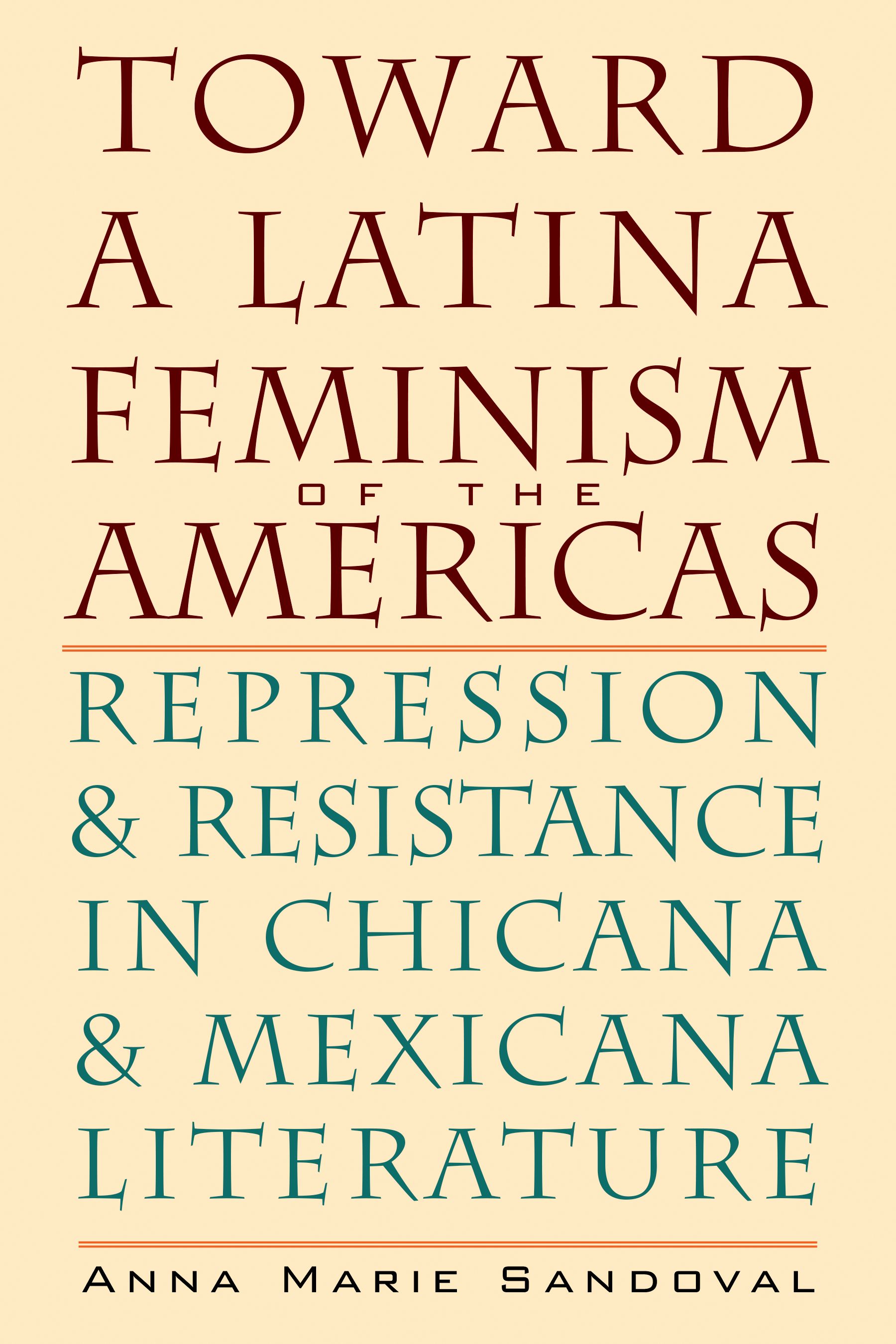
Toward a Latina Feminism of the Americas
Weaving strands of Chicana and Mexicana subjectivities, Toward a Latina Feminism of the Americas explores political and theoretical agendas, particularly those that undermine the patriarchy, across a diverse range of Latina authors. Within this range, calls for a coalition are clear, but questions surrounding the process of these revolutionary dialogues provide important lines of inquiry. Examining the works of authors such as Sandra Cisneros, Laura Esquivel, Carmen Boullosa, and Helena María Viramontes, Anna Sandoval considers resistance to traditional cultural symbols and contemporary efforts to counteract negative representations of womanhood in literature and society. Offering a new perspective on the oppositional nature of Latina writers, Sandoval emphasizes the ways in which national literatures have privileged male authors, whose viewpoint is generally distinct from that of women—a point of departure rarely acknowledged in postcolonial theory. Applying her observations to the disciplinary, historical, and spatial facets of literary production, Sandoval interrogates the boundaries of the Latina experience. Building on the dialogues begun with such works as Sonia Saldivar-Hull's Feminism on the Border and Ellen McCracken's New Latina Narrative, this is a concise yet ambitious comparative approach to the historical and cultural connections (as well as disparities) found in Chicana and Mexicana literature.
eBook


The Latino Body
The Latino Body tells the story of the United States Latino body politic and its relation to the state: how the state configures Latino subjects and how Latino subjects have in turn altered the state. Lázaro Lima charts the interrelated groups that define themselves as Latinos and examines how these groups have responded to calls for unity and nationally shared conceptions of American cultural identity. He contends that their responses, in times of cultural or political crisis, have given rise to profound cultural transformations, enabling the so-called “Latino subject“ to emerge. Analyzing a variety of cultural, literary, artistic, and popular texts from the nineteenth century to the present, Lima dissects the ways in which the Latino body has been imagined, dismembered, and reimagined anew, providing one of the first comprehensive accounts of the construction of Latino cultural identity in the United States.
eBook