
Catalogue Search | MBRL


Are you sure you want to remove the book from the shelf?

{{itemTitle}}
5,721
result(s) for
"Mexico City (Mexico)"
Sort by:

Mexico City
\"Quesadillas sizzling on street corners outside cosy coffee shops; mariachi in sequined sombreros serenading late-night revellers; tower blocks casting long shadows over baroque churches and Aztec ruins studded with cacti. Mexico City simultaneously conforms to every stereotype and challenges every preconception with shameless self-assurance. We push past the colourful chaos and Frida Kahlo merchandise (although, naturally, we drop by her cobalt-blue home) to find the city's tastiest tacos and the retailers breathing new life into classic crafts. We lead you to our favourite mural-splashed buildings and the best places in which to practise your salsa ending up in a dimly lit mezcal bar or two for good measure. There's never been a better time to visit the Mexican capital so dust off your dancing shoes and join the fiesta. âOrale, amigos!\"--Provided by the publisher.
Book

The Death of Aztec Tenochtitlan, the Life of Mexico City
The capital of the Aztec empire, Tenochtitlan, was, in its era, one of the largest cities in the world. Built on an island in the middle of a shallow lake, its population numbered perhaps 150,000, with another 350,000 people in the urban network clustered around the lake shores. In 1521, at the height of Tenochtitlan's power, which extended over much of Central Mexico, Hernando Cortés and his followers conquered the city. Cortés boasted to King Charles V of Spain that Tenochtitlan was \"destroyed and razed to the ground.\" But was it?Drawing on period representations of the city in sculptures, texts, and maps, The Death of Aztec Tenochtitlan, the Life of Mexico City builds a convincing case that this global capital remained, through the sixteenth century, very much an Amerindian city. Barbara E. Mundy foregrounds the role the city's indigenous peoples, the Nahua, played in shaping Mexico City through the construction of permanent architecture and engagement in ceremonial actions. She demonstrates that the Aztec ruling elites, who retained power even after the conquest, were instrumental in building and then rebuilding the city. Mundy shows how the Nahua entered into mutually advantageous alliances with the Franciscans to maintain the city's sacred nodes. She also focuses on the practical and symbolic role of the city's extraordinary waterworks—the product of a massive ecological manipulation begun in the fifteenth century—to reveal how the Nahua struggled to maintain control of water resources in early Mexico City.
eBook


Resurrecting Tenochtitlan
How Mexican artists and intellectuals created a new
identity for modern Mexico City through its ties to Aztec
Tenochtitlan. After archaeologists rediscovered a corner
of the Templo Mayor in 1914, artists, intellectuals, and government
officials attempted to revive Tenochtitlan as an instrument for
reassessing Mexican national identity in the wake of the Revolution
of 1910. What followed was a conceptual excavation of the original
Mexica capital in relation to the transforming urban landscape of
modern Mexico City.
Revolutionary-era scholars took a renewed interest in sixteenth
century maps as they recognized an intersection between
Tenochtitlan and the foundation of a Spanish colonial settlement
directly over it. Meanwhile, Mexico City developed with modern
roads and expanded civic areas as agents of nationalism promoted
concepts like indigenismo, the embrace of Indigenous
cultural expressions. The promotion of artworks and new
architectural projects such as Diego Rivera's Anahuacalli Museum
helped to make real the notion of a modern Tenochtitlan. Employing
archival materials, newspaper reports, and art criticism from 1914
to 1964, Resurrecting Tenochtitlan connects art history
with urban studies to reveal the construction of a complex physical
and cultural layout for Mexico's modern capital.
eBook

Intimate crimes : kidnapping, gangs, and trust in Mexico City
\"... The book ... analyses the effect of kidnapping--and crime more broadly-- on how communities experience [Mexico City] as well as the strategies put in place by potential kidnapping victims to deal with the threat of being victimised by someone close to them, a common occurrence in Mexico City ...\"--Dust jacket.
Book

Photopoetics at Tlatelolco
In the months leading up to the 1968 Olympic games in Mexico City, students took to the streets, calling for greater democratization and decrying crackdowns on political resistance by the ruling PRI party. During a mass meeting held at the Plaza of the Three Cultures in the Tlatelolco neighborhood, paramilitary forces opened fire on the gathering. The death toll from the massacre remains a contested number, ranging from an official count in the dozens to estimates in the hundreds by journalists and scholars. Rereading the legacy of this tragedy through diverse artistic-political interventions across the decades, Photopoetics at Tlatelolco explores the state’s dual repression—both the massacre’s crushing effects on the movement and the manipulation of cultural discourse and political thought in the aftermath. Examining artifacts ranging from documentary photography and testimony to poetry, essays, chronicles, cinema, literary texts, video, and performance, Samuel Steinberg considers the broad photographic and photopoetic nature of modern witnessing as well as the specific elements of light (gunfire, flares, camera flashes) that ultimately defined the massacre. Steinberg also demonstrates the ways in which the labels of “massacre\" and “sacrifice\" inform contemporary perceptions of the state’s blatant and violent repression of unrest. With implications for similar processes throughout the rest of Latin America from the 1960s to the present day, Photopoetics at Tlatelolco provides a powerful new model for understanding the intersection of political history and cultural memory.
eBook

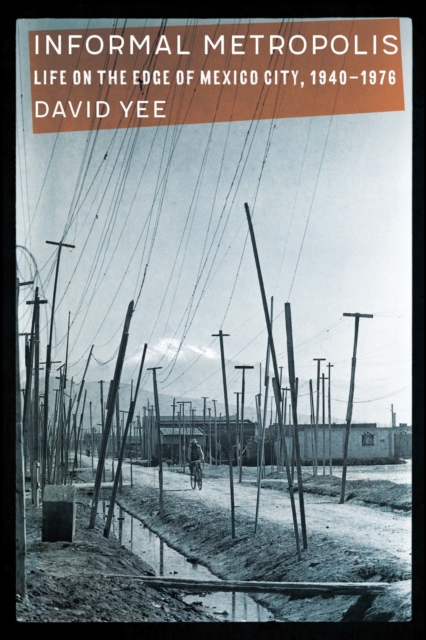
Informal Metropolis
In the 1940s, as Mexican families trekked north to the United
States in search of a better life, tens of millions also left their
towns and villages for Mexico's major cities. In Mexico City
migrant families excluded from new housing programs began to settle
on a dried-out lake bed near the airport, eventually transforming
its dusty plains into an informal city of more than one million
people. In Informal Metropolis David Yee uncovers how this
former lake bed grew into the world's largest shantytown-Ciudad
Nezahualcóyotl-and rethinks the relationship between urban space
and inequality in twentieth-century Mexico. By chronicling the
residents' struggles to build their own homes and gain land rights
in the face of extreme adversity, Yee presents a hidden history of
land fraud, political corruption, and legal impunity underlying the
rise of Mexico City's informal settlements. When urban social
movements erupted across Mexico in the 1970s, Ciudad
Nezahualcóyotl's residents organized to demand land, water, and
humane living conditions. Though guided by demands for basic needs,
these movements would ultimately achieve a more lasting
significance as a precursor to a new urban citizenry in Mexico. In
the first comprehensive history of modern housing in Mexico City,
Yee challenges widely held assumptions about urban inequality and
politics in Mexico.
eBook

City on fire : technology, social change, and the hazards of progress in Mexico City, 1860-1910
\"City on Fire is a chronicle of progress and danger, that integrates urban environmental history with histories of technology, science, and medicine to reveal how Mexico City changed in response to the growing threat of fire in the urban center\"-- Provided by publisher.
Book

Progress Against Poverty: Sustaining Mexico's Progresa-Oportunidades Program
In 1997, Mexico launched a new incentive-based poverty reduction program to enhance the human capital of those living in extreme poverty. This book presents a case study of Progresa-Oportunidades, focusing on the main factors that have contributed to the program's sustainability, policies that have allowed it to operate at the national level, and future challenges.
eBook