
Catalogue Search | MBRL


Are you sure you want to remove the book from the shelf?

{{itemTitle}}
267
result(s) for
"Mexico Fiction."
Sort by:

Backlands : a novel of the American west
Catapulted into early adulthood after the death of an older brother he idolized, eight-year-old Matthew Kerney assumes difficult responsibilities to save the family ranch against a backdrop of the Great Depression and a drought-stricken Tularosa Basin.
Book

Narrating Narcos
Narrating Narcospresents a probing examination of the prominent role of narcotics trafficking in contemporary Latin American cultural production. In her study, Gabriela Polit Dueñas juxtaposes two infamous narco regions, Culiacán, Mexico, and Medellín, Colombia, to demonstrate the powerful forces of violence, corruption, and avarice and their influence over locally based cultural texts.Polit Dueñas provides a theoretical basis for her methods, citing the work of Walter Benjamin, Pierre Bourdieu, and other cultural analysts. She supplements this with extensive ethnographic fieldwork, interviewing artists and writers, their confidants, relatives, and others, and documents their responses to the portrayal of narco culture. Polit Dueñas offers close readings of the characters, language, and milieu of popular works of literature and the visual arts and relates their ethical and thematic undercurrents to real life experiences. In both regions, there are few individuals who have not been personally affected by the narcotics trade. Each region has witnessed corrupt state, police, and paramilitary actors in league with drug capos. Both have a legacy of murder.Polit Dueñas documents how narco culture developed at different times historically in the two regions. In Mexico, drugs have been cultivated and trafficked for over a century, while in Colombia the cocaine trade is a relatively recent development. In Culiacán, characters in narco narratives are often modeled after the serrano (highlander), a romanticized historic figure and sometime thief who nobly defied a corrupt state and its laws. In Medellín, the oft-portrayed sicario (assassin) is a recent creation, an individual recruited by drug lords from poverty stricken shantytowns who would have little economic opportunity otherwise. As Polit Dueñas shows, each character occupies a different place in the psyche of the local populace.Narrating Narcosoffers a unique melding of archival and ground-level research combined with textual analysis. Here, the relationship of writer, subject, and audience becomes clearly evident, and our understanding of the cultural bonds of Latin American drug trafficking is greatly enhanced. As such, this book will be an important resource for students and scholars of Latin American literature, history, culture, and contemporary issues.
eBook

Ismael and his sisters
\"Siblings Ismael, Rosie and Cristina are deaf, and so are many in their Maya village. The deaf and hearing alike communicate in sign language, forming a tightly-knit community with an unsophisticated, simple lifestyle. But when Ismael gets into a fight at the local fiesta and flees the village, leaving Rosie and Cristina to fend for themselves, the daily rhythms of village life are disrupted, and all that they trust in comes under threat. Ismael and His Sisters is a remarkable debut novel from the acclaimed author of Chattering. It conjures up a world set apart, made visceral through its concentrated language, where sign language bridges exterior and interior worlds and gives a physical shape to the way we experience the world. It explores the interplay between the powerful forces within us and the dark elemental forces beyond our control, exposing the 'bottomless, hostile ocean' in which we all flounder. This is an extraordinary novel about the power of familial bonds, the barriers we build out of language, the dark elemental forces that threaten to overwhelm us, and above all, what it is like to be human\" --Publisher's description.
Book

Una ciudad más sucia, más gris, más necia
La ciudad es necia, no pide disculpas.No se las pide a la mujer, pronta a convertirse en otro cadáver citadino, mientras cae desde el piso once de una torre en Polanco, enfrascada en lo que, sin lugar a dudas, son demasiados pensamientos para una caída tan libre. Tampoco se las pide a la niña de nueve años que, sin decirle a nadie, decide dejar de vivir. No quiero morirme, piensa la niña, solo dejar de vivir. Así se escapa, sin que nadie la note, tragada por la ciudad que no se preocupa. Ni a la anciana que intenta protegerse de las avenidas que la oprimen con cobijas y mascadas, confundida entre amores imposibles y conciencia masacrada.
Ni al bloguero/artista conceptual que navega por la vida a través de una pantalla, ni al dueño de un museo, ni al reconocido artista que hace obras que solo él comprende. Menos, a la abuelita que descubre los placeres de ver cuerpos desnudos en su tableta. Tampoco, por supuesto, perdona a Calvo.En ese amor-odio con la ciudad, Calvo se desnuda ante ella sin convencerla. Ni borracha contigo, le insiste la ciudad, necia a pesar de su entusiasmo y evidente necesidad. Si él no la entiende, ella apenas lo tolera. Escudado detrás del güisqui, de sus memorias, de su inocencia, Calvo circula por las calles en el Capre ´77, en el Metrobús y a pata, tratando de esconder sus hallazgos para desenredar el caso de la mujer voladora, arrastrando, como siempre, la sombra de Rocío, su ex mujer de quien vive enamorado. [Texto de la editorial]
eBook


Inquisitor's Diary
A zealous advocate of the Mexican Inquisition forms an unusual bond with a captured heretic and questions his faith.
eBook


The Magic Lantern
José Tomas de Cuéllar (1830-1894) was a Mexican writer noted for his sharp sense of humor and gift for caricature. Having a Ball and Christmas Eve are two novellas written in the costumbrista style, made popular in the mid-nineteenth century by the periodical press in which these sketches of contemporary manners were first published. The stories are a sensitive reflection of the effects of modernization brought by an authoritarian regime dedicated to order and progress. Christmas Eve describes a volatile middle class in which people pursue pleasure and entertainment without regard to morality. Having a Ball depicts women and their dedication to fashion. It is through them that Cuellar examines a society susceptible to foreign values, the importation of which radically altered the face of Mexico and its traditional customs.
eBook

Village : a novel
This rollicking ride through a single day in the ill-fated village of San Marcos will leave you reeling with laughter, even as you cringe at the misadventures of the hapless Porter Clapp and his pitiable wife, Steph; the jaundiced Onesimo Moro and his ever-watchful spouse, Isabel; and the rest of Crawford's riotous cast. At this story's beginning, a meeting notice from the state water agency, posted at the local store, seems to portend an imminent threat to the valleys precious acequias. But perhaps more ominous--at least to the paranoid Clapp--is the possibility of the outside world meddling with the isolation, blissful or not, of this remote Hispanic plaza town. As the time of the meeting looms, we follow the characters through the day and become immersed in a place unnervingly familiar to anyone who has lived in Northern New Mexico. Crawford spares no one from his acerbic wit and skewering prose, yet there remains an unmistakable affection for the marvelously dysfunctional community and the very faults that he so eloquently parodies. As the tale unfolds, we dread the incipient threat from outside the valley less and begin to hope that something will deflect the downward spiral every character seems doomed to follow--but nothing anticipates or prepares us for the denouement that Crawford skillfully delivers, leaving us punch drunk with mirth.
Book
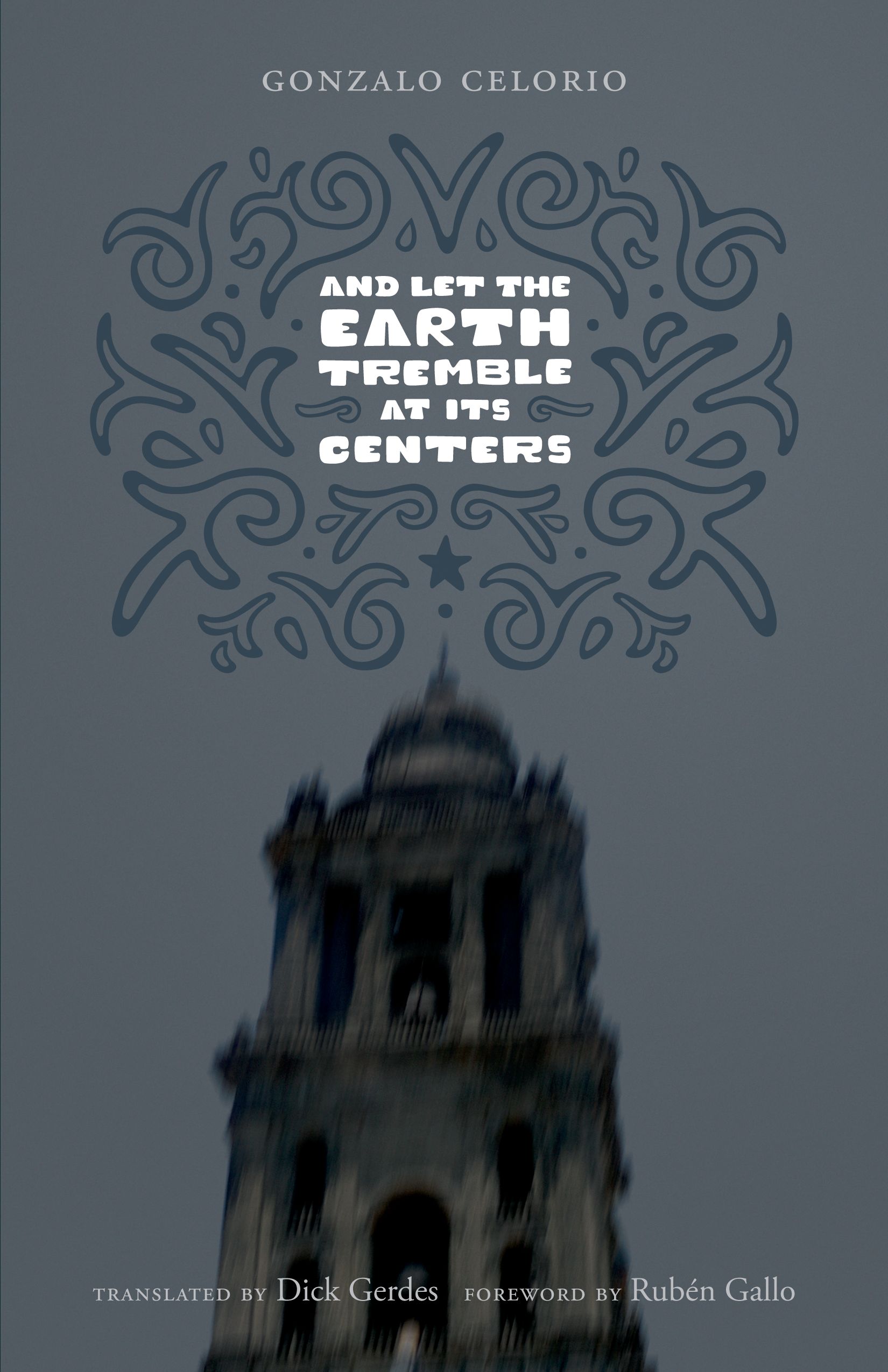
And Let the Earth Tremble at Its Centers
Professor Juan Manuel Barrientos prefers footsteps to footnotes. Fighting a hangover, he manages to keep his appointment to lead a group of students on a walking lecture among the historic buildings of downtown Mexico City. When the students fail to show up, however, he undertakes a solo tour that includes more cantinas than cathedrals. Unable to resist either alcohol itself or the introspection it inspires, Professor Barrientos muddles his personal past with his historic surroundings, setting up an inevitable conclusion in the very center of Mexico City. First published in Mexico in the late 1990s, And Let the Earth Tremble at Its Centers was immediately lauded as a contemporary masterpiece in the long tradition of literary portraits of Mexico City. It is a book worthy of its dramatic title, which is drawn from a line in the Mexican national anthem. Gonzalo Celorio first earned a place among the leading figures of Mexican letters for his scholarship and criticism, and careful readers will recognize a scholar's attention to accuracy within the novel's dyspeptic descriptions of Mexico City. The places described are indeed real (this edition includes a map that marks those visited in the story), though a few have since closed or been put to new uses. Dick Gerdes's elegant translation now preserves them all for a new audience.
eBook