
Catalogue Search | MBRL


Are you sure you want to remove the book from the shelf?

{{itemTitle}}
23,094
result(s) for
"Michael Moore"
Sort by:


Michael Moore and the Rhetoric of Documentary
Not afraid to tackle provocative topics in American culture, from gun violence and labor policies to terrorism and health care, Michael Moore has earned both applause and invective in his career as a documentarian. In such polarizing films as Bowling for Columbine , Fahrenheit 9/11 , and Sicko , Moore has established a unique voice of radical nostalgia for progressivism, and in doing so has become one of the most recognized documentary filmmakers of all time.
In the first in-depth study of Moore’s feature-length documentary films, editors Thomas W. Benson and Brian J. Snee have gathered leading rhetoric scholars to examine the production, rhetorical appeals, and audience reception of these films. Contributors critique the films primarily as modes of public argument and political art. Each essay is devoted to one of Moore’s films and traces in detail how each film invites specific audience responses.
Michael Moore and the Rhetoric of Documentary reveals not only the art, the argument, and the emotional appeals of Moore’s documentaries but also how these films have revolutionized the genre of documentary filmmaking.
eBook

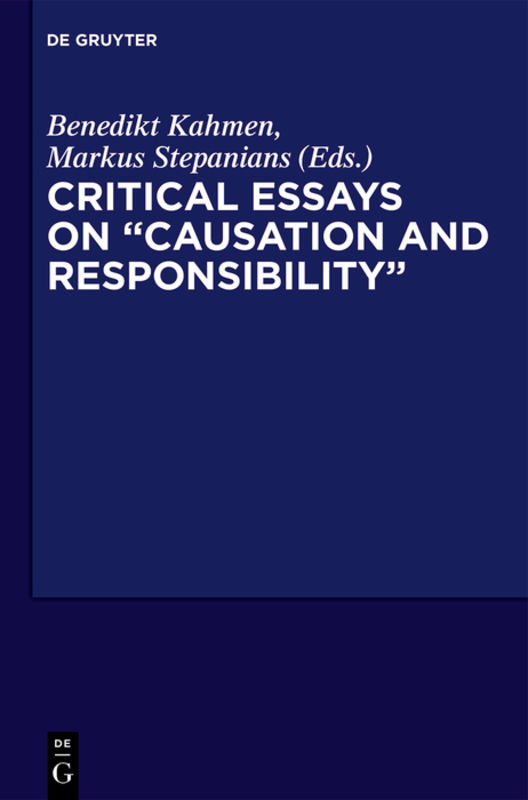
Critical Essays on \Causation and Responsibility\
Due to its scope and depth, Moore's Causation and Responsibility is probably the most important publication in the philosophy of law since the publication of Hart's and Honoré's Causation in the Law in 1959. This volume offers, for the first time, a detailed exchange between legal and philosophical scholars over Moore's most recent work. In particular, it pioneers the dialogue between English-speaking and German philosophy of law on a broad range of pressing foundational questions concerning causation in the law. It thereby fulfills the need for a comprehensive, international and critical discussion of Moore's influential arguments. The 15 contributors to the proposed volume span the whole interdisciplinary field from law and morals to metaphysics, and the authors include distinguished criminal and tort lawyers, as well as prominent theoretical and practical philosophers from four nations. In addition, young researchers take brand-new approaches in the field. The collection is essential reading for anyone interested in legal and moral theory.
eBook

The Price of Knowledge
This essay examines several documentary films, all of which share the same intertextual goal: to critique and ultimately rebut the progressive political ideas found in films directed by Michael Moore. The complete cycle of politically conservative documentaries include Michael & Me (Elder 2004), FahrenHype 9/11 (Peterson 2004), Celsius 41.11 (Knoblock 2004), Michael Moore Hates America (Wilson 2004), and Manufacturing Dissent (Caine & Melnyk 2007).
Journal Article

Causalism Without Causation
Moore’s Mechanical Choices is ripe with interesting ideas. Here I’ll focus on a particularly intriguing one that intersects with some aspects of my own work. It’s the suggestion that causalism should be amended in a way that doesn’t require causation. At first, this suggestion may sound absurd: How can causalism survive without causation, of all things? But I think that Moore is actually right about the main suggestion. I don’t think he’s right for the right reasons, but he’s still right about the main idea. So, the aim of this paper is to explain how causalism can survive without causation, and how it may not.
Journal Article

Persuasion through people: The rhetorical categories of documentary subjects in Michael Moore’s films
Michael Moore’s documentaries have been central to the development of the contemporary political documentary and have served as an instrument of political activism or, as some argue, even propaganda. Delving into the underlying mechanisms, in this article, I examine the ways in which documentary subjects are persuasively deployed in Moore’s documentaries. An analysis combining close reading, qualitative content analysis, and rhetorical analysis points to key rhetorical categories of documentary subjects. These subjects’ embodiment of six main rhetorical categories displays a correlation with Aristotle’s cornerstones of rhetoric: ethos, logos, and pathos. Further, the categories demonstrate how moral emotions are utilised in constructing the ethos of documentary subjects. In addition, the article addresses the significance of identification in Moore’s persuasive rhetoric. This research participates in deconstructing the mechanics of persuasive mediated communication and contributes to outlining a theory of audiovisual rhetoric.
Journal Article


SiCKO
The number of uninsured is approximately 50 million, a record high, while health care expenditures consume approximately 18% of the GDP. Holland has a public/private partnership that involves private insurance companies bidding to provide health care coverage.
Journal Article

Motyw autobiograficzny w filmach Michaela Moore’a
Michael Moore jest nie tylko jednym z najwybitniejszych, ale zarazem jednym z najbardziej kontrowersyjnych współczesnych reżyserów. Styl jego filmów można określić jako „heterogeniczny”, ponieważ są w nich wykorzystywane różnorodne wzorce stylistyczne, takie jak np. właściwe kinu dokumentalnemu tryby wyjaśniający czy uczestniczący. Klejsa analizuje filmy Moore’a, przyjmując założenie, że do dokumentów tych reżyser wplótł wątki autobiograficzne. Na poparcie tej tezy autor podejmuje się opisu zarówno wizualnych, jak i dźwiękowych aspektów filmów Moore’a. Przede wszystkim zwraca uwagę na zastosowanie narracji voice-over w wariancie pierwszoosobowym, co należy uznać za kluczowy element filmowego stylu Moore’a. Klejsa podkreśla także, że sceny zawierające materiały z rodzinnego archiwum reżysera (filmy i zdjęcia) budują silny autobiograficzny kontekst. W zakończeniu autor podejmuje kwestię autobiograficznych strategii kreowania statusu reżysera jako gwiazdy we współczesnym pejzażu medialnym.
Journal Article