
Catalogue Search | MBRL


Are you sure you want to remove the book from the shelf?

{{itemTitle}}
284
result(s) for
"Michael Oakeshott"
Sort by:

The Cambridge companion to Oakeshott
\"Michael Oakeshott (1901-1990) was one of the leading British philosophers of the twentieth century. He has been influential particularly as a political philosopher, but his work reflects a range of philosophical interests that have more gradually come to be appreciated. In this volume a broad group of scholars offers a comprehensive overview of Oakeshott's philosophy, including his moral and political philosophy, his philosophy of history, science and aesthetics, and his views on the role of education. They analyse Oakeshott's ideas in different intellectual contexts and assess his overall contribution to twentieth-century thought. Accessible and rich with new scholarly material, this volume will be an excellent guide for students and scholars alike\"-- Provided by publisher.
Book

A Companion to Michael Oakeshott
Michael Oakeshott has long been recognized as one of the most important political philosophers of the twentieth century, but until now no single volume has been able to examine all the facets of his wide-ranging philosophy with sufficient depth, expertise, and authority. The essays collected here cover all aspects of Oakeshott’s thought, from his theory of knowledge and philosophies of history, religion, art, and education to his reflections on morality, politics, and law. The volume provides an authoritative and synoptic guide to one of the most important philosophers of the twentieth century. Aside from the editors, the contributors are Corey Abel, David Boucher, Elizabeth Corey, Robert Devigne, Timothy Fuller, Steven Gerencser, Robert Grant, Noel Malcolm, Kenneth McIntyre, Kenneth Minogue, Noël O’Sullivan, Geoffrey Thomas, and Martyn Thompson.
eBook

Michael Oakeshott's political philosophy of international relations : civil association and international society
The book argues that Michael Okeshott's political philosophy contributes to current debates in normative international theory and international political theory on the historical, social, and moral dimension of international society. Davide Orsi contends that the theory of civil association may be the ground for an understanding of international society as a rule-based form of moral association constituted by customary international law. The book also considers the role of evolving practices of morality in debates on international justice. Orsi grounds this work on a study of Oakeshott's philosophical arguments and compares the Oakeshottian perspective to recent constructivist literature in International Relations.
Book

The Meanings of Michael Oakeshott's Conservatism
This collection of recent scholarship on the thought of Michael Oakeshott includes essays by both distinguished and established authors as well as a fresh crop of younger talent. Together, they address the meanings of Oakeshott's conservatism through the lenses of his ideas on religion, history, and tradition, and explore his relationships to philosophers ranging from Hume to Ryle, Cavell, and others. The collection assigns no single or final meaning to Oakeshott's conservatism, but finds in him a number of possibilities for thinking fruitfully about what conservatism might mean, when it is no longer considered as a doctrine, but as a habit or a turn of mind.
eBook


The democratic theory of Michael Oakeshott : discourse, contingency, and \the politics of conversation\
his book offers a description, explanation, and evaluation of Michael Oakeshott's democratic theory. He was not a democratic theorist as such, but as a twentieth-century English political theorist for whom liberal theory held deep importance, his thought often engaged democratic theory implicitly, and many times did so explicitly. The author's project penetrates two renewals. The first is the revitalization of interest in Oakeshott, and the second is the renewal of democratic theory which began in the 1980s. In respect to this latter renewal, the book engages the deliberative turn in democratic theory. These revivals create the context for this new look at Oakeshott. To state the matter as a problem, one might say that in light of new and fecund democratic theory, it is a problem for political theory if one of the most important political theorists of the twentieth century is left out of the discourse insofar as he has something relevant to say about deliberative democracy. It is o.
eBook

Education and conversation : exploring Oakeshott's legacy
\"Since Michael Oakeshott spoke of education as initiation into \"the conversation of mankind\" more than fifty years ago, the idea has inspired a diverse array of thinkers and continues to be invoked today by those seeking to resist the influence of managerialism and narrow instrumentalism in educational policy and practice. Education and Conversation draws together papers written by scholars from both the analytic and continental philosophical traditions to offer a variety of perspectives on the implications of Oakeshott's educational ideas. The metaphor of the conversation of mankind is explored, together with the roots of Oakeshott's thinking in his early philosophical work, the relevance of his ideas to the concept of Bildung, and the significance of his political conservatism in evaluating the seemingly progressive potential of his educational ideas. In addition, concepts prominent in Oakeshott's thought are taken up and brought to bear on contemporary philosophical discussions about education, learning and development, including the nature of initiation, the phenomenology of listening, and the value of the liberal arts tradition. Education and Conversation shows how the idea of conversation illuminates both the character and the ends of education, yielding insight into the scope and limits of the philosophy of education and the character of philosophical inquiry more generally\"-- Provided by publisher.
Book
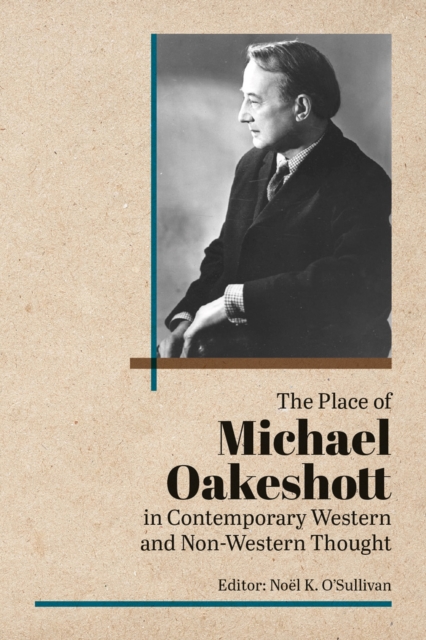
The Place of Michael Oakeshott in Contemporary Western and Non-Western Thought
The continuing growth of worldwide interest in Michael Oakeshott's philosophy and political theory has recently (2016) been marked by the publication of two 'Companion to Oakeshott' volumes. This event provides a welcome opportunity to explore the reasons for his influence both within the West and beyond it.Essays by contributors from Britain, Canada, Hong Kong, India, and the USA provide a comprehensive critical assessment of the principal aspects of Oakeshott's thought that account for his contemporary relevance.The unusually multi-national background of the authors aims to give the volume a wide appeal, extending not only to those already familiar with Oakeshott's writings but also to those as yet unfamiliar with them, regardless of their cultural background.All the contributors have attempted to write in a way that makes Oakeshott as accessible as possible.
eBook


Faces of Moderation
Aristotle listed moderation as one of the moral virtues. He also defined virtue as the mean between extremes, implying that moderation plays a vital role in all forms of moral excellence. But moderation's protean character—its vague and ill-defined omnipresence in judgment and action—makes it exceedingly difficult to grasp theoretically. At the same time, moderation seems to be the foundation of many contemporary democratic political regimes, because the competition between parties cannot properly function without compromise and bargaining. The success of representative government and its institutions depends to a great extent on the virtue of moderation, yet the latter persists in being absent from both the conceptual discourse of many political philosophers and the campaign speeches of politicians fearful of losing elections if they are perceived as moderates.Aurelian Craiutu aims to resolve this paradox. Examining the writings of prominent twentieth-century thinkers such as Raymond Aron, Isaiah Berlin, Norberto Bobbio, Michael Oakeshott, and Adam Michnik, he addresses the following questions: What does it mean to be a moderate voice in political and public life? What are the virtues and limits of moderation? Can moderation be the foundation for a successful platform or party? Though critics maintain that moderation is merely a matter of background and personal temperament, Craiutu finds several basic norms that have consistently appeared in different national and political contexts. The authors studied in this book defended pluralism of ideas, interests, and social forces, and sought to achieve a sound balance between them through political trimming. They shared a preoccupation with political evil and human dignity, but refused to see the world in Manichaean terms that divide it neatly into the forces of light and those of darkness. Faces of Moderation argues that moderation remains crucial for today's encounters with new forms of extremism and fundamentalism across the world.
eBook