
Catalogue Search | MBRL


Are you sure you want to remove the book from the shelf?

{{itemTitle}}
4
result(s) for
"Microfinance Mediterranean Region."
Sort by:

Microcredit guarantee funds in the Mediterranean : a comparative analysis
\"Microfinance/microcredit today is facing two challenges. Firstly, it needs be more economically and financially sustainable. Secondly, it needs to increase its outreach in order to have a more significant impact on poorer areas of the world. Access to credit for the poorest people is a trade-off between economic and financial sustainability and the spread of activity. Greater innovation in processes and products is required in order to reduce transactional costs and informational asymmetries, extend the term structure of contracts and provide suitable assessment and risk management in the microfinance sector. This book offers a comprehensive comparative analysis of the most significant models of microcredit guarantee funds adopted in three South European countries (Italy, France, Spain) and in three North African countries (Morocco, Tunisia, Egypt). It provides a clear picture of microcredit guarantee funds in each country, focusing on three keys areas: analysis of the regulatory framework, mapping of microcredit institutions and analysis of the main features of guarantee funds. The authors highlight the strengths and weaknesses of the microcredit guarantee system and provide regulatory or operative solutions which may improve the economic sustainability of microcredit institutions and, ultimately, contribute to facilitating access to credit for microenterprises and the microborrower. The book will be a valuable resource for supervisors, microcredit institutions, guarantee intermediaries and financial intermediaries\"-- Provided by publisher.
Book
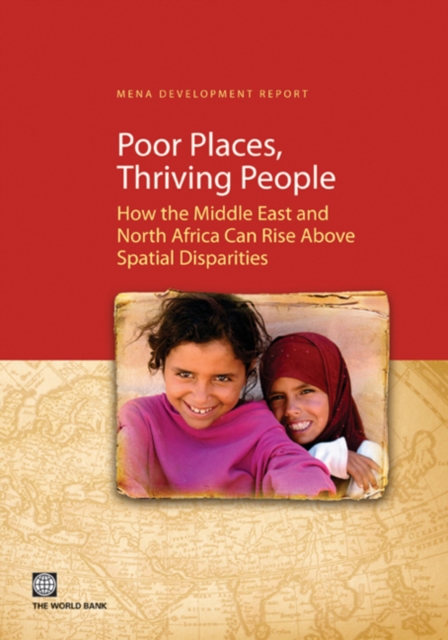
Poor places, thriving people : how the Middle East and North Africa can rise above spatial disparities
The main messages of poor places, thriving people: how the Middle East and North Africa can rise above spatial disparities can be summarized in four words: people, connections, clusters, and institutions. This report shows how smart investments and policies in transport can connect poor places to the dynamic economies of their rich neighbors. There is also a wide open field of opportunity for telecommunications to bring electronic proximity to lagging areas. Many countries have spent huge sums on subsidies to entice investors to lagging areas-usually without any sustainable impact. This report recommends that governments turn their efforts toward the new approach to local economic development, which is gaining ground around the world, and is based on economic clusters, local competitive advantage, private initiative, and public-private dialogue. The report describes the state-of-play in territorial planning, public financial management, targeted programs, deconcentration, and decentralization, and it sketches some emerging lessons. This report combines the insights of specialists in the majority of the World Bank's key sectors: agriculture, development economics, education, health, poverty analysis, social protection, and transport. It is the report's modest aim, if not to offer a single formula for reducing spatial disparities, at least to propose a range of policy options that the region's leaders can reflect on in the light of their national objectives.
eBook

Women and Microfinance in Mediterranean Countries
Marcella Corsi and her co-workers analyze the social and economic impact that microfinance programmes have on participant's lives, particularly on women in the Mediterranean countries. They identify the changes of the women who took part in the microcredit programme. They examine the consumption levels, savings, housing conditions and investigate using an index of the changes whether the microcredit programme did indeed bring about women empowerment.
Journal Article

Some Principles for Development of Statistics for a Gulf Cooperation Council Currency Union
Looking ahead to the creation of a Gulf Cooperation Council (GCC) Currency Union in 2010, the paper covers some implications for the statistical programs of the GCC countries. Despite uncertainty over the structure of the proposed union, the paper envisions several types of mutually reinforcing statistics-convergence criteria, statistics on the core policy variables and instruments, additional macroeconomic data, specialized statistics related to the economic and institutional conditions within the union, and public information. Major changes to national statistical programs are needed that should begin soon.
eBook