
Catalogue Search | MBRL


Are you sure you want to remove the book from the shelf?

{{itemTitle}}
473
result(s) for
"Middle East Study and teaching."
Sort by:
Middle East studies after September 11 : neo-orientalism, American hegemony and academia
Middle East Studies after September 11: Neo-Orientalism, American Hegemony and Academia will show the long-term implications of current approaches to Middle East scholarship on the internal transformation of Middle Eastern societies. It describes the complex relationship between American academia and state government: a relationship which has influenced and restructured the state, society and politics in the Middle East as well as in the United States. It engages the disciplines of Sociology, Political Science, Anthropology, History and International Studies, while maintaining the epistemological, methodological, and ontological insights of a sociological approach to the Middle East.
Book

Contending Visions of the Middle East
Zachary Lockman's book offers a broad survey of the development of Western knowledge about Islam and the Middle East. Beginning with ancient Greek and Roman conceptions of the world, the book goes on to discuss European ideas about Islam from its emergence in the seventh century, with particular attention to the age of European imperialism, the era of deepening American involvement in this region, and the aftermath of the 9/11 terrorist attacks. Along the way, Lockman explores how scholars and others in the West have studied and depicted Islam and the Middle East, focusing on the politics and controversies that have shaped Middle East studies in the United States over the past half century, including the debates over Said's influential critique, Orientalism. This book relates many of today's critical issues, including Muslim extremism, terrorism and United States policy in the Middle East, to the broader historical and political contexts.
eBook

Emerging Scholarship on the Middle East and Central Asia
Emerging Scholarship on the Middle East and Central Asia: Moving from the Periphery provides fresh analysis and cutting-edge critique of phenomena and events across the region. Working out of diverse disciplinary traditions, the authors call on varied theoretical frameworks in order to challenge entrenched stereotypes and long-standing perspectives. This volume explores emerging directions in scholarship across a range of issues, including: the Gulf; Saudi strategizing; Afghan refugees in the Islamic Republic of Iran; contemporary Turkish politics; the current Syrian conflict; Middle Eastern and Central Asian art; perceptions of security threats from Afghanistan; and the potential future role of China in the region. The authors in this volume have given wide-berth to dominant approaches to scholarship on the region, while grappling with overlooked issues and marginal populations in order to advance new frameworks. On the Periphery deserves a central place in future scholarly engagement with the Middle East and Central Asia.
eBook

Routledge handbook of Middle East politics : interdisciplinary inscriptions
\"Drawing on various perspectives and analysis, the Handbook problematizes Middle East politics through an interdisciplinary prism, seeking a melioristic account of the field. Thematically organized, the chapters address political, social and historical questions by showcasing both theoretical and empirical insights, all of which are represented in a style that ease readers into sophisticated induction in the Middle East. It positions the didactic at the centre of inquiry. Contributions by forty-four scholars, both veterans and newcomers, rethink knowledge frames, conceptual categories, and fieldwork praxis. Substantive themes include secularity and religion, gender, democracy, authoritarianism, and new \"borderline\" politics of the Middle East. Like any field of knowledge, the Middle East is constituted by texts, authors and readers, but also by the cultural, spatial and temporal contexts within which diverse intellectual inflections help construct (write - speak) academic meaning, knowing and practice. By denaturalizing notions of singularity of authorship or scholarship, the Handbook plants a diologic interplay animated by multi-vocality, multimodality, and multi-disciplinarity. Targeting graduate students and young scholars of political and social sciences, the Handbook is significant for understanding how the Middle East is written and re-written, read and re-read (epistemology, methodology), and for how it comes to exist (ontology)\"-- Provided by publisher.
Book

Routledge Handbook of Middle East Politics
Drawing on various perspectives and analysis, the Handbook problematizes Middle East politics through an interdisciplinary prism, seeking a melioristic account of the field. Thematically organized, the chapters address political, social, and historical questions by showcasing both theoretical and empirical insights, all of which are represented in a style that ease readers into sophisticated induction in the Middle East.
It positions the didactic at the centre of inquiry. Contributions by forty-four scholars, both veterans and newcomers, rethink knowledge frames, conceptual categories, and fieldwork praxis. Substantive themes include secularity and religion, gender, democracy, authoritarianism, and new \"borderline\" politics of the Middle East. Like any field of knowledge, the Middle East is constituted by texts, authors, and readers, but also by the cultural, spatial, and temporal contexts within which diverse intellectual inflections help construct (write-speak) academic meaning, knowing, and practice. By denaturalizing notions of singularity of authorship or scholarship, the Handbook plants a dialogic interplay animated by multi-vocality, multi-modality, and multi-disciplinarity.
Targeting graduate students and young scholars of political and social sciences, the Handbook is significant for understanding how the Middle East is written and re-written, read and re-read (epistemology, methodology), and for how it comes to exist (ontology).
eBook

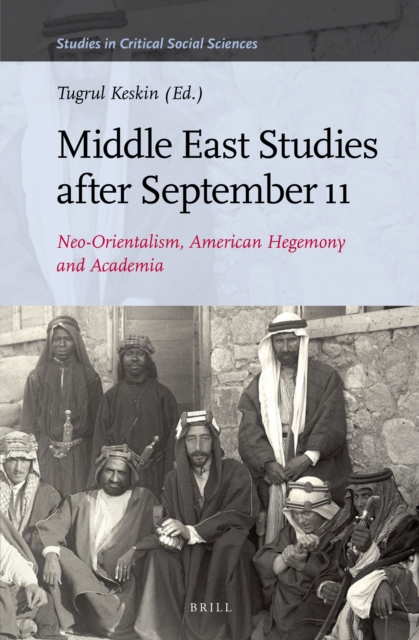
Middle East Studies after September 11
Middle East Studies after September 11: Neo-Orientalism, American Hegemony and Academia describes the complex relationship between American academia and state government: a relationship which has influenced and restructured the state, society and politics in the Middle East as well as in the United States.
eBook

Perspectives on the History of Ancient near Eastern Studies
The present volume collects eighteen essays exploring the history of ancient Near Eastern studies. Combining diverse approaches—synthetic and analytic, diachronic and transnational—this collection offers critical reflections on the who, why, and how of this cluster of fields. How have political contexts determined the conduct of research? How do academic agendas reflect larger social, economic, and cultural interests? How have schools of thought and intellectual traditions configured, and sometimes predetermined, the study of the ancient Near East? Contributions treating research during the Nazi and fascist periods examine the interpenetration of academic work with politics, while contributions dealing with specific national contexts disclose fresh perspectives on individual scholars as well as the conditions and institutions in which they worked. Particular attention is given to scholarship in countries such as Turkey, Portugal, Iran, China, and Spain, which have hitherto been marginal to historiographic accounts of ancient Near Eastern studies.In addition to the editors, the contributors are Selim Ferru Adali, Silvia Alaura, Isabel Almeida, Petr Charvát, Parsa Daneshmand, Eva von Dassow, Hakan Erol, Sebastian Fink, Jakob Flygare, Pietro Giammellaro, Carlos Gonçalves, Katrien de Graef, Steven W. Holloway, Ahmed Fatima Kzzo, Changyu Liu, Patrick Maxime Michel, Emanuel Pfoh, Jitka Sýkorová, Luděk Vacín, and Jordi Vidal.
eBook