
Catalogue Search | MBRL


Are you sure you want to remove the book from the shelf?

{{itemTitle}}
6,165
result(s) for
"Middle English literature"
Sort by:

Opening up Middle English manuscripts : literary and visual approaches
\"This deeply informed and lavishly illustrated book is a comprehensive introduction to the modern study of Middle English manuscripts. It is intended for students and scholars who are familiar with some of the major Middle English literary works, such as The Canterbury Tales, Gawain and the Green Knight, Piers Plowman, and the romances, mystical works or cycle plays, but who may not know much about the surviving manuscripts. The book approaches these texts in a way that takes into account the whole manuscript or codex--its textual and visual contents, physical state, readership, and cultural history. Opening Up Middle English Manuscripts also explores the function of illustrations in fashioning audience response to particular authors and their texts over the course of the fourteenth and fifteenth centuries.\"--Publisher's website.
Book

The politics of Middle English parables
The politics of Middle English parables examines the dynamic intersection of fiction, theology, and social practice in translated Gospel stories. Parables occupy a prominent place in Middle English literature, appearing in dream visions and story collections as well as in lives of Christ and devotional treatises. While most scholarship approaches these scriptural stories as stable vehicles of Christian teachings, this book characterises Gospel parables as ambiguous, riddling stories that invited audience interpretation and inspired the construction of new, culturally inflected narratives. In parables related to labour, social inequality, charity, and penance, the book locates a creative theological discourse through which writers reconstructed scriptural stories and, in doing so, attempted to shape Christian belief and practice. Analysis of these diverse retellings reveals not what a given parable meant in a definitive sense but rather how Middle English parables inscribe the ideologies, power structures, and cultural debates of late medieval Christianity.
eBook

The Cambridge companion to Medieval English law and literature
Despite an unprecedented level of interest in the interaction between law and literature over the past two decades, readers have had no accessible introduction to this rich engagement in medieval and early Tudor England. The Cambridge Companion to Medieval English Law and Literature addresses this need by combining an authoritative guide through the bewildering maze of medieval law with concise examples illustrating how the law infiltrated literary texts during this period. Foundational chapters written by leading specialists in legal history prepare readers to be guided by noted literary scholars through unexpected conversations with the law found in numerous medieval texts, including major works by Chaucer, Langland, Gower, and Malory. Part I contains detailed introductions to legal concepts, practices and institutions in medieval England, and Part II covers medieval texts and authors whose verse and prose can be understood as engaging with the law.
Book
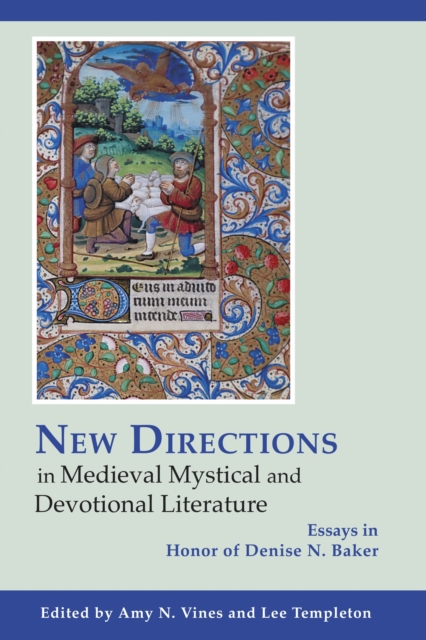
New Directions in Medieval Mystical and Devotional Literature
In pursuing how fourteenth-century English texts engage with philosophical, intellectual, and theological questions, the work of Denise N. Baker has powerfully shaped the field of medieval studies. This collection honors Baker's legacy as a scholar and teacher by taking a fresh approach to the most salient literary, mystical, and devotional works written in late medieval England. The contributors examine a variety of foundational texts ranging from Piers Plowman and The Canterbury Tales to The Cloud of Unknowing and Julian of Norwich's Showings. Their analyses offer new insights into medieval literature and culture by examining the intricacies of vice and virtue, the connections between gender and literary form, and the ethical potential of social formations. Additionally, the volume attests to the wider influence of fourteenth-century literature. Not only do the contributors explore how medieval writers make their own claims of memorialization, but they also analyze later iterations of Middle English writing in the context of nineteenth- and twentieth-century print culture. Featuring chapters by both early scholars and those at the later stages of their careers, this volume celebrates the impact of Baker's scholarship over the past four decades. At the same time, this book offers an incisive inquiry into many of the most debated issues and texts in studies of late medieval England.
eBook


Animal Encounters
Traces of the living animal run across the entire corpus of medieval writing and reveal how pervasively animals mattered in medieval thought and practice. In fascinating scenes of cross-species encounters, a raven offers St. Cuthbert a lump of lard that waterproofs his visitors' boots for a whole year, a scholar finds inspiration for his studies in his cat's perfect focus on killing mice, and a dispossessed knight wins back his heritage only to give it up again in order to save the life of his warhorse. Readers have often taken such encounters to be merely figurative or fanciful, but Susan Crane discovers that these scenes of interaction are firmly grounded in the intimate cohabitation with animals that characterized every medieval milieu from palace to village. The animal encounters of medieval literature reveal their full meaning only when we recover the living animal's place within the written animal.The grip of a certain humanism was strong in medieval Britain, as it is today: the humanism that conceives animals in diametrical opposition to humankind. Yet medieval writing was far from univocal in this regard. Latin and vernacular works abound in other ways of thinking about animals that invite the saint, the scholar, and the knight to explore how bodies and minds interpenetrate across species lines. Crane brings these other ways of thinking to light in her readings of the beast fable, the hunting treatise, the saint's life, the bestiary, and other genres. Her substantial contribution to the field of animal studies investigates how animals and people interact in culture making, how conceiving the animal is integral to conceiving the human, and how cross-species encounters transform both their animal and their human participants.
eBook

The Texts and Contexts of Oxford, Bodleian Library, MS Laud Misc. 108
This book serves as the essential companion to the late thirteenth-century, Middle English manuscript, Oxford, Bodleian Library, MS Laud Misc. 108. It marks a collaborative effort by scholars who investigate the codicological and contextual features of this manuscript's vernacular poems.
eBook


Sovereign Fantasies
During and after the Hundred Years War, English rulers struggled with a host of dynastic difficulties, including problems of royal succession, volatile relations with their French cousins, and the consolidation of their colonial ambitions toward the areas of Wales and Scotland. Patricia Ingham brings these precarious historical positions to bear on readings of Arthurian literature in Sovereign Fantasies, a provocative work deeply engaged with postcolonial and gender theory.Ingham argues that late medieval English Arthurian romance has broad cultural ambitions, offering a fantasy of insular union as an \"imagined community\" of British sovereignty. The Arthurian legends offer a means to explore England's historical indebtedness to and intimacies with Celtic culture, allowing nobles to repudiate their dynastic ties to France and claim themselves heirs to an insular heritage. Yet these traditions also provided a means to critique English conquest, elaborating the problems of centralized sovereignty and the suffering produced by chivalric culture. Texts such as Sir Gawain and the Green Knight, the Alliterative Morte Arthure, and Caxton's edition of Malory's Morte Darthur provide what she terms a \"sovereign fantasy\" for Britain. That is, Arthurian romance offers a cultural means to explore broad political contestations over British identity and heritage while also detailing the poignant complications and losses that belonging to such a community poses to particular regions and subjects. These contestations and complications emerge in exactly those aspects of the tales usually read as fantasy-for example, in the narratives of Arthur's losses, in the prophecies of his return, and in tales that dwell on death, exotic strangeness, uncanny magic, gender, and sexuality.Ingham's study suggests the nuances of the insular identity that is emphasized in this body of literature. Sovereign Fantasies shows the significance, rather than the irrelevance, of medieval dynastic motifs to projects of national unification, arguing that medieval studies can contribute to our understanding of national formations in part by marking the losses produced by union.
eBook