
Catalogue Search | MBRL


Are you sure you want to remove the book from the shelf?

{{itemTitle}}
25
result(s) for
"Middle class Rome."
Sort by:

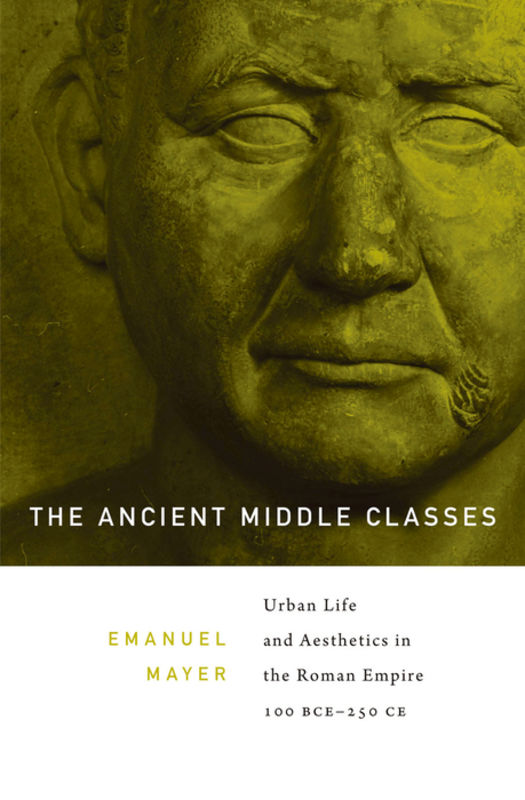
The ancient middle classes : urban life and aesthetics in the Roman Empire, 100 BCE-250 CE
Our image of the Roman world is shaped by the writings of upper-class intellectuals. Yet most of the material evidence we have--art, architecture, household artifacts--belonged to artisans, merchants, and professionals. Roman culture as we have seen it with our own eyes is distinctly middle-class and requires a radically new framework of analysis.
eBook

The Ancient Middle Classes
Our image of the Roman world is shaped by the writings of Roman statesmen and upper class intellectuals. Yet most of the material evidence we have from Roman times—art, architecture, and household artifacts from Pompeii and elsewhere—belonged to, and was made for, artisans, merchants, and professionals. Roman culture as we have seen it with our own eyes, Emanuel Mayer boldly argues, turns out to be distinctly middle class and requires a radically new framework of analysis. Starting in the first century bce, ancient communities, largely shaped by farmers living within city walls, were transformed into vibrant urban centers where wealth could be quickly acquired through commercial success. From 100 bce to 250 ce, the archaeological record details the growth of a cosmopolitan empire and a prosperous new class rising along with it. Not as keen as statesmen and intellectuals to show off their status and refinement, members of this new middle class found novel ways to create pleasure and meaning. In the décor of their houses and tombs, Mayer finds evidence that middle-class Romans took pride in their work and commemorated familial love and affection in ways that departed from the tastes and practices of social elites.
eBook

Exploring the relationship between irritable bowel syndrome and psychosocial, demographic, and health factors in Syrian hospital settings
Background
Irritable bowel syndrome (IBS) is a prevalent and complex gastrointestinal disorder that profoundly affects patients’ quality of life. This study, the first of its kind in Syria, explores the intricate relationship between IBS and demographic factors, with a focus on gender, age, socioeconomic status, the presence of chronic diseases, and psychological status.
Methods
A cross-sectional study of 562 participants was conducted in Damascus to investigate the prevalence of IBS and its association with psychological distress. Participants were assessed using a structured questionnaire that collected data on demographic factors, chronic diseases, and psychological distress. Statistical analysis, including chi-square, t-tests and one-way Anova, were performed to identify associations between these factors and IBS prevalence.
Results
The results revealed a higher prevalence of IBS among females and participants aged 40–50. Socioeconomic status was found to play a significant role, with lower income levels correlating with a higher likelihood of IBS. Furthermore, participants with chronic diseases exhibited an elevated likelihood for IBS, emphasizing the importance of considering comorbidities in IBS management. IBS was strongly associated with psychological distress, with a higher prevalence of depression and distress among participants with IBS. Weight was also associated with IBS, with a higher BMI linked to an increased likelihood of the condition.
Conclusion
This study highlights the multifaceted nature of IBS, and underscores the need for a comprehensive approach that integrates the physical and psychological aspects of its assessment and management. While this research provides valuable insights, it also acknowledges its limitations and calls for further investigation to elucidate the underlying mechanisms of these associations and develop tailored interventions for participants with IBS.
Journal Article

Dynamics, experiences and political meaning of the black market in Second World War Italy
Rationing and illegal food trade in Second World War Italy have received very little scholarly attention in comparison to the scale and impact they had on people's daily life. This article contributes to filling this gap, first by providing an overview of the dynamics that already in the early years of the war determined the development of an illegal system of food trade. It then considers the experience of the black market through two wartime diaries, one published and the other unpublished, written by women of opposite political views, both living in Rome and its outskirts. The analysis of the diaries considers women's attitudes towards the black market. The article argues that the Fascist propaganda of duty to the homeland, so intensively practised through domestic literature during the 1920s and 1930s, was again exploited in wartime in the discourse around the black market and hid the political responsibilities of the government.
Journal Article

Migrant Filipina Domestic Workers and the International Division of Reproductive Labor
This article examines the politics of reproductive labor in globalization. Using the case of migrant Filipina domestic workers, the author presents the formation of a three-tier transfer of reproductive labor in globalization between the following groups of women: (1) middle-class women in receiving nations, (2) migrant domestic workers, and (3) Third World women who are too poor to migrate. The formation of this international division of labor suggests that reproduction activities, as they have been increasingly commodified, have to be situated in the context of the global market economy. This division of labor is a structural process that determines the migration of Filipina domestic workers. As such, this article also uses in-depth interviews to examine and enumerate the contradictions that migrant Filipina domestic workers experience in their family and work lives as a result of \"being in the middle\" of this division of labor.
Journal Article

The Ancient Middle Classes
Our image of the Roman world is shaped by the writings of upper-class intellectuals. Yet most of the material evidence we have—art, architecture, household artifacts—belonged to artisans, merchants, and professionals. Roman culture as we have seen it with our own eyes is distinctly middle-class and requires a radically new framework of analysis.
eBook

Traveling via Rome through the Stereoscope: Reality, Memory, and Virtual Travel
Underwood and Underwood’s Rome through the Stereoscope of 1902 was a landmark in stereoscopic photography publishing, both as an intense, visually immersive experience and as a cognitively demanding exercise. The set consisted of a guidebook, forty-six stereographs, and five maps whose notations enabled the reader/viewer to precisely replicate the location and orientation of the photographer at each site. Combined with the extensive narrative within the guidebook, the maps and images guided its users through the city via forty-six sites, whether as an example of armchair travel or an actual travel companion. The user’s experience is examined and analyzed within the following parameters: the medium of stereoscopic photography, narrative, geographical imagination, and memory, bringing forth issues of movement, survey and route frames of reference, orientation, visualization, immersion, and primary versus secondary memories. Rome through the Stereoscope was an example of virtual travel, and the process of fusing dual images into one — stereoscopic synthesis — further demarcated the experience as a virtual environment.
Journal Article

Making Meaning of Everyday Practices: Parents' Attitudes toward Children's Extracurricular Activities in the United States and in Italy
This article focuses on children's engagement in extracurricular activities from the perspective of middle-class parents in Rome, Italy, and Los Angeles, California. Analysis of parents' accounts captured in interviews and ethnographic fieldzvork reveals that both sets of parents perceive activities as important for children's success. Yet Roman parents consider activities as part of \"children's world,\" downplaying intense involvement and performance. Conversely, L.A. parents view activities as preparing children for adult life, emphasizing competition and accomplishment.
Journal Article