
Catalogue Search | MBRL


Are you sure you want to remove the book from the shelf?

{{itemTitle}}
82,168
result(s) for
"Middle management"
Sort by:

Handbook of human resource management in the Middle East
\"The Handbook of Human Resource Management in the Middle East provides evidence-based information regarding the dynamics of human resource management (HRM) in this important region. This systematic analysis highlights the main forces determining HRM systems in the region. Its 23 chapters move from a general overview of HRM in the Middle East to a research-based presentation and discussion of the current status, role and strategic importance of the HR function in a wide range of settings, before highlighting emerging themes in HRM models and discussing future challenges for research, policy and practice. This book is invaluable reading for academics and students alike, especially those interested in international and comparative human resource management. Practitioners with interest in the Middle East will appreciate its up-to-date analysis and contextualisation of HRM issues.\"--Back cover.
Book

An exploration of changes in the mental models of middle management and their association with activities to implement a dialogue tool to address mental health in the workplace
Background
There is a growing awareness for addressing mental health in the workplace. Although interventions to promote mental health at the organizational-level exist, implementation is a challenge. Middle management can play a crucial role in implementing organisational-level interventions. Also, we know that mental models often need to change first, before enactment of such interventions occur. The aim of this study is therefore to better understand whether and how changes in mental models of middle managers are associated with the implementation activities of an organisational-level intervention to support mental health. Ultimately, this is meant to lead to the enactment of, in this case, a dialogue tool to normalize a conversation between middle manager and employee to enhance mental health.
Methods
Participatory Action Research was used as a method to design our implementation of a dialogue tool primarily focused on middle management to address mental in health in one SME company with 238 employees. In-depth interviews with 11 (middle) managers at the start of the implementation phase were held. After nine months, 9 out of the same 11 (middle) managers were interviewed again to gain understanding whether and how changes occurred during the implementation. Thematic analysis was applied to the interviews, from inductive and deductive perspective. Focus groups with employees and observations during the implementation activities were used for triangulation purposes.
Results
The mental models of the (middle) managers were analyzed based on readiness for change, perceived challenges and perceived opportunities. These mental models were generally positive towards the project, despite the low trust towards the Top Management and the general lack of experience with addressing mental health at the workplace. Nine months later, mental models changed towards more awareness and engagement in addressing mental health. Also, enactment of the dialogue tool by middle management and employees occurred. An association of these changes with, for example, the frequency and pace of implementation activities in which all employees were involved was reported.
Conclusion
To implement interventions addressing mental health at the workplace, taking the time and using implementation activities that match the needs of middle management might help to change mental models of (middle) management.
Journal Article


Chances for Peace
Drawing on a newly developed theoretical definition of “missed opportunity,\" Chances for Peace uses extensive sources in English, Hebrew, and Arabic to systematically measure the potentiality levels of opportunity across some ninety years of attempted negotiations in the Arab-Israeli conflict. With enlightening revelations that defy conventional wisdom, this study provides a balanced account of the most significant attempts to forge peace, initiated by the world’s superpowers, the Arabs (including the Palestinians), and Israel. From Arab-Zionist negotiations at the end of World War I to the subsequent partition, the aftermath of the 1967 War and the Sadat Initiative, and numerous agreements throughout the 1980s and 1990s, concluding with the Annapolis Conference in 2007 and the Abu Mazen-Olmert talks in 2008, pioneering scholar Elie Podeh uses empirical criteria and diverse secondary sources to assess the protagonists’ roles at more than two dozen key junctures. A resource that brings together historiography, political science, and the practice of peace negotiation, Podeh’s insightful exploration also showcases opportunities that were not missed. Three agreements in particular (Israeli-Egyptian, 1979; Israeli-Lebanese, 1983; and Israeli-Jordanian, 1994) illuminate important variables for forging new paths to successful negotiation. By applying his framework to a broad range of power brokers and time periods, Podeh also sheds light on numerous incidents that contradict official narratives. This unique approach is poised to reshape the realm of conflict resolution.
eBook


The transformative AI initiative: from process digitization to AI strategic digitalization
Purpose
Strategically focused AI transformation will almost certainly be more profound than the era of AI process optimization that has preceded it because it potentially changes the way the organizations operate and compete in the marketplace.
Design/methodology/approach
Potentially transformative strategic digitalization, although built on the AI technology to create process efficiencies that preceded it, will need leaders to adopt a new decision mindset first, and therefore is currently an aspirational initiative in progress.
Findings
Strategic digitalization shifts the focus of attention from the technical features of process digitization to the transformation of the context and of the organization itself, triggered or enabled by the advent of new technological possibilities.
Practical implications
Strategic digitalization has the potential to automate the decision-making in middle-management functions in order to greatly potentiate the value of their work. Contrary to the conventional organizational pyramid, strategic digitalization will likely be most effective in an hourglass form of organization, one that replaces many middle management tasks through AI and related technologies in order to create higher-value jobs for managers.
Originality/value
Guidelines derived from effective initiatives offer a roadmap to the ongoing experimental approach to applying AI to both organization and strategy, a transformation that will be crucial to the future success of organizations.
Journal Article


Impact of Strategic Human Capital Management Practices on Innovation Performance through Middle Management Characteristics: A Study of Industrial Companies in Jordan
The aim of this study is to determine the impact of strategic human capital management practices on innovation performance through middle management characteristics. Using a sample comprised three-hundred managers and human resource professionals from thirty industrial companies in Jordan, data were collected via a questionnaire established based on the literature. A total of three-hundred questionnaires were administered to sample members and two-hundred and sixty-three questionnaires were returned complete with a response rate of eighty eight percent. Analysing data by the aid of IBM SPSS and AMOS, the results revealed that strategic human capital management practices have significant effects on innovation performance and middle management characteristics. Middle management characteristics significantly exerted an effect on innovation performance. Therefore, it was revealed that middle management characteristics have no significant effect on innovation performance. On the basis of these results, the practical conclusion of the study accentuated the importance of middle managers in local industrial organizations who should gain a great attention as major facilitators of strategies implementation.
Journal Article
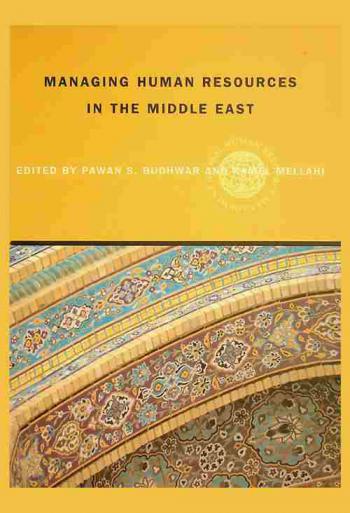
Managing human resources in the Middle East
This text presents the HRM scenario in a number of countries in the Middle East, highlighting the growth of the HR function in these countries, their dominant HRM systems, the influence of different factors and the challenges faced.
Book

The impact of middle management commitment on improvement initiatives in public organisations
Purpose
– Top management commitment is considered a significant factor in improvement programmes, and many papers have been written about the role of top management commitment in implementing a quality management system. However, not considering other management levels’ commitment, such as middle management, may lead to issues in achieving organisational development. Public organisations that work through vertical structures may face a lack of middle management commitment, which might have a negative impact on lower and non-management staff commitment to improvement programmes. In this regard, the purpose of this paper is to examine the impact of middle management’s commitment towards improvement initiatives in public organisations.
Design/methodology/approach
– Empirical research with a mixed-method design used semi-structured interviews and a questionnaire to explore the current practices of continuous improvement (CI) and examine employees’ views from different management levels of the implications of current improvements in a Saudi public service organisation.
Findings
– The analysis indicated that the lower managers and non-management staff agree that, after the implementation of the quality management system, the organisation’s middle management showed a lack of commitment to that system. Moreover, this lack of commitment is recognised in the analysis of participants’ views of CI practices recorded in the questionnaire and interviews. This lack of commitment has caused poor employee commitment and thus a lack of problem solving in organisational departments. It is also responsible for a lack of employee involvement, the centralisation of decisions, deficiencies in terms of determining and applying training, inequality between employees and a lack of trust between employees and their managers. These issues could be managed and resolved through middle management and their commitment.
Practical implications
– Increasing middle managers’ awareness of the importance of their commitment to improvement initiatives can have an impact on employees’ commitment towards improvement initiatives, especially in those public organisations that have vertical/hierarchical structures. The level of commitment towards the implementation of improvement programmes needs further in-depth analyses to identify which factors influence public organisation leaders’ commitment to improvement programmes.
Originality/value
– The results of this study could motivate middle managers in public organisations to review their policies and to facilitate CI initiatives.
Journal Article