
Catalogue Search | MBRL


Are you sure you want to remove the book from the shelf?

{{itemTitle}}
302
result(s) for
"Military/Naval"
Sort by:

Pirates
A global account of pirates and theirmodus operandifrom the middle ages to the present dayIn the twenty-first century piracy has regained a central place in Western culture, thanks to a surprising combination of Johnny Depp and thePirates of the Caribbeanfranchise as well as the dramatic rise of modern-day piracy around Somalia and the Horn of Africa. In this global history of the phenomenon, maritime terrorism and piracy expert Peter Lehr casts fresh light on pirates. Ranging from the Vikings and Wako pirates in the Middle Ages to modern day Somali pirates, Lehr delves deep into what motivates pirates and how they operate. He also illuminates the state's role in the development of piracy throughout history: from privateers sanctioned by Queen Elizabeth to pirates operating off the coast of Africa taking the law into their own hands. After exploring the structural failures which create fertile ground for pirate activities, Lehr evaluates the success of counter-piracy efforts-and the reasons behind its failures.
eBook

Routledge Handbook of the Global History of Warfare
This handbook examines key aspects of the development of the global history of warfare and the changing patterns of warfare over time.
Although scholarship has long eschewed a chronological narrative of the evolution of warfare that privileges the Western experience, global histories of warfare have had difficulty avoiding an overemphasis on the West. The present volume is a collection of themes rather than a history per se; it provides important perspectives on the emergence of warfare as a global historical experience from the ancient past to the present day. Drawing together numerous experts, it tells a broader, more inclusive story of the global, human experience with wars and warfare. The 35 chapters are organised in eight thematic Parts:
Part I: Origins of Warfare
Part II: Polities and Armed Forces in the Pre-Modern Era
Part III: Steppe Nomads of Eurasia
Part IV: Naval Warfare and Piracy in the Pre-Industrial World
Part V: The Impact of Gunpowder
Part VI: Transition from Industrial to Total War
Part VII: Wars of Decolonisation and Cold War
Part VIII: Postmodern/New Wars
These Parts offer an overview of the global experience of warfare to help readers understand how the wars and the militaries we see today have been shaped by historical developments across the globe.
This handbook will be of great interest to students of military history, naval history, strategic studies and world history in general.
eBook

Migrating Words, Migrating Merchants, Migrating Law
Migrating Words, Migrating Merchants, Migrating Law, edited by S. Gialdroni, A. Cordes, S. Dauchy, D. De ruysscher and H. Pihlajamäki, offers a transdisciplinary account of the connections between merchants’ journeys, the languages they used and the development of commercial law.
eBook


Spy Ships
Almost from the first days of seafaring, men have used ships for
\"spying\" and intelligence collection. Since early in the twentieth
century, with the technological advancements of radio and radar,
the U.S. Navy and other government agencies and many other navies
have used increasingly specialized ships and submarines to ferret
out the secrets of other nations. The United States and the Soviet
Union/Russia have been the leaders in those efforts, especially
during the forty-five years of the Cold War. But, as Norman Polmar
and Lee J. Mathers reveal, so has China, which has become a major
maritime power in the twenty-first century, with special interests
in the South China Sea and with increasing hostility toward the
United States. Through extensive, meticulous research and through
the lens of such notorious spy ship events as the Israeli attack on
the USS Liberty , the North Korean capture of the USS
Pueblo , and the U.S. Central Intelligence Agency's success
in clandestinely salvaging part of a Soviet submarine with the
Hughes Glomar Explorer , Spy Ships is a
fascinating and valuable resource for understanding maritime
intelligence collection and what we have learned from it.
eBook

Marine Maxims: Turning Leadership Principles Into Practice
Marine Maxims is a collection of fifty principle-based leadership lessons that Thomas J. Gordon acquired commanding Marines over a career spanning three decades of service. Dealing with the complexities and challenges of the contemporary operating environment requires an internal moral compass fixed true. These maxims focus on developing inner citadels of character, moral courage, and the resilience to persevere in a contested domain where information is key. Its purpose is to provide future leaders with a professional development plan that will steel their resolve and enable them to lead with honor. Thematically, these maxims build upon a foundation of character, courage, and will. To be effective, a leader must model and inspire the will to persevere in the face of danger or adversity. The essence of effective leadership is credibility. A leader's credibility is derived from a congruence of competence and character. Exceptional leaders are not remembered for what they accomplished, but how they did it. Those that lead with integrity will be remembered as a leader worth following.
eBook

Admiral Gorshkov: the man who challenged the U.S. Navy
This is a book about a man and his ability to change a culture and to create a powerful navy that was radically different than traditional navies. And he accomplished this despite strong opposition from the nation's Army-dominated power structure. The Russian Navy that is at sea in the 21st Century is to a significant degree based on the fleet that this man built. This Russian Navy that sent a nuclear-propelled battle cruiser into the Caribbean in 2008 supported the Soviet combat actions in Syria beginning in 2015 and fired missiles from surface ships and a submarine into \"rebel\" areas in Syria can trace its \"roots\" directly to Admiral of the Fleet of the Soviet Union Sergei G. Gorshkov.
eBook
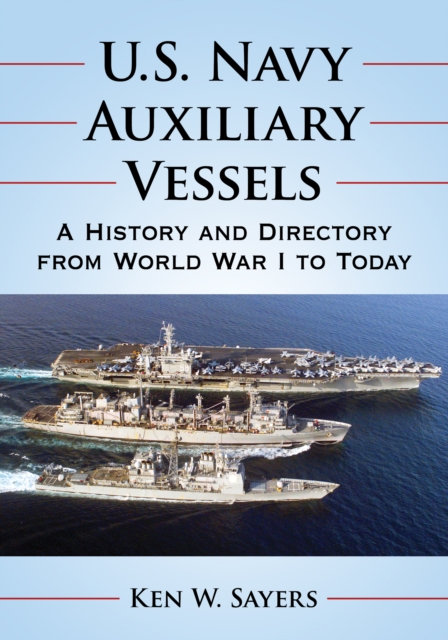
U.S. Navy auxiliary vessels: a history and directory from World War I to today
For more than a century, the U.S. Navy's battleships, cruisers, destroyers, submarines and amphibious warfare vessels have depended on a small group of specialized auxiliary ships to provide fuel, food, ammunition, parts and other material support and services. Without these workhorse vessels, the U.S. Fleet could not have won in World War II and it could not today deploy and remain on station in the far distant waters of the world. This book provides the rosters, histories, specifications and illustrations of 130 different auxiliary ship types in the last 100 years, including the little-known ones, the latest expeditionary fast transports and future towing, salvage and rescue ships.
eBook

China's Quest for Great Power
This book addresses three important facets of China's modern development. First is the ongoing modernization of the People's Liberation Army Navy (PLAN). The Chinese navy has grown from a relatively small, backward force in the 1980s into a capable twenty-first century maritime power. The PLAN now deploys around the world and includes nuclear-powered submarines, the first of several aircraft carriers, modern guided missile destroyers and frigates, and the world's most formidable force of seagoing cruise and ballistic missiles. This modern, growing navy is intended in significant part to undergird China's global search for energy sources and security. Beijing's determination to maintain its historic economic growth depends on energy security. These two national priorities--a navy capable of defending China's national security and economic interests and secury energy resources--come together to define and support Chinese foreign policy. This book addresses these three in both global and Asian contextual terms, with special emphasis on relations between China and the United States.
eBook

Forests and French Sea Power
Mr. Bamford has provided the first monograph in the English language on discovering what forest resources were available to the French navy during theancien régimeand what use it was able to make of them in the English language.
eBook