
Catalogue Search | MBRL


Are you sure you want to remove the book from the shelf?

{{itemTitle}}
56,404
result(s) for
"Military courts"
Sort by:


Military Courts, Civil-Military Relations, and the Legal Battle for Democracy
The interaction between military and civilian courts, the political power that legal prerogatives can provide to the armed forces, and the difficult process civilian politicians face in reforming military justice remain glaringly under-examined, despite their implications for the quality and survival of democracy. This book breaks new ground by providing a theoretically rich, global examination of the operation and reform of military courts in democratic countries. Drawing on a new dataset of 120 countries over more than two centuries, it presents the first comprehensive picture of the evolution of military justice across states and over time. Combined with qualitative historical case studies of Colombia, Portugal, Indonesia, Fiji, Brazil, Pakistan, and the United States, the book presents a new framework for understanding how civilian actors are able to gain or lose legal control of the armed forces. The book's findings have important lessons for scholars and policymakers working in the fields of democracy, civil-military relations, human rights, and the rule of law.
eBook


Courting conflict
Israel's military court system, a centerpiece of Israel's apparatus of control in the West Bank and Gaza since 1967, has prosecuted hundreds of thousands of Palestinians. This authoritative book provides a rare look at an institution that lies both figuratively and literally at the center of the Israeli-Palestinian conflict. Lisa Hajjar has conducted in-depth interviews with dozens of Israelis and Palestinians--including judges, prosecutors, defense lawyers, defendants, and translators--about their experiences and practices to explain how this system functions, and how its functioning has affected the conflict. Her lucid, richly detailed, and theoretically sophisticated study highlights the array of problems and debates that characterize Israel's military courts as it asks how the law is deployed to protect and further the interests of the Israeli state and how it has been used to articulate and defend the rights of Palestinians living under occupation.
eBook


THE MILITARY COURTS SYSTEM OF THE LITHUANIAN REPUBLIC (1919–1940): COURT‘S STRUCTURE, PROCEDURES AND PRACTISE
In 1919, the foundation for Lithuania’s military judicial system was laid following the approval of the Regiment Court Statute on 13 February, the Court-Martial Statute on 27 March, and the Interim Army (Military) Court Statute on 7 July. By 1928, the system was fully developed with the release of the Statute of the Military Court of Honour, which governed the functioning of a court of honour. Thus, the permanent justice institutions of the Lithuanian Army comprised the Army (Military) Court, the Regiment Court, the Military Court of Honour, with the later addition of a temporary institution, the (Field) Court-Martial. These courts were based on the military courts of the former Czarist Russian Empire and presided over justice, discipline and order, and the speedy resolution of cases and the application of strict penalties. A military state defender/the Military Prosecutor’s Office was established, together with the Army / Military court which acted alongside. The latter was similar to the Russian Military Prosecutor’s Office, in that it performed, organised, supervised and controlled pre-trial investigations, supported charges, and supplied advice to judicial institutions on matters of procedural actions. The High Tribunal was established before the military courts, although it commenced operations at the same time. The Tribunal was entrusted with the functions of the Military Court of Cassation, since there was no separate, specialised cassation institution of military courts in Lithuania. Initially, the High Tribunal handled appeals and cassation for the Army / Military court, but only cassation for the troop court. From 1928, the Tribunal acted only in cassation. The internal structure and composition of military courts were determined by specific principles of how it was deemed courts should be organized, their various activities and functions. Accordingly, the courts were staffed with military representatives who had received a military and legal education (usually at degree level), were in good health, of the right age, and had exceptional qualities of character and manner. They were appointed by the supreme political and military leadership for a permanent and temporary office in a court. Among all the military courts, that of the army was the best in terms of its composition. Military courts exercised their intended functions, and the administration of justice aligned closely with administrative and judicial activities, which followed internal documents of the courts and the law, while efficiency of work was in line with the level of a military court. The military courts relied heavily on existing case law relating to criminal law practiced by the former the Russian Empire (as well as recent legal precedent), the statutes of local military courts, and other criminal laws. Those who came before the courts were both serving and passive military officers, military clerks, rank and file soldiers, Ministry of Defence civil servants, riflemen, war prisoners, internees and civilian cases. The matters before the court related to general crimes, crimes against military discipline, good order, service, as well offenses associated with military honour, dignity, nobility, and customs and traditions. For certain crimes and offences, military representatives could be punished by the military authorities, civil administration bodies, churches, and courts of general jurisdiction. Military courts were characterised by extensive expertise, quick decisions and strict punishments, and in response to different emergency situations that existed almost during the entire period of independence, especially during the years of conservative authoritarian rule, they were one of the most important judicial organs that maintained the régime. They dealt mostly with criminal cases and civil actions. Of all the military courts, the army court examined the greatest number of cases, including a wide variety of urgent and important cases, and highprofile cases that attracted public attention. The troop court examined fewer cases of lesser importance, while the military field courts resolved straightforward cases that were easily resolved. The Military Court of Honour examined cases involving military honour and dignity, customs and traditions. A special commission that judged only high-ranking officers operated as an alternative to the latter.
Journal Article

Obama's Guantâanamo : stories from an enduring prison
\"Obama's Guantâanamo: Stories from an Enduring Prison describes President Obama's failure to close America's enduring offshore detention center, as he had promised to do within his first year in office, and the costs of that failure for those imprisoned there. Like its predecessor, Guantâanamo Lawyers: Inside a Prison Outside the Law, Obama's Guantâanamo consists of accounts from lawyers who have not only represented detainees, but also served as their main connection to the outside world. Their stories provide us with an accessible explanation of the forces at work in the detentions and place detainees' stories in the larger context of America's submission to fearmongering. These stories demonstrate all that is wrong with the prison and the importance of maintaining a commitment to human rights even in times of insecurity\"--Publisher's web site.
Book

The Terror Courts
Soon after the September 11 attacks in 2001, the United States captured hundreds of suspected al-Qaeda terrorists in Afghanistan and around the world. By the following January the first of these prisoners arrived at the U.S. military's prison camp in Guantanamo Bay, Cuba, where they were subject to President George W. Bush's executive order authorizing their trial by military commissions. Jess Bravin, theWall Street Journal's Supreme Court correspondent, was there within days of the prison's opening, and has continued ever since to cover the U.S. effort to create a parallel justice system for enemy aliens. A maze of legal, political, and moral issues has stood in the way of justice-issues often raised by military prosecutors who found themselves torn between duty to the chain of command and their commitment to fundamental American values.
While much has been written about Guantanamo and brutal detention practices following 9/11, Bravin is the first to go inside the Pentagon's prosecution team to expose the real-world legal consequences of those policies. Bravin describes cases undermined by inadmissible evidence obtained through torture, clashes between military lawyers and administration appointees, and political interference in criminal prosecutions that would be shocking within the traditional civilian and military justice systems. With the Obama administration planning to try the alleged 9/11 conspirators at Guantanamo-and vindicate the legal experiment the Bush administration could barely get off the ground-The Terror Courtscould not be more timely.
eBook
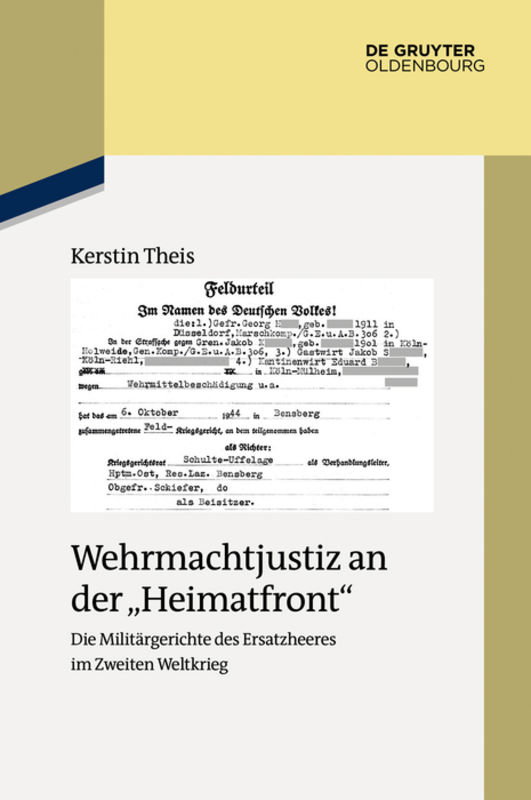
Wehrmachtjustiz an der \Heimatfront\
Das Ersatzheer der Wehrmacht im Zweiten Weltkrieg ist immer noch eine Terra incognita.Dabei war seine Bedeutung an der Heimatfront immens.Es übernahm dort für das NS-Regime wichtige gesellschaftliche Aufgaben, wozu auch ein besonderer Aspekt der NS-Gerichtsbarkeit zu zählen ist: die Wehrmachtjustiz im Heimatgebiet.
eBook

Women Making War
Partisan activities of disloyal women and the Union army's reaction During the American Civil War, more than four hundred women were arrested and imprisoned by the Union Army in the St.Louis area.
eBook