
Catalogue Search | MBRL


Are you sure you want to remove the book from the shelf?

{{itemTitle}}
186,545
result(s) for
"Military law"
Sort by:


Programme procurement in construction
\"This book...adds to the impressive 'legacy' of learning which is still emerging from the successful delivery of the London 2012 construction programme.The authors combine the reforming zeal of a champion for change, who was there every step of the way, with academic rigour, and the result is delivered with impressive passion and commitment to.
eBook


Military Courts, Civil-Military Relations, and the Legal Battle for Democracy
The interaction between military and civilian courts, the political power that legal prerogatives can provide to the armed forces, and the difficult process civilian politicians face in reforming military justice remain glaringly under-examined, despite their implications for the quality and survival of democracy. This book breaks new ground by providing a theoretically rich, global examination of the operation and reform of military courts in democratic countries. Drawing on a new dataset of 120 countries over more than two centuries, it presents the first comprehensive picture of the evolution of military justice across states and over time. Combined with qualitative historical case studies of Colombia, Portugal, Indonesia, Fiji, Brazil, Pakistan, and the United States, the book presents a new framework for understanding how civilian actors are able to gain or lose legal control of the armed forces. The book's findings have important lessons for scholars and policymakers working in the fields of democracy, civil-military relations, human rights, and the rule of law.
eBook


State Control over Private Military and Security Companies in Armed Conflict
The past two decades have witnessed the rapid proliferation of private military and security companies (PMSCs) in armed conflicts around the world, with PMSCs participating in, for example, offensive combat, prisoner interrogation and the provision of advice and training. The extensive outsourcing of military and security activities has challenged conventional conceptions of the state as the primary holder of coercive power and raised concerns about the reduction in state control over the use of violence. Hannah Tonkin critically analyses the international obligations on three key states - the hiring state, the home state and the host state of a PMSC - and identifies the circumstances in which PMSC misconduct may give rise to state responsibility. This analysis will facilitate the assessment of state responsibility in cases of PMSC misconduct and set standards to guide states in developing their domestic laws and policies on private security.
eBook

International legitimacy and the politics of security
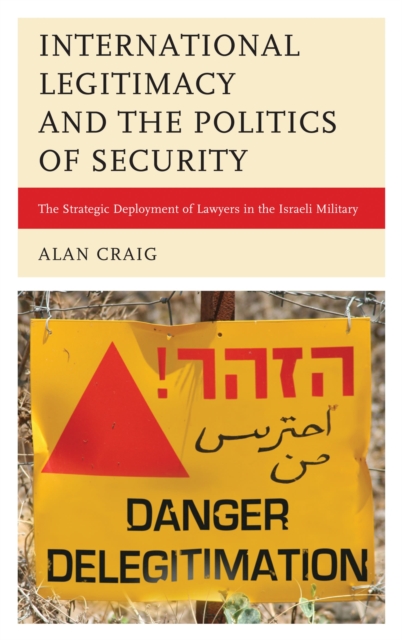
Delegitimation has become the new battleground for Israel and the critics of Israeli military operations. But the Israeli experience reveals a more general engagement where all states act strategically to build legitimacy for their policies and all resist attempts at delegitimation. To understand these processes it is necessary to see how politicized moral and legal judgments shape both the use of force by states and our judgments about the means and the outcomes. This is a book about legitimacy, military lawyers, and security. More particularly, it is about how the legitimacy of Israel’s asymmetric military operations cannot be detached from the politics of law and ethics. Sometimes it is enough that states respect the laws of armed conflict, but at other times they may be held to a higher standard. This does not happen in a vacuum. Rather it is the product of political engagement in the murky politics of international legitimacy where standards are negotiable and some states get a harder time than others. There is a strong theoretical analysis underpinning a discussion that constantly returns to the practical problems of modern armed conflict where combatants hide among civilians and states complain about the unrealistic expectations of human rights NGOs. Here, the law is unclear and there are choices to be made. The book presents new research into the involvement of Israeli military lawyers in operational targeting decision making that has life and death consequences. The case studies concern targeted killing during the Second Intifada, Israel’s 2006 Lebanon War, the 2009 Operation Cast Lead in Gaza and, finally, the 2010 Israeli maritime interception of the ‘Turkish Flotilla’ to Gaza. The investigation identifies a struggle between the proponents of human rights in war and those who promote the rights of states to deploy military force for the security of their citizens. But not all parties to a military conflict are held to the same standards. In fact, the analysis maps a complex political deployment of law and ethics in the strategic calculation of legitimacy costs and the diplomatic processes whereby they are contested, with policy implications for those in charge of the design and execution of military operations.
eBook


The European Union and the use of force
In The European Union and the Use of Force Julia Schmidt examines the development and activities of the EU as an emerging international military actor. The author offers a comprehensive analysis of the legal framework for the EU's military crisis management operations.
eBook