
Catalogue Search | MBRL


Are you sure you want to remove the book from the shelf?

{{itemTitle}}
94
result(s) for
"Military participation Indian."
Sort by:

The testimonies of Indian soldiers and the two World Wars : between self and sepoy
After the Indian Army was united into a single entity in 1902, it was relied upon to police the Empire and fight in France and the Middle East during the First World War as it grew into the largest volunteer army in recorded history by 1945. Yet the soldiers who comprised this army were fundamentally non-British, marked as they were by Orientalized uniforms, racial ethnographies and special censors in case they mutinied. This book explains how the sipahis - the soldiers beneath the rank of the commissioned officers - that largely made up this military body lived a dual, fragmented existence as both colonizer and colonized.
Book

Defending Whose Country?
In the campaign against Japan in the Pacific during the Second World War, the armed forces of the United States, Australia, and the Australian colonies of Papua and New Guinea made use of indigenous peoples in new capacities. The United States had long used American Indians as soldiers and scouts in frontier conflicts and in wars with other nations. With the advent of the Navajo Code Talkers in the Pacific theater, Native servicemen were now being employed for contributions that were unique to their Native cultures. In contrast, Australia, Papua, and New Guinea had long attempted to keep indigenous peoples out of the armed forces altogether. With the threat of Japanese invasion, however, they began to bring indigenous peoples into the military as guerilla patrollers, coastwatchers, and regular soldiers.
Defending Whose Country?is a comparative study of the military participation of Papua New Guineans, Yolngu, and Navajos in the Pacific theater. In examining the decisions of state and military leaders to bring indigenous peoples into military service, as well as the decisions of indigenous individuals to serve in the armed forces, Noah Riseman reconsiders the impact of the largely forgotten contributions of indigenous soldiers in the Second World War.
eBook

First Americans : U.S. patriotism in Indian country after World War I
Drawing from archival sources and oral histories, Thomas Grillot demonstrates how the relationship between Native American tribes and the United States was reinvented in the years following World War I. During that conflict, twelve thousand Native American soldiers served in the U.S. Army. They returned home to their reservations with newfound patriotism, leveraging their veteran cachet for political power and claiming all the benefits of citizenship - even supporting the termination policy that ended the U.S. government's recognition of tribal sovereignty. -- Provided by publisher.
Book
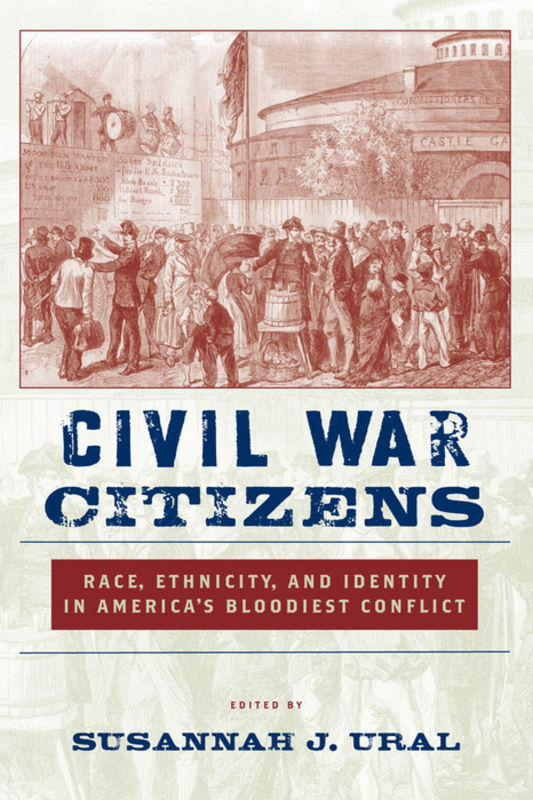
Civil War Citizens
At its core, the Civil War was a conflict over the meaning of citizenship. Most famously, it became a struggle over whether or not to grant rights to a group that stood outside the pale of civil-society: African Americans. But other groups--namely Jews, Germans, the Irish, and Native Americans--also became part of this struggle to exercise rights stripped from them by legislation, court rulings, and the prejudices that defined the age. Grounded in extensive research by experts in their respective fields, Civil War Citizens is the first volume to collectively analyze the wartime experiences of those who lived outside the dominant white, Anglo-Saxon Protestant citizenry of nineteenth-century America. The essays examine the momentous decisions made by these communities in the face of war, their desire for full citizenship, the complex loyalties that shaped their actions, and the inspiring and heartbreaking results of their choices-- choices that still echo through the United States today. Contributors: Stephen D. Engle, William McKee Evans, David T. Gleeson, Andrea Mehrländer, Joseph P. Reidy, Robert N. Rosen, and Susannah J. Ural.
eBook


The Civil War and Reconstruction in Indian Territory
In Indian Territory the Civil War is a story best told through shades of gray rather than black and white or heroes and villains. Since neutrality appeared virtually impossible, the vast majority of territory residents chose a side, doing so for myriad reasons and not necessarily out of affection for either the Union or the Confederacy. Indigenous residents found themselves fighting to protect their unusual dual status as communities distinct from the American citizenry yet legal wards of the federal government.
The Civil War and Reconstruction in Indian Territoryis a nuanced and authoritative examination of the layers of conflicts both on and off the Civil War battlefield. It examines the military front and the home front; the experiences of the Five Nations and those of the agency tribes in the western portion of the territory; the severe conflicts between Native Americans and the federal government and between Indian nations and their former slaves during and beyond the Reconstruction years; and the concept of memory as viewed through the lenses of Native American oral traditions and the modern evolution of public history. These carefully crafted essays by leading scholars such as Amanda Cobb-Greetham, Clarissa Confer, Richard B. McCaslin, Linda W. Reese, and F. Todd Smith will help teachers and students better understand the Civil War, Native American history, and Oklahoma history.
eBook

Native American code talkers
This title examines the Native American servicemen known as the code talkers, focusing on their role in coded communication during World War II including developing the codes, their training, and their work in war zones. Narrative text, historical photographs, and primary sources assist the reader in report writing.
Book

Civil War Citizens
At its core, the Civil War was a conflict over the meaning of
citizenship. Most famously, it became a struggle over whether or
not to grant rights to a group that stood outside the pale of
civil-society: African Americans. But other groups--namely Jews,
Germans, the Irish, and Native Americans--also became part of this
struggle to exercise rights stripped from them by legislation,
court rulings, and the prejudices that defined the age. Grounded in
extensive research by experts in their respective fields,
Civil War Citizens is the first volume to
collectively analyze the wartime experiences of those who lived
outside the dominant white, Anglo-Saxon Protestant citizenry of
nineteenth-century America. The essays examine the momentous
decisions made by these communities in the face of war, their
desire for full citizenship, the complex loyalties that shaped
their actions, and the inspiring and heartbreaking results of their
choices-- choices that still echo through the United States today.
Contributors: Stephen D. Engle, William McKee
Evans, David T. Gleeson, Andrea Mehrländer, Joseph P. Reidy, Robert
N. Rosen, and Susannah J. Ural.
eBook

American Indian code talkers
A brief look at the use of American Indian soldiers who used their native languages to communicate during World War II to prevent enemies from understanding what was being said.
Book

The Comanche Code Talkers of World War II
Among the allied troops that came ashore in Normandy on D-Day, June 6, 1944, were thirteen Comanches in the 4th Infantry Division, 4th Signal Company. Under German fire they laid communications lines and began sending messages in a form never before heard in Europe—coded Comanche. For the rest of World War II, the Comanche Code Talkers played a vital role in transmitting orders and messages in a code that was never broken by the Germans. This book tells the full story of the Comanche Code Talkers for the first time. Drawing on interviews with all surviving members of the unit, their original training officer, and fellow soldiers, as well as military records and news accounts, William C. Meadows follows the group from their recruitment and training to their active duty in World War II and on through their postwar lives up to the present. He also provides the first comparison of Native American code talking programs, comparing the Comanche Code Talkers with their better-known Navajo counterparts in the Pacific and with other Native Americans who used their languages, coded or not, for secret communication. Meadows sets this history in a larger discussion of the development of Native American code talking in World Wars I and II, identifying two distinct forms of Native American code talking, examining the attitudes of the American military toward Native American code talkers, and assessing the complex cultural factors that led Comanche and other Native Americans to serve their country in this way.
eBook