
Catalogue Search | MBRL


Are you sure you want to remove the book from the shelf?

{{itemTitle}}
16,091
result(s) for
"Military revolution"
Sort by:

Revolution on the Hudson : New York City and the Hudson River Valley in the American War of Independence
Daughan \"makes the bold new argument that Britain's attempt to cut off New England [as a strategy during the Revolutionary War] never would have worked, and that doggedly pursuing dominance of the Hudson ultimately cost the crown her colonies. It unpacks intricate military maneuvers on land and sea, introduces the personalities presiding over each side's strategy, and reinterprets the vagaries of colonial politics to offer a ... response to one of our most vexing historical questions: how could a fledgling nation have defeated the most powerful war machine of the era?\"--Amazon.com.
Book

Firearms and Military Adaptation: The Ottomans and the European Military Revolution, 1450-1800
The mass adoption of firearms as a tool of warfare dramatically changed the nature of military conflict from the mid fifteenth century onward, prompting historians of early modern Europe to describe the changes as a \"gunpowder revolution\" or \"Military Revolution\"—a thesis that provoked a spirited scholarly debate in the 1990s. Although the original concept, as set forth by Michael Roberts in 1955, did not single out firearms technology, in the influential elaboration of the thesis by Geoffrey Parker (1988), firearms and artillery fortifications (trace italienne, which were developed in response to artillery firepower) became the main building blocks of the thesis. According to the thesis, the new fortresses required much larger armies to successfully besiege them, leading to a dramatic increase in the size of European armies. To build and maintain artillery fortifications, large artillery trains, and ever-larger armies in turn required a more centralized government. Thus, the introduction of firearms led to the rise of centralized states in Europe—and, on a global scale, to the \"rise of the West.\"
Journal Article

Henry and the cannons : an extraordinary true story of the American Revolution
\"In 1775 in the dead of winter, a bookseller named Henry Knox dragged 59 cannons from Fort Ticonderoga to Boston--225 miles of lakes, forest, mountains, and few roads. It was a feat of remarkable ingenuity and determination and one of the most remarkable stories of the revolutionary war.\"--Amazon.com.
Book
A Korean Military Revolution? Parallel Military Innovations in East Asia and Europe
This article argues that advances in drilling techniques and the use of muskets—essential ingredients of the famous Military Revolution paradigm—were central to Korean military reforms following the Imjin War of 1592-1598. Drawing on recent work in East Asian military history that argues that guns also wrought deep changes in non-European ways of war, we use the Korean military of the Chosŏn dynasty, a fascinating nexus of Chinese, Japanese, and Dutch influences, as a case study to compare East Asian tactics with European ones. Using military manuals from the seventeenth century, we show that European drilling regimes—centered around musketry units—had striking analogues in Korea (as they also did in China and Japan). The very fact of these similarities in such far-removed societies should point us toward caution in making pronouncements about a \"Western way of war,\" making clear that there is a need for a truly global military history.
Journal Article

Rostov in the Russian Civil War, 1917-1920 : the key to victory
\"These documents were collected from the archives in Roslov-on-Don, and this book makes them available for the first time in print. Since becoming freely accessible, Soviet archives have provided a rich source for understanding the hopes, fears and strivings of the Russians during the greatest crisis in their history. Both Reds and Whites realized Rostov's vital strategic importance, and the city changed hands six times between 1917 and 1920. These newly published personal stories fill out the social background to its complex mix of classes and nationalities. They convey the daily experience of life in the streets, and the perils faced by either side when changing fortunes forced them to escape across the River Don.\"--Jacket.
Book
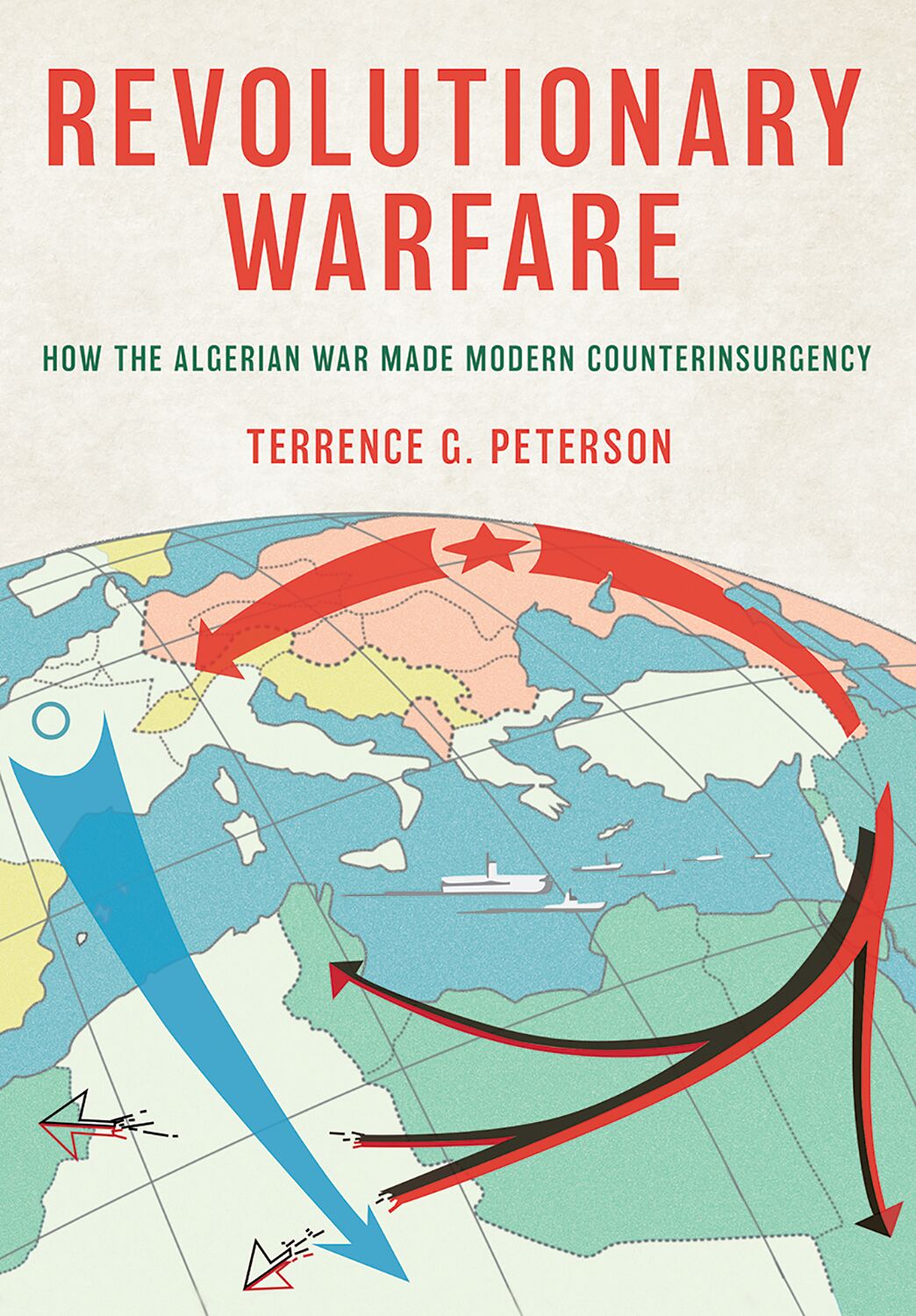
Revolutionary Warfare
Revolutionary Warfare
investigates how efforts to counter a revolution could also
be revolutionary. The Algerian War fractured the French
Empire, destroyed the legitimacy of colonial rule, and helped
launch the Third Worldist movement for the liberation of the Global
South. By tracing how French generals, officers, and civil
officials sought to counter Algerian independence with their own
project of radical social transformation, Terrence G. Peterson
reveals that the conflict also helped to transform the nature of
modern warfare.
The French war effort was never defined solely by repression. As
Peterson details, it also sought to fashion new forms of
surveillance and social control that could capture the loyalty of
Algerians and transform Algerian society. Hygiene and medical aid
efforts, youth sports and education programs, and psychological
warfare campaigns all attempted to remake Algerian social
structures and bind them more closely to the French state. In
tracing the emergence of such programs, Peterson reframes the
French war effort as a project of armed social reform that sought
not to preserve colonial rule unchanged, but to revolutionize it in
order to preserve it against the global challenges of
decolonization.
Revolutionary Warfare demonstrates how French officers'
efforts to transform warfare into an exercise in social engineering
not only shaped how the Algerian War unfolded from its earliest
months, but also helped to forge a paradigm of warfare that
dominated strategic thinking during the Cold War and after:
counterinsurgency.
eBook

Ribbons of scarlet : a novel of the French Revolution's women
\"Six best-selling and award-winning authors bring to life a breathtaking epic novel illuminating the hopes, desires, and destinies of princesses and peasants, harlots and wives, fanatics and philosophers - six unforgettable women whose paths cross during one of the most tumultuous and transformative events in history: the French Revolution. Ribbons of Scarlet is a timely story of the power of women to start a revolution - and change the world. In late 18th-century France, women do not have a place in politics. But as the tide of revolution rises, women from gilded salons to the streets of Paris decide otherwise - upending a world order that has long oppressed them. Blue-blooded Sophie de Grouchy believes in democracy, education, and equal rights for women and marries the only man in Paris who agrees. Emboldened to fight the injustices of King Louis XVI, Sophie aims to prove that an educated populace can govern itself - but one of her students, fruit-seller Louise Audu, is hungrier for bread and vengeance than learning. When the Bastille falls and Louise leads a women's march to Versailles, the monarchy is forced to bend, but not without a fight. The king's pious sister, Princess Elisabeth, takes a stand to defend her brother, spirit her family to safety, and restore the old order, even at the risk of her head. But when fanatics use the newspapers to twist the revolution's ideals into a new tyranny, even the women who toppled the monarchy are threatened by the guillotine. Putting her faith in the pen, brilliant political wife Manon Roland tries to write a way out of France's blood-soaked Reign of Terror while pike-bearing Pauline Leon and steely Charlotte Corday embrace violence as the only way to save the nation. With justice corrupted by revenge, all the women must make impossible choices to survive - unless unlikely heroine and courtesan's daughter Emilie de Sainte-Amaranthe can sway the man who controls France's fate: the fearsome Robespierre.\"--provided by publisher.
Book
Warfare on the Deccan Plateau, 1450-1600: A Military Revolution in Early Modern India?
According to conventional understandings of the Military Revolution, the introduction of firearms in early modern European warfare yielded wide-ranging consequences that were by no means confined to the realm of military affairs. This essay examines the earliest known introduction of firearms technology in India, with a view to evaluating how its consequences there compared or contrasted with those claimed to have occurred in early modern Europe. We further ask: Why did cannon appear in the dry, upland plateau of peninsular India, known as the Deccan, before anywhere else in India? Within the Deccan, how can we explain the different responses to the advent of gunpowder technologies? What effects did new military technologies have on the Deccan's architectural landscape, and on its society at large?
Journal Article


Evolution of Military Logistics
Background: Military logistics has been present from the moment a soldier was created, and its evolution has been influenced by the technology used. Indeed, it has been observed over time that every military revolution was intrinsically caused by a military logistics revolution, directly promoted by the technology applied to the manner of making war. Few papers have been written about military logistics in relation to the development of war itself. Its application was conceptualized in two dimensions: as an art and as a science, interdependent on decision-making. With the evolution of human beings, the way of making war also evolved and therefore a transformation was generated. This makes it necessary to deepen the application of mathematical modeling, statistics, and new technologies in military logistics, promoting the application of concepts based on technology to improve the effectiveness of armies. The aim of this paper is to review the evolution of military logistics. Methods: A systematic approach to the literature review is followed. The backgrounds of the military logistics thought, key authors, trends and a new definition of military logistics is presented, among others. Results: The findings allow us to identify a set of 21 definitions of military logistics since 1792.
Journal Article