
Catalogue Search | MBRL


Are you sure you want to remove the book from the shelf?

{{itemTitle}}
96
result(s) for
"Mind-Body Relations (Metaphysics)"
Sort by:

Natural chi movement : accessing the world of the miraculous
\"Developed by a chi master who teaches Natural Chi Movement workshops internationally, this innovative approach to body-mind health combats stress, fatigue, and illness with the simple activation of chi\"--Provided by publisher.
Book

Critical neuroscience : a handbook of the social and cultural contexts of neuroscience
Critical Neuroscience: A Handbook of the Social and Cultural Contexts of Neuroscience brings together multi-disciplinary scholars from around the world to explore key social, historical and philosophical studies of neuroscience, and to analyze the socio-cultural implications of recent advances in the field. This text's original, interdisciplinary approach explores the creative potential for engaging experimental neuroscience with social studies of neuroscience while furthering the dialogue between neuroscience and the disciplines of the social sciences and humanities. Critical Neuroscience transcends traditional skepticism, introducing novel ideas about 'how to be critical' in and about science.
eBook

The cure within : a history of mind-body medicine
When it comes to disease and healing, most of us believe we must look beyond doctors and drugs; we must look within ourselves. Faith, relationships, and attitude matter. We've all heard that people suffering from serious illnesses improve their survival chances by adopting a positive attitude and refusing to believe in the worst, that stress can kill, and that ancient Eastern mind-body techniques can bring us balance and healing. But why do we believe such things? From psychoanalysis to the placebo effect to meditation, this history describes our commitments to mind-body healing as rooted in a patchwork of stories that have allowed people to make new sense of their suffering, express discontent with existing care, and rationalize new treatments and lifestyles. These stories are sometimes supported by science, sometimes at odds with science, but are all ultimately about much more than just science.--From publisher description.
Book

Time and the Science of the Soul in Early Modern Philosophy
Time and the Science of the Soul in Early Modern Philosophy traces the complex and productive connections established between time and the soul from late Aristotelianism to the natural and political philosophy of Thomas Hobbes and René Descartes.
eBook


Matters of the Heart
The heart is the most symbolic organ of the human body. Across cultures it is seen as the site of emotions, as well as the origin of life. We feel emotions in the heart, from the heart-stopping sensation of romantic love to the crushing sensation of despair. And yet since the nineteenth century the heart has been redefined in medical terms as a pump, an organ responsible for the circulation of the blood. Emotions have been removed from the heart as an active site of influence and towards the brain. It is the brain that is the organ most commonly associated with emotion in the modern West. So why, then, do the emotional meanings of the heart linger? Why do many transplantation patients believe that the heart, for instance, can transmit memories and emotions and why do we still refer to emotions as ‘heartfelt’? We cannot answer these questions without reference to the history of the heart as both physical organ and emotional symbol. Matters of the Heart traces the ways emotions have been understood between the seventeenth and nineteenth centuries as both physical entities and spiritual experiences. With reference to historical interpretations of such key concepts as gender, emotion, subjectivity, and the self, it also addresses the shifting relationship from heart to brain as competing centres of emotion in the West.
eBook

Integral Psychology
Integral Psychology connects Eastern and Western approaches to psychology and healing. Psychology in the East has focused on our inner being and spiritual foundation of the psyche. Psychology in the West has focused on our outer being and the wounding of the body-heart-mind and self. Each requires the other to complete it, and in bringing them together an integral view of psychology comes into view.
The classical Indian yogas are used as a way to see psychotherapy: psychotherapy as behavior change or karma yoga; psychotherapy as mindfulness practice or jnana yoga; psychotherapy as opening the heart or bhakti yoga. Finally, an integral approach is suggested that synthesizes traditional Western and Eastern practices for healing, growth, and transformation.
eBook

The Medieval Heart
Drawing from the works of Dante, Catherine of Siena, Boccaccio, Aquinas, and Cavalcanti and other literary, philosophic, and scientific texts, Heather Webb studies medieval notions of the heart to explore the \"lost circulations\" of an era when individual lives and bodies were defined by their extensions into the world rather than as self-perpetuating, self-limited entities.
eBook
Common to Body and Soul
Der Band versammelt Beiträge zur philosophischen Erklärung der Beziehung zwischen Körper und Seele in der Antike von den Vorsokratikern bis Galen. Er enthält Beiträge über das Denken bei Parmenides (E. Hussey, R. Dilcher), die Liebe bei Empedokles (D. O'Brien), die Dreiteilung der Seele bei Platon (T. Buchheim), Aristoteles – vor allem die Parva Naturalia – (C. Rapp, T. Johansen, P.-M. Morel), nacharistotelische Peripatetiker (R. Sharples), hellenistische Philosophie (C. Rapp, C. Gill) und Galen (R. J. Hankinson). Der Titel spielt auf einen Ausdruck bei Platon, Aristoteles und Plotin an, der sich auf Aspekte des Lebendigseins an Körper und Seele bezieht und ein Topos in der antiken Philosophie wurde, der bei den verschiedenen Autoren unterschiedlich behandelt wurde.
eBook
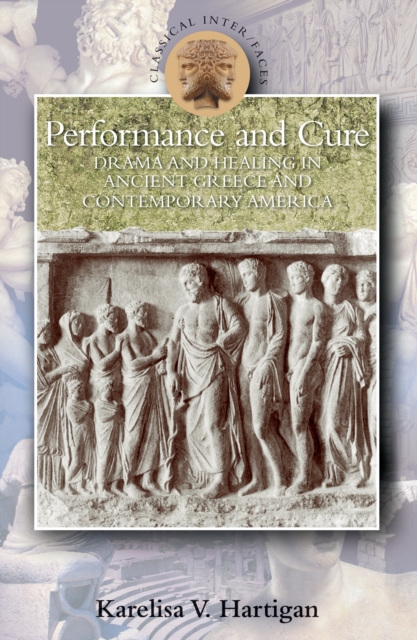
Performance and cure : drama and healing in ancient Greece and contemporary America
In this fascinating addition to the Classical Inter/faces series, Karelisa V. Hartigan suggests that drama was regularly performed in the theatres built within or adjacent to the ancient sanctuaries of Asklepios. She argues that a pageant which showed the enactment of the god healing prompted the dream therapy the patient experienced at the sanctuary. Patients who viewed this drama were ready to receive the nightly ministrations of the deity, his attendants and his animals while they slept in the dormitory at the Asklepieion. To support her thesis, Hartigan discusses the mind-body relationship in the healing process, a relationship the medical profession is beginning to recognize. She concludes by presenting first-hand material based on her experience doing Playback Theatre for patients at Shands Hospital at the University of Florida. In performing improvisational scenes at bedside or in a community space, she has witnessed how the mini-dramas lift the patients' spirits and offer them hope for a successful outcome to their illness.
eBook