
Catalogue Search | MBRL


Are you sure you want to remove the book from the shelf?

{{itemTitle}}
1,503
result(s) for
"Mineral industries Developing countries."
Sort by:


Extractive Economies and Conflicts in the Global South
The majority of developing countries in the Global South are evidently rich in natural resources, but paradoxically blighted by excruciating poverty and conflicts. This paradox of deprivation and war in the midst of plenteous resources has been the subject of great debate in international political economy in contemporary history. This book contributes to the debate by examining the underlying structures, actors and contexts of rentier politics and how they often produce and aggravate conflicts in the various extractive economies and regions of the Global South. The book critically explores the theories of rentier economies and natural resource conflicts, as well as the practical ramifications of rentier politics in the Global South with all their resonance for political economy and security in the Global North.
Contents: Extractive economies and conflicts in the global South: re-engaging rentier theory and politics, Kenneth Omeje; Rentier politics, extractive economies and conflict in the global South: emerging ramifications and theoretical exploration, Usman A. Tar; Anatomy of an oil insurgency: violence and militants in the Niger delta, Nigeria, Michael Watts; Nationalization versus indigenization of the rentier space: oil and conflicts in Nigeria, Ukoha Ukiwo; Greed or grievance? Diamonds, rent-seeking and the civil war in Sierra Leone (1991-2002), John M. Kabia; Politics and oil in Sudan, Peter Woodward; São Tom nd Príncipe: the troubles of oil in an aid-dependent micro-state, Gerhard Seibert; Rentier politics and low intensity conflicts in the DRC: the case of Kasai and Katange provinces, Germain Tshibambe Ngoie and Kenneth Omeje; Thugs' paradise, agencies' guinea pig and the natural resource intrigue: the civil war in Liberia, T. Debey Sayndee; Resource exploitation, repression and resistance in the Sahara-Sahel: the rise of the rentier state in Algeria, Chad and Niger, Jeremy Keenan; Oil sovereignties in the Mexican Gulf and Nigerian Niger delta, Anna Zalik; Extractive resources and the rentier space: a South American perspective, Julia Buxton; Rentier states and war-making: the United Arab Emirates and Iraq in comparative perspective, Rolf Schwarz; Rethinking the rentier syndrome: oil and resource conflict in the Persian Gulf, Dauda Abubakar; Index.
Kenneth Omeje, University of Bradford, UK
eBook


Extractive industries and sustainable development : an evaluation of World Bank Group experience
This evaluation finds that with its global mandate and experience, comprehensive country development focus, and overarching mission to fight poverty, the World Bank Group is well positioned to help countries overcome the policy, institutional, and technical challenges that prevent them from transforming resource endowments into sustainable benefits. Furthermore, the World Bank Group's achievements are many. On the whole, its extractive industries projects have produced positive economic and financial results, though compliance with its environmental and social safeguards remains a challenge. Its research has broadened and deepened understanding of the causes for the disappointing performance of resource-rich countries. Its guidelines for the mitigation of adverse environmental and social impacts have been widely used and appreciated. More recently, it has begun to address the challenge of country governance with a variety of instruments.
Book


Between the Plough and the Pick
This book drives home the understanding that, collectively, this social and economic milieu redefines our conceptualisation of resource politics, mineral‑dependent livelihoods, extractive geographies of resources and commodities, and their multiple meanings.
eBook
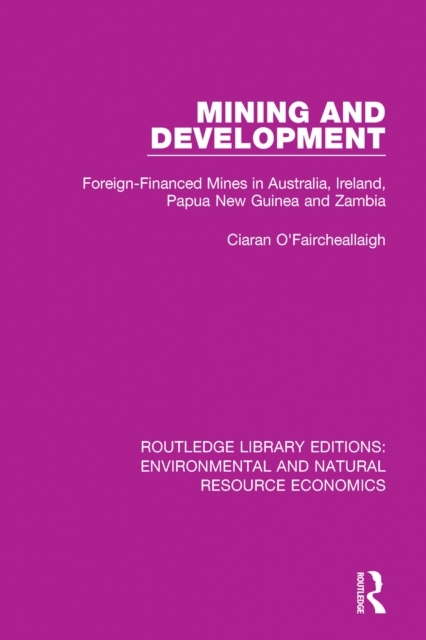
Mining and development : foreign-financed mines in Australia, Ireland, Papua New Guinea and Zambia
This book, first published in 1984, examines the economics and political issues raised by foreign investment in mineral development. It is an attempt to identify, as far as possible, what occurs in and between countries when foreign investments are made in mineral development, concentrating on two main themes: on the nature of the transactions which constitute the process of foreign investment on the physical level -- money and instruments of credit, objects, information and people as they cross national boundaries -- and on the nature of the relationships which are created between foreign investors and governments in the countries where the investments are made. The author argues that the nature of physical transactions plays a crucial role in determining the character of host country-foreign investor relations, and the policies and attitudes adopted by host country authorities exercise an important influence, in turn, on the physical effects of foreign investments. As such, the book constitutes a comprehensive overview of the economic and political factors involved in mining and its development.
eBook
The extractive industries sector
The extractive industries (EI) sector occupies an outsize space in the economies of many developing countries. Economists, public finance professionals, and policy makers working in such countries are frequently confronted with issues that require an in-depth understanding of the sector. The objective of this volume is to provide a concise overview of EI-related topics these professionals are likely to encounter. The volume provides an overview of issues central to EI economics; discusses key components of the sector's governance, policy, and institutional frameworks; and identifies the public sector's EI-related financing obligations. Its discussion of EI economics covers the valuation of subsoil assets, the economic interpretation of ore, and the structure of energy and mineral markets. The volume maps the responsibilities of relevant government entities and outlines the characteristics of the EI sector's legal and regulatory frameworks. Specific key functions of the sector are briefly discussed, as are the financial structures that underpin environmental and social safeguards; investment of public revenues generated from oil, gas, or minerals; as well as extractive-based economic diversification. The authors hope that decision makers in ministries of finance, international organizations, and other relevant entities will find the study useful to their understanding and analysis of the EI sector.
eBook

Extractive Industries Sector
Front Cover -- Contents -- Acknowledgments -- About the Authors -- Abbreviations -- Overview -- What Should We Know about the Extractive Industries Sector? -- Notes -- Organization of this Volume -- Chapter 1 Defining Sector Policy Objectives -- The Extractive Industries Value Chain -- Improving Revenue Mobilization -- Generating Extractive-Based Economic and Social Development -- Note -- Chapter 2 The Economics of the Extractive Industries Sector -- Accounting for Physical Stocks: Resources, Reserves, and the Economic Interpretation of Ore -- Theory of Rents and Valuation of Subsoil Assets -- Structure of Energy and Mineral Markets -- Notes -- Chapter 3 Institutional Framework -- Mandates and Coordination -- Role of the Sector Ministry -- Roles of the Ministry of Finance and Revenue-Collecting Agencies -- Role of the National Resource Company -- Roles of Other Ministries and Government Agencies -- Note -- Chapter 4 Investment and Production Cycles -- Characteristics of Extractive Industry Investments -- The Mining Cycle -- The Oil and Gas Cycle -- Chapter 5 Extractive Industries Policy -- Policy and Regulatory Frameworks -- Sector Financing, Ownership, and Liabilities -- Mineral Legislation, Regulation, and Contracting Regimes -- Establishing and Maintaining a Geodata Information Base -- Mineral Rights Cadastre -- Overview of Extractive Industries Tax and Royalty Regimes -- Enhancing Competitiveness and Productivity -- Note -- Chapter 6 Monitoring and Enforcing Contracts: Legal Obligations and Institutional Responsibilities -- Legal and Contractual Regimes -- Building Transparency and Accountability in Contract and Revenue Management -- Monitoring and Enforcing Fiscal Regimes for the Extractive Sector -- Environmental Safeguards: Financial Sureties for Decommissioning -- Social Safeguards: Community Foundations, Trusts, and Funds.
Book
Extractive Industries and Sustainable Development
How effectively has the World Bank Group assisted its clients in enhancing the contribution of the extractive industries to sustainable development? This evaluation finds that with its global mandate and experience, comprehensive country development focus, and overarching mission to fight poverty, the World Bank Group is well positioned to help countries overcome the policy, institutional, and technical challenges that prevent them from transforming resource endowments into sustainable benefits. Furthermore, the World Bank Group’s achievements are many. On the whole, its extractive industries projects have produced positive economic and financial results, though compliance with its environmental and social safeguards remains a challenge. Its research has broadened and deepened understanding of the causes for the disappointing performance of resource-rich countries. Its guidelines for the mitigation of adverse environmental and social impacts have been widely used and appreciated. More recently, it has begun to address the challenge of country governance with a variety of instruments. The World Bank Group can, however, do much to improve its performance in enhancing the extractive industry sector’s contribution to sustainable development and poverty reduction. The report identifies three main areas for improvement – formulating an integrated strategy, strengthening implementation and engagement of stakeholders.
eBook