
Catalogue Search | MBRL


Are you sure you want to remove the book from the shelf?

{{itemTitle}}
9
result(s) for
"Minorities -- Southern States -- Social life and customs"
Sort by:

Southern heritage on display : public ritual and ethnic diversity within southern regionalism
This provocative collection draws on extensive ethnographic fieldwork to shed light on the role that public ceremonies play in affirming or debunking cultural identities associated with the South. W. J. Cash's 1941 observation that there are many Souths and many cultural traditions among them is certainly validated by this book. Although the Civil War and its lost cause tradition continues to serve as a cultural root paradigm in celebrations, both uniting and dividing loyalties, southerners also embrace a panoply of public rituals—parades, cook-offs, kinship homecom-ings, church assemblies, music spectacles, and material culture exhibitions—that affirm other identities. From the Appalachian uplands to the Mississippi Delta, from Kentucky bluegrass to Carolina piedmont, southerners celebrate in festivals that showcase their diverse cultural backgrounds and their mythic beliefs about themselves. The ten essays of this cohesive, interdisciplinary collection present event-centered research from various fields of study—anthropology, geography, history, and literature—to establish a rich, complex picture of the stereotypically Solid South. Topics include the Mardi Gras Indian song cycle as a means of expressing African-American identity in New Orleans; powwow performances and Native American traditions in southeast North Carolina; religious healings in southern Appalachian communities; Mexican Independence Day festivals in central Florida; and, in eastern Tennessee, bonding ceremonies of melungeons who share Indian, Scots Irish, Mediterranean, and African ancestry. Seen together, these public heritage displays reveal a rich creole of cultures that have always been a part of southern life and that continue to affirm a flourishing regionalism. This book will be valuable to students and scholars of cultural anthropology, American studies, and southern history; academic and public libraries; and general readers interested in the American South. It contributes a vibrant, colorful layer of understanding to the continuously emerging picture of complexity in this region historically depicted by simple stereotypes.
Celeste Ray is Assistant Professor of Anthropology at the University of the South, Sewanee, Tennessee, and author of Highland Heritage: Scottish Americans in the American South.
eBook

Sacral Grooves, Limbo Gateways
\"We're seeing people that we didn't know exist,\" the director of FEMA acknowledged in the wake of Hurricane Katrina. Sacral Grooves, Limbo Gateways offers a corrective to some of America's institutionalized invisibilities by delving into the submerged networks of ritual performance, writing, intercultural history, and migration that have linked the coastal U.S. South with the Caribbean and the wider Atlantic world. This interdisciplinary study slips beneath the bar of rigid national and literary periods, embarking upon deeper-more rhythmic and embodied-signatures of time. It swings low through ecologies and symbolic orders of creolized space. And it reappraises pluralistic modes of knowledge, kinship, and authority that have sustained vital forms of agency (such as jazz) amid abysses of racialized trauma. Drawing from Haitian Vodou and New Orleanian Voudou and from Cuban and South Floridian Santería, as well as from Afro-Baptist (Caribbean, Geechee, and Bahamian) models of encounters with otherness, this book reemplaces deep-southern texts within the counterclockwise ring-stepping of a long Afro-Atlantic modernity. Turning to an orphan girl's West African initiation tale to follow a remarkably traveled body of feminine rites and writing (in works by Paule Marshall, Zora Neale Hurston, Lydia Cabrera, William Faulkner, James Weldon Johnson, and LeAnne Howe, among others), Cartwright argues that only in holistic form, emergent from gulfs of cross-cultural witness, can literary and humanistic authority find legitimacy. Without such grounding, he contends, our educational institutions blind and even poison students, bringing them to \"swallow lye,\" like the grandson of Phoenix Jackson in Eudora Welty's \"A Worn Path.\" Here, literary study may open pathways to alternative medicines-fetched by tenacious avatars like Phoenix (or an orphan Kumba or a shell-shaking Turtle)-to remedy the lies our partial histories have made us swallow.
eBook
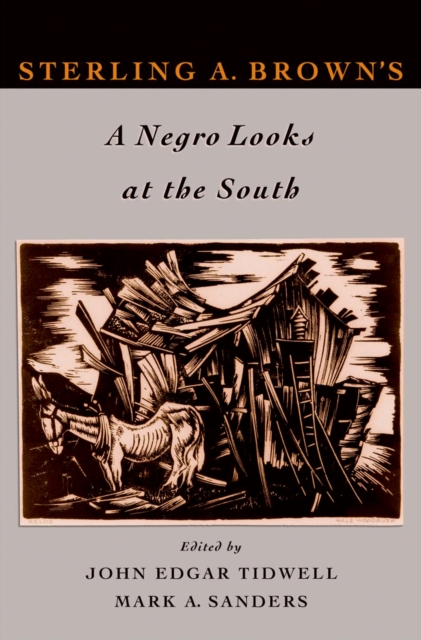
Sterling A. Brown's a Negro looks at the South
Using oral history and the printed word, Sterling A. Brown set out during the Second World War to capture the response of African Americans, primarily living in the South, to America's involvement in the war and how it affected them. These responses, brought together in extended, non-fiction essays of many different types, illustrate the diversity of opinions in the Black South about the war and the war period in America. For nearly sixteen years, the excerpts that were never published languished in Brown's manuscript collection at Howard University. Now, for the first time, all of the completed pieces of unpublished writings are combined with the few published sections into the book that Brown envisioned. The legacy Brown left us is not only a superb portrait of the way in which African Americans of the mid-century talked and lived; he also provided a methodology that oral and written historians will find extremely useful. This is clearly a document from another time, as its now outdated title reminds us, but it reveals a world that still informs our sense of ourself as a nation. In fact, it is an unforgettable history, which Brown has cast in a bright, elucidating new light.
eBook

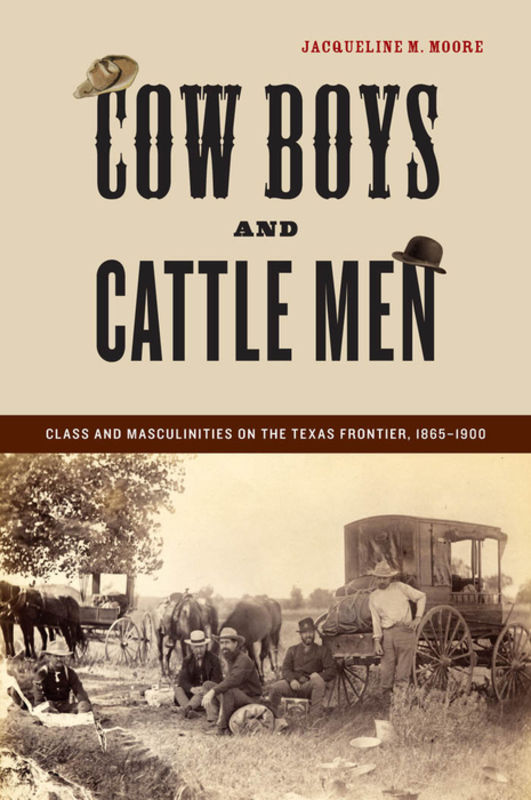
Cow Boys and Cattle Men
Cowboys are an American legend, but despite ubiquity in history and popular culture, misperceptions abound. Technically, a cowboy worked with cattle, as a ranch hand, while his boss, the cattleman, owned the ranch. Jacqueline M. Moore casts aside romantic and one-dimensional images of cowboys by analyzing the class, gender, and labor histories of ranching in Texas during the second half of the nineteenth century.As working-class men, cowboys showed their masculinity through their skills at work as well as public displays in town. But what cowboys thought was manly behavior did not always match those ideas of the business-minded cattlemen, who largely absorbed middle-class masculine ideals of restraint. Real men, by these standards, had self-mastery over their impulses and didn't fight, drink, gamble or consort with \"unsavory\" women. Moore explores how, in contrast to the mythic image, from the late 1870s on, as the Texas frontier became more settled and the open range disappeared, the real cowboys faced increasing demands from the people around them to rein in the very traits that Americans considered the most masculine.Published in Cooperation with the William P. Clements Center for Southwest Studies, Southern Methodist University.
eBook

Bengali Harlem and the Lost Histories of South Asian America
Nineteenth-century Muslim peddlers arrived at Ellis Island, bags heavy with embroidered silks from their villages in Bengal. Demand for “Oriental goods\" took these migrants on a curious path, from New Jersey’s boardwalks into the segregated South. Bald’s history reveals cross-racial affinities below the surface of early twentieth-century America.
eBook
Imperialism within the margins : queer representation and the politics of culture in Southern Africa
Through focusing on the sexual politics that have emerged out of post-apartheid South Africa, Spurlin investigates textual and cultural representations of same-sex desire outside of the Euroamerican axes of queer culture and politics, and considers the ways in which queer cultural productions in southern Africa both intersect with and resist these.
eBook

Family Bible
\"Swimming and sex seemed a lot alike to me when I was growing up. You took off most of your clothes to do them and you only did them with people who were the same color as you. As your daddy got richer, you got to do them in fancier places.\" Starting with her father, who never met a whitetail buck he couldn't shoot, a whiskey bottle he couldn't empty, or a woman he couldn't charm, and her mother, who \"invented road rage before 1960,\" Melissa Delbridge introduces us to the people in her own family bible. Readers will find elements of Southern Gothic and familiar vernacular characters, but Delbridge endows each with her startling and original interpretation. In this disarmingly unguarded and unapologetic memoir, she shows us what really happened in the \"stew of religion and sex\" that was 1960s Tuscaloosa.
eBook
