
Catalogue Search | MBRL


Are you sure you want to remove the book from the shelf?

{{itemTitle}}
3,090
result(s) for
"Minorities Middle East."
Sort by:

Routledge handbook of minorities in the Middle East
The Routledge Handbook of Minorities in the Middle East gathers a diverse team of international scholars, each of whom provides unique expertise into the status and prospects of minority populations in the region. The dramatic events of the past decade, from the Arab Spring protests to the rise of the Islamic state, have brought the status of these populations onto centre stage. The overturn of various long-term autocratic governments in states such as Tunisia, Egypt, Libya, and Yemen, and the ongoing threat to government stability in Syria, Iraq, and Lebanon have all contributed to a new assertion of majoritarian politics amid demands for democratization and regime change. In the midst of the dramatic changes and latent armed conflict, minority populations have been targeted, marginalized, and victimized. Calls for social and political change have led many to contemplate the ways in which citizenship and governance may be changed to accommodate minorities - or indeed if such change is possible. At a time when the survival of minority populations, and the utility of the label minority has been challenged, this handbook answers the following set of research questions: What are the unique challenges of minority populations in the Middle East? How do minority populations integrate into their host societies, both as a function of their own internal choices, and as a response to majoritarian consensus on their status? Finally, given their inherent challenges, and the vast, sweeping changes that have taken place in the region over the past decade, what is the future of these minority populations? What impact have minority populations had on their societies, and to what extent will they remain prominent actors in their respective settings?
Book

The Better Story
Finalist for the 2014 Next Generation Indie Book Awards in
the GLBT category With a focus on aesthetic texts that
narrate stories about or from the Middle East, The Better
Story offers fresh insights into political conflict. Dina
Georgis argues that narrative is an emotional resource for learning
and for generating better political futures. This book suggests
that narrative not only gives us insight into social constructs,
but also leads us into understanding the enigmatic processes by
which we become and give our \"selfs\" over to collective memories,
histories, and identities. Stories link us to queer \"forgotten\"
spaces that official history has discarded. The Better
Story argues that feminist, queer, and postcolonial studies
have not helped us think about lives that do not neatly fit into
the valorized logic of resistance and emancipation.
eBook

Arabic and its alternatives : religious minorities and their languages in the emerging nation states of the Middle East (1920-1950)
\"Arabic and its Alternatives discusses the complicated relationships between language, religion and communal identities in the Middle East in the period following the First World War. This volume takes its starting point in the non-Arabic and non-Muslim communities, tracing their linguistic and literary practices as part of a number of interlinked processes, including that of religious modernization, of new types of communal identity politics and of socio-political engagement with the emerging nation states and their accompanying nationalisms. These twentieth-century developments are firmly rooted in literary and linguistic practices of the Ottoman period, but take new turns under influence of colonization and decolonization, showing the versatility and resilience as much as the vulnerability of these linguistic and religious minorities in the region. Contributors are Tijmen C. Baarda, Leyla Dakhli, Sasha R. Goldstein-Sabbah, Liora R. Halperin, Robert Isaf, Michiel Leezenberg, Merav Mack, Heleen Murre-van den Berg, Konstantinos Papastathis, Franck Salameh, Cyrus Schayegh, Emmanuel Szurek, Peter Wien\"-- Provided by publisher.
Book
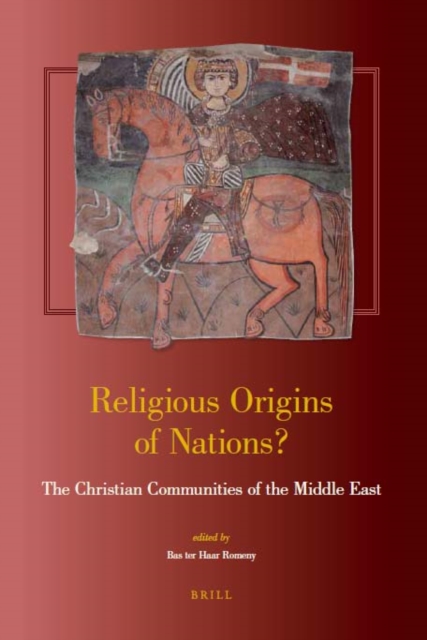
Religious Origins of Nations?
This volume presents the results of the Leiden project on the identity formation of the Syrian Orthodox Christians, which developed from a religious association into an ethnic community. A number of specialists react to the findings and discuss the cases of the East Syrians, Armenians, Copts, and Ethiopians.
eBook

Modernity, minority, and the public sphere : Jews and Christians in the Middle East
Modernity, Minority, and the Public Sphere: Jews and Christians in the Middle East explores the many facets associated with the questions of modernity and minority in the context of religious communities in the Middle East by focusing on inter-communal dialogues and identity construction among the Jewish and Christian communities of the Middle East and paying special attention to the concept of space. This volume draws examples of these issues from experiences in the public sphere such as education, public performance, and political engagement discussing how religious communities were perceived and how they perceived themselves. Based on the conference proceedings from the 2013 conference at Leiden University entitled Common Ground? Changing Interpretations of Public Space in the Middle East among Jews, Christians and Muslims in the 19th and 20th Century this volume presents a variety of cases of minority engagement in Middle Eastern society.
Book
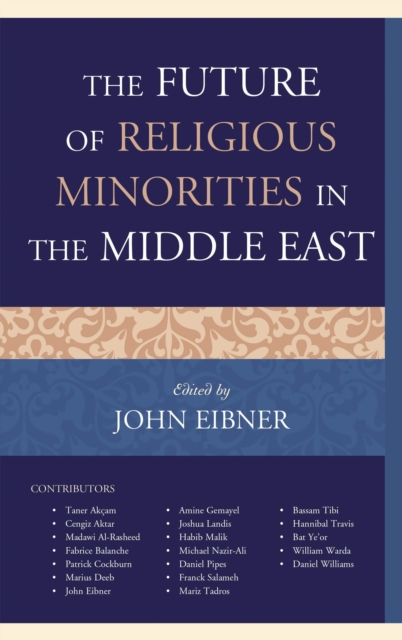
The future of religious minorities in the Middle East
The Future of Religious Minorities in the Middle East addresses the domestic and international politics that have created conditions for contemporary religious cleansing in the Middle East. It provides a platform for a host of distinguished scholars, journalists, human rights activists, and political practitioners. The contributors come from diverse political, cultural, and religious backgrounds, each one drawing on a deep wellspring of scholarship, experience, sobriety, and passion. Collectively, they make a major contribution to understanding the dynamics of the mortal threat to the social pluralism upon which the survival of religious minorities depends.
eBook


The Mandaean Community and Ottoman-British Rivalry in Late 19th-Century Iraq: The Curious Case of Shaykh Ṣaḥan
In 1895, a Mandaean priest was captured near the town of Chabāyish in Iraq and brought to the jailhouse in Basra. Shaykh Ṣaḥan was accused of murdering his nephew and, more significantly, of supporting an Arab tribal rebellion against Ottoman authority. Using archival sources and Mandaean oral history, this article analyzes the case of Shaykh Ṣaḥan within the context of state centralization, Ottoman-British rivalry, and the internal conflicts among the Mandaeans. The case is significant because it sheds light on how large-scale transformations affected vulnerable minorities like the Mandaeans, and the way these communities struggled to survive in turbulent times.
Journal Article

Open wounds : Armenians, Turks and a century of genocide
\"The assassination of the author Hrant Dink in Istanbul in 2007, a high-profile advocate of Turkish-Armenian reconciliation, reignited the debate in Turkey on the annihilation of the Ottoman Armenians. Many Turks soon re-awakened to their Armenian heritage, reflecting on how their grandparents were forcibly Islamised and Turkified, and the suffering their families endured to keep their stories secret. There was public debate around Armenian property confiscated by the Turkish state and the extermination of the minorities. At last the silence had been broken. Open Wounds explains how, after the First World War, the new Turkish Republic forcibly erased the memory of the atrocities, and traces of Armenians, from their historic lands--a process to which the international community turned a blind eye. The price for this amnesia was, Vicken Cheterian argues, 'a century of genocide.' Turkish intellectuals acknowledge the price society must pay collectively to forget such traumatic events, and that Turkey cannot solve its recurrent conflicts with its minorities--like the Kurds today--nor have an open and democratic society without addressing the original sin on which the state was founded: the Armenian Genocide\"-- Provided by publisher.
Book

Endangered peoples of Africa and the Middle East : struggles to survive and thrive
Africa and the Middle East are undergoing dramatic transformations, environmentally, demographically, economically, politically and otherwise. This book turns the spotlight on 14 endangered cultures as examples of how diverse peoples cope with these transformations in the 21st century.
eBook