
Catalogue Search | MBRL


Are you sure you want to remove the book from the shelf?

{{itemTitle}}
8,941
result(s) for
"Miocene"
Sort by:

The age of mammals : the Oligocene & Miocene epochs
Learn about how mammals and birds increased their collective footprint to dominate the Earth, and how they evolved to present-day form.
Book

Correction: First record of the Miocene hominoid Sivapithecus from Kutch, Gujarat state, western India
[This corrects the article DOI: 10.1371/journal.pone.0206314.].
Journal Article

Correction: A New Miocene-Divergent Lineage of Old World Racer Snake from India
[This corrects the article DOI: 10.1371/journal.pone.0148380.].
Journal Article
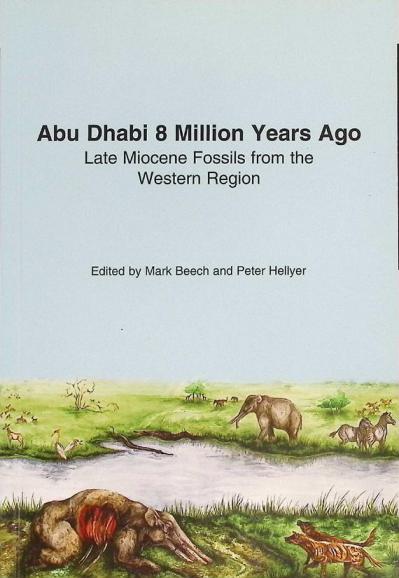
Abu Dhabi - 8 million years ago : late Miocene fossils from the western region
\"Abu Dhabi - 8 Million Years Ago\" is a seminal scientific survey of the fossil-rich Baynunah Formation in the Al Dhafra (Western) Region of Abu Dhabi. Edited by archaeologists Mark Beech and Peter Hellyer, the volume compiles the findings of the Abu Dhabi Islands Archaeological Survey (ADIAS) and international collaborators. It provides a startling reconstruction of a \"Green Arabia,\" revealing that eight million years ago, the now-arid desert was a lush riverine landscape comparable to the modern East African savannah, inhabited by a diverse array of extinct megafauna.
BOOK


A thousand and one fossils : discoveries in the desert at Al Gharbia, United Arab Emirates = Alf aٍhfهur wa-aٍhfهur : iktishهafهat min al-zaman al-saٍhهiq fهi ٍSaٍhrهa® al-Gharbهiyah, Abهu ٍZaby, al-Imهarهat al-°Arabهiyah al-Muttaٍhidah
\"This book in English and Arabic provides a visual summary of the prehistory of the Arabian Peninsula, describing the plant and animal diversity that existed there some seven million years ago through discoveries by an international team of paleontologists from Germany, France, the United States, and the United Arab Emirates\"--Provided by publisher.
Book


Insights into the historical assembly of East Asian subtropical evergreen broadleaved forests revealed by the temporal history of the tea family
Subtropical evergreen broadleaved forests (EBLFs) inhabit large areas of East Asia. Although paleovegetation reconstructions have revealed that the subtropical EBLFs existed in Southwest China during the Miocene, the historical construction of these forests remains poorly known. Here, we used the tea family (Theaceae), a characteristic component of the subtropical EBLFs, to gain new insights into the assembly of this important biome.
Using a robust phylogenetic framework of Theaceae based on plastome and nuclear ribosomal DNA sequence data, the temporal history of the family was reconstructed. Data from other characteristic components of subtropical EBLFs, including Fagaceae, Lauraceae and Magnoliaceae, were also integrated.
Most of the essential elements of the subtropical EBLFs appear to have originated around the Oligocene–Miocene (O–M) boundary. However, small woody lineages (e.g. Camellia, Hartia) from Theaceae were dated to the late Miocene. Accelerated net diversification rates within Theaceae were also detected near the O–M transition period and the late Miocene.
Our results suggest that two independent intensifications of the East Asian summer monsoon (EASM) around the O–M boundary and the late Miocene may have facilitated the historical assembly of the subtropical EBLFs in East Asia.
Journal Article