
Catalogue Search | MBRL


Are you sure you want to remove the book from the shelf?

{{itemTitle}}
10
result(s) for
"Mirrors-History"
Sort by:

In the looking glass : mirrors and identity in early America
\"In the Looking Glass explores how mirrors shaped human identity in North America from the earliest European explorations through the nineteenth century. Early Americans--African, Native, and European--had uses for and beliefs about reflective surfaces, largely associating reflection with ritual and magic, which predated the introduction of accurately reflective mirrors (ca. 1500). These new mirrors played a critical role in shaping a person's individual sense of self and came to be intimately linked to identity formation in early America. Moreover, mirrors became an object through which white men asserted their claims to modernity, emphasizing mirrors as fulcrums of truth that enabled them to know and master themselves and their world. In claiming that mirrors revealed and substantiated their own enlightenment and rationality, white men sought to differentiate how they used mirrors from not only white women but also from Native American and African American men and women. Mirrors thus played an important role in the construction of early American racial and gender hierarchies. This project brings together the history of technology and the history of identity, using textual, visual, and material sources to focus on how mirrors were created, adopted, adapted, and discussed by a wide variety of early Americans. In the Looking Glass will attract a wide audience of scholars from history, African American studies, Native American studies, material studies, history of technology, and gender studies, as well as a broader audience concerned with questions of image and identity\"--Provided by publisher.
Book
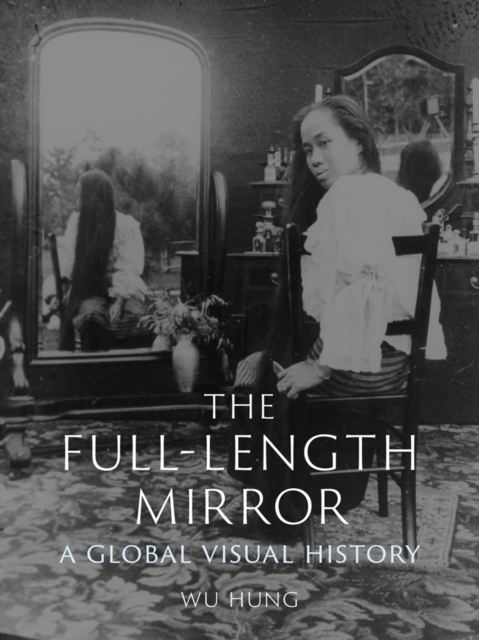
The Full-Length Mirror
Beautifully illustrated, a stirring and wide-ranging reflection on art, technology, culture—and the full-length mirror. This book tells two stories about the full-length mirror. One story, through time and space, crisscrosses the globe to introduce a broad range of historical actors: kings and slaves, artists and writers, merchants and craftsmen, courtesans, and commoners. The other story explores the connections among objects, painting, and photography, the full-length mirror providing a new perspective on historical artifacts and their images in art and visual culture. The Full-Length Mirror represents a new kind of global art history in which \"global\" is understood in terms of both geography and visual medium, a history encompassing Europe, Asia, and North America, and spanning over two millennia from the fourth century BCE to the early twentieth century.
eBook

Spiegel--Medium--Kunst : zur Geschichte des Spiegels im Zeitalter des Bildes
Mit Hilfe des Spiegels kam der Mensch nicht nur sich selbst, sondern auch den unendlichen Fernen des Universums näher als mit irgendeinem anderen Medium.Als Medium der Selbsterkenntnis fand der Spiegel die Grenzen seiner wissenschaftlichen Rezipierbarkeit in der Selbstbezüglichkeit, dem großen Thema aller psychoanalytisch orientierten.
eBook

The culture broker
Franklin Murphy? It's not a name that is widely known; even during his lifetime the public knew little of him. But for nearly thirty years, Murphy was the dominant figure in the cultural development of Los Angeles. Behind the scenes, Murphy used his role as confidant, family friend, and advisor to the founders and scions of some of America's greatest fortunes—Ahmanson, Rockefeller, Ford, Mellon, and Annenberg—to direct the largesse of the wealthy into cultural institutions of his choosing. In this first full biography of Franklin D. Murphy (1916-994), Margaret Leslie Davis delivers the compelling story of how Murphy, as chancellor of UCLA and later as chief executive of the Times Mirror media empire, was able to influence academia, the media, and cultural foundations to reshape a fundamentally provincial city. The Culture Broker brings to light the influence of L.A.'s powerful families and chronicles the mixed motives behind large public endeavors. Channeling more than one billion dollars into the city's arts and educational infrastructure, Franklin Murphy elevated Los Angeles to a vibrant world-class city positioned for its role in the new era of global trade and cross-cultural arts.
eBook

The age of Auden
How W. H. Auden's emigration to the United States changed the course of postwar American poetry
W. H. Auden's emigration from England to the United States in 1939 marked more than a turning point in his own life and work—it changed the course of American poetry itself. The Age of Auden takes, for the first time, the full measure of Auden's influence on American poetry. Combining a broad survey of Auden's midcentury U.S. cultural presence with an account of his dramatic impact on a wide range of younger American poets—from Allen Ginsberg to Sylvia Plath—the book offers a new history of postwar American poetry.
For Auden, facing private crisis and global catastrophe, moving to the United States became, in the famous words of his first American poem, a new \"way of happening.\" But his redefinition of his work had a significance that was felt far beyond the pages of his own books. Aidan Wasley shows how Auden's signal role in the work and lives of an entire younger generation of American poets challenges conventional literary histories that place Auden outside the American poetic tradition. In making his case, Wasley pays special attention to three of Auden's most distinguished American inheritors, presenting major new readings of James Merrill, John Ashbery, and Adrienne Rich. The result is a persuasive and compelling demonstration of a novel claim: In order to understand modern American poetry, we need to understand Auden's central place within it.
eBook

Research on the Analogous Characters of the Bronze Mirror Inscriptions in the Han Dynasty
There are numerous variant characters engraved in bronze mirrors of the Han Dynasty, and the analogous character is one of the very important forms among them. At present, many achievements have been made in the studies of the analogous characters. However, there are still few remarkable findings in the field of the analogous characters, especially those in the bronze mirror inscriptions of the Han Dynasty. Based on the existing relevant literature, the analogous characters of the bronze mirror inscriptions in the Han Dynasty in this paper are mainly categorized into four types : analogy generated from certain characters, analogy caused by the contexts, analogy coming from similar characters and analogy born of Li or Cao script. In order to strengthen the understanding of the analogous characters, this paper makes contrastive analysis by listing many examples of analogous characters in the bronze mirror inscriptions of the Han Dynasty. Moreover, according to the theory of Chinese characters structure, this re
Journal Article

Between two worlds
Between Two Worlds is an authoritative commentary on--and powerful reinterpretation of--the founding work of modern philosophy, Descartes's Meditations. Philosophers have tended to read Descartes's seminal work in an occasional way, examining its treatment of individual topics while ignoring other parts of the text. In contrast, John Carriero provides a sustained, systematic reading of the whole text, giving a detailed account of the positions against which Descartes was reacting, and revealing anew the unity, meaning, and originality of the Meditations.
eBook

Mirrors of Entrapment and Emancipation
Mirrors of Entrapment and Emancipation explores the rich diversity of the meanings associated with the mirror and reflection in literature by women on the basis of the works of the Persian Forugh Farrokhzad (1935-1967) and her American contemporary Sylvia Plath (1932-1963). These two poets astutely employed mirror images for the realization as well as for communication of their turbulent psycho-emotional states to their readers, thereby capturing and conveying the essence of women desperately trapped among the antithetical images of twentieth-century womanhood.
eBook

Philosophy in a Feminist Voice
In this book, Janet Kourany offers an antidote to the pervasive and pernicious strains in Western philosophy that discount women. Most areas of Western philosophy tend not only to ignore women, but also to perpetuate long-standing antifeminine biases of the society as a whole. It does not have to be this way. Rather than be part of the problem, philosophy can be a powerful force for much needed social change. In this collection of essays by some of the most noted feminist philosophers, Kourany showcases ideas on the newest work of Western philosophy that is benefiting women as well as men. Included here are articles by Eileen O'Neill, Louise Antony, Virginia Held, Susan Okin, Carolyn Korsmeyer, Nancy Frankenberry, Lorraine Code, Janet Kourany, Andrea Nye, and Susan Bordo, all of whom show further directions in which philosophy ought to proceed.
This book demonstrates that feminist philosophy is not a separate area of philosophy that can safely be ignored by philosophers not \"in\" it. Rather, it relates to at least most of the major areas of philosophy, and its gains will stand to benefit all philosophers, no matter what their field.
eBook

Our Politics, Our Selves?
Is statecraft soulcraft? Should we look to our souls and selves in assessing the quality of our politics? Is it the business of politics to cultivate, shape, or structure our internal lives? Summarizing and answering the major theoretical positions on these issues, Peter Digeser formulates a qualified permission to protect or encourage particular forms of human identity. Public discourse on politics should not preclude talk about the role of reason in our souls or the importance of wholeness and community to our selves or the significance of autonomy for individuals. However, those who seek to place only their own conception of the self or soul within the reach of politics are as mistaken as those who would completely preclude such matters from the political realm.
In proposing this view, Digeser responds to communitarians, classical political rationalists, and genealogists who argue that liberal culture fragments, debases, or normalizes our selves. He also critically analyzes perfectionist liberals who justify liberalism by virtue of its ability to cultivate autonomy and authenticity, as well as liberal neutralists who wish to avoid altogether the problem of selfcraft. All these, he argues, fall short in some way in defining the extent to which politics should be concerned with the self.
eBook