
Catalogue Search | MBRL


Are you sure you want to remove the book from the shelf?

{{itemTitle}}
3,715
result(s) for
"Missions, American"
Sort by:


Citizens of a Christian Nation
In America after the Civil War, the emancipation of four million slaves and the explosion of Chinese immigration fundamentally challenged traditional ideas about who belonged in the national polity. As Americans struggled to redefine citizenship in the United States, the \"Negro Problem\" and the \"Chinese Question\" dominated the debate. During this turbulent period, which witnessed the Supreme Court'sPlessy v. Fergusondecision and passage of the Chinese Exclusion Act, among other restrictive measures, American Baptists promoted religion instead of race as the primary marker of citizenship. Through its domestic missionary wing, the American Baptist Home Missionary Society, Baptists ministered to former slaves in the South and Chinese immigrants on the Pacific coast. Espousing an ideology of evangelical nationalism, in which the country would be united around Christianity rather than a particular race or creed, Baptists advocated inclusion of Chinese and African Americans in the national polity. Their hope for a Christian nation hinged on the social transformation of these two groups through spiritual and educational uplift. By 1900, the Society had helped establish important institutions that are still active today, including the Chinese Baptist Church and many historically black colleges and universities.Citizens of a Christian Nationchronicles the intertwined lives of African Americans, Chinese Americans, and the white missionaries who ministered to them. It traces the radical, religious, and nationalist ideology of the domestic mission movement, examining both the opportunities provided by the egalitarian tradition of evangelical Christianity and the limits imposed by its assumptions of cultural difference. The book further explores how blacks and Chinese reimagined the evangelical nationalist project to suit their own needs and hopes. Historian Derek Chang brings together for the first time African American and Chinese American religious histories through a multitiered local, regional, national, and even transnational analysis of race, nationalism, and evangelical thought and practice.
eBook


Korea Letters in the William Elliot Griffis Collection
William Elliot Griffis (1843 - 1928) graduated from Rutgers College in 1869 and taught four years in Fukui and Tokyo.After his return to the United States, he devoted himself to his research and writing on East Asia throughout his life.
eBook

Christian Imperialism
In 1812, eight American missionaries, under the direction of the recently formed American Board of Commissioners for Foreign Missions, sailed from the United States to South Asia. The plans that motivated their voyage were ano less grand than taking part in the Protestant conversion of the entire world. Over the next several decades, these men and women were joined by hundreds more American missionaries at stations all over the globe. Emily Conroy-Krutz shows the surprising extent of the early missionary impulse and demonstrates that American evangelical Protestants of the early nineteenth century were motivated by Christian imperialism-an understanding of international relations that asserted the duty of supposedly Christian nations, such as the United States and Britain, to use their colonial and commercial power to spread Christianity.
In describing how American missionaries interacted with a range of foreign locations (including India, Liberia, the Middle East, the Pacific Islands, North America, and Singapore) and imperial contexts,Christian Imperialismprovides a new perspective on how Americans thought of their country's role in the world. While in the early republican period many were engaged in territorial expansion in the west, missionary supporters looked east and across the seas toward Africa, Asia, and the Pacific. Conroy-Krutz's history of the mission movement reveals that strong Anglo-American and global connections persisted through the early republic. Considering Britain and its empire to be models for their work, the missionaries of the American Board attempted to convert the globe into the image of Anglo-American civilization.
eBook

The Changing Muslim World: Energy, Extraction, and the Racialization of Islam in Protestant Missions
This essay examines the role of Anglo Protestant missions in the Persian Gulf in racializing “the Moslem world” for the emergent white world order at the beginning of the 20th century. More specifically, I consider the way Protestant missionaries extracted knowledge about Islam, racializing “the Moslem world” as a civilizational “unit” devoid of energetic life—and therefore incompatible with the modern world—even as they simultaneously mediated the rise of oil extraction along the Persian Gulf in that same period. Extraction was not only evident in the material relations of empire, but also in the way Protestant missionary discourse shaped “the Muslim world” into a racial unit in need of management and optimization. I consider two energetic grammars used by Protestant missionaries to signify the changes occurring in “the Moslem World”, namely, Samuel Zwemer’s use of “disintegration” and Basil Mathews use of “ferment”. I argue that it was in these material and discursive entanglements of oil extraction where knowledge about Islam became an important tool of European colonial governance, and where energetic grammars of religion became critical to the biopolitical production and management of racialized Muslim populations.
Journal Article
Boundless Faith
In Boundless Faith, the first book to look systematically at American Christianity in relation to globalization, Robert Wuthnow shows that American Christianity is increasingly influenced by globalization and is, in turn, playing a larger role in other countries and in U.S. policies and programs abroad. These changes, he argues, can be seen in the growth of support at home for missionaries and churches in other countries and in the large number of Americans who participate in short-term volunteer efforts abroad. These outreaches include building orphanages, starting microbusinesses, and setting up computer networks. Drawing on a comprehensive survey that was conducted for this book, as well as several hundred in-depth interviews with church leaders, Wuthnow refutes several prevailing stereotypes: that U.S. churches have turned away from the global church and overseas missions, that congregations only look inward, and that the growing voice of religion in areas of foreign policy is primarily evangelical. This fresh and revealing book encourages Americans to pay attention to the grass-roots mechanisms by which global ties are created and sustained.
eBook
Educating across Cultures
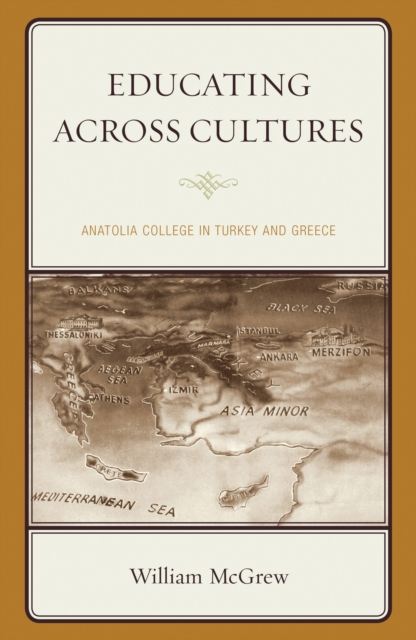
This compelling book chronicles the challenges faced by Anatolia College, whose rich history provides a unique window on the American missionary movement, the Armenian genocides, the Greek-Turkish conflict, and two world wars from the prism of the survival and growth of an American college caught in near-perpetual upheaval.
eBook

Redemption and Revolution
In the early twentieth century, a good number of college-educated Protestant American women went abroad by taking up missionary careers in teaching, nursing, and medicine. Most often, their destination was China, which became a major mission field for the U.S. Protestant missionary movement as the United States emerged to become an imperial power. These missionary women formed a cohort of new women who sought to be liberated from traditional gender roles. As educators and benevolent emancipators, they attempted to transform Chinese women into self-sufficient middle-class professional women just like themselves. As Motoe Sasaki shows inRedemption and Revolution, these aspirations ran parallel to and were in conflict with those of the Chinesexin nüxing(New Women) they encountered.
The subjectivity of the New Woman was an element of global modernity expressing gendered visions of progress. At the same time it was closely intertwined with the view of historical progress in the nation. Though American and Chinese New Women emphasized individual autonomy in that each sought to act as historical agents for modern progress, their notions of subjectivity were in different ways linked to the ideologies of historical progress of their nations. Sasaki's transnational history of these New Women explores the intersections of gender, modernity, and national identity within the politics of world history, where the nation-state increased its presence as a universal unit in an ever-interconnecting global context.
eBook
The Bible and the Gun
This book takes a new look at the impacts of Christianity in the late-nineteenth-century China. Using American Baptist and English Presbyterian examples in Guangdong province, it examines the scale of Chinese conversions, the creation of Christian villages, and the power relations between Christians and non-Christians, and between different Christian denominations. This book is based on a very comprehensive foundation of data. By supplementing the Protestant missionary and Chinese archival materials with fieldwork data that were collected in several Christian villages, this study not only highlights the inner dynamics of Chinese Christianity but also explores a variety of crisis management strategies employed by missionaries, Christian converts, foreign diplomats and Chinese officials in local politics.
eBook