
Catalogue Search | MBRL


Are you sure you want to remove the book from the shelf?

{{itemTitle}}
38,966
result(s) for
"Missouri"
Sort by:


Mapping Decline
Once a thriving metropolis on the banks of the Mississippi, St. Louis, Missouri, is now a ghostly landscape of vacant houses, boarded-up storefronts, and abandoned factories. The Gateway City is, by any measure, one of the most depopulated, deindustrialized, and deeply segregated examples of American urban decay. \"Not a typical city,\" as one observer noted in the late 1970s, \"but, like a Eugene O'Neill play, it shows a general condition in a stark and dramatic form.\"
Mapping Declineexamines the causes and consequences of St. Louis's urban crisis. It traces the complicity of private real estate restrictions, local planning and zoning, and federal housing policies in the \"white flight\" of people and wealth from the central city. And it traces the inadequacy-and often sheer folly-of a generation of urban renewal, in which even programs and resources aimed at eradicating blight in the city ended up encouraging flight to the suburbs. The urban crisis, as this study of St. Louis makes clear, is not just a consequence of economic and demographic change; it is also the most profound political failure of our recent history.
Mapping Declineis the first history of a modern American city to combine extensive local archival research with the latest geographic information system (GIS) digital mapping techniques. More than 75 full-color maps-rendered from census data, archival sources, case law, and local planning and property records-illustrate, in often stark and dramatic ways, the still-unfolding political history of our neglected cities.
eBook

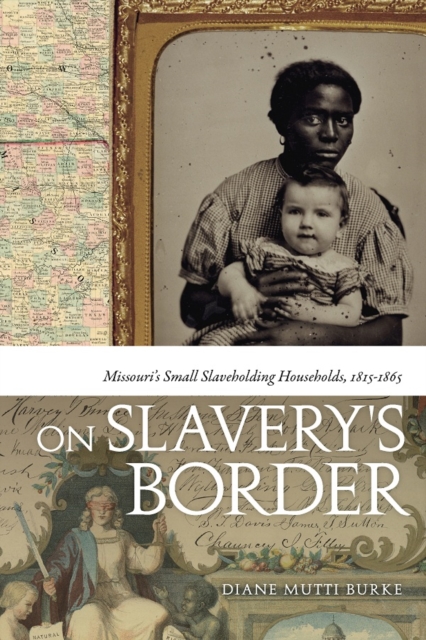
On Slavery's Border
On Slavery's Borderis a bottom-up examination of how slavery and slaveholding were influenced by both the geography and the scale of the slaveholding enterprise. Missouri's strategic access to important waterways made it a key site at the periphery of the Atlantic world. By the time of statehood in 1821, people were moving there in large numbers, especially from the upper South, hoping to replicate the slave society they'd left behind.
Diane Mutti Burke focuses on the Missouri counties located along the Mississippi and Missouri rivers to investigate small-scale slavery at the level of the household and neighborhood. She examines such topics as small slaveholders' child-rearing and fiscal strategies, the economics of slavery, relations between slaves and owners, the challenges faced by slave families, sociability among enslaved and free Missourians within rural neighborhoods, and the disintegration of slavery during the Civil War. Mutti Burke argues that economic and social factors gave Missouri slavery an especially intimate quality. Owners directly oversaw their slaves and lived in close proximity with them, sometimes in the same building. White Missourians believed this made for a milder version of bondage. Some slaves, who expressed fear of being sold further south, seemed to agree.
Mutti Burke reveals, however, that while small slaveholding created some advantages for slaves, it also made them more vulnerable to abuse and interference in their personal lives. In a region with easy access to the free states, the perception that slavery was threatened spawned white anxiety, which frequently led to violent reassertions of supremacy.
eBook


The Missouri Home Guard
Missouri was one of many states that established a defense organization to take over the duties of the National Guard that had been federalized for military service when the United States declared war on Germany in 1917. The tasks of this volunteer Home Guard included traditional National Guard responsibilities such as providing introductory military training for draftable men, protecting crucial infrastructure from potential enemy activities, and maintaining law and order during labor activism. The Home Guard also functioned to preserve patriotism and reduce opposition to the war. Service in the Guard was a way to show loyalty to one's country, particularly for German Americans, who were frequently under suspicion as untrustworthy. Many German Americans in Missouri enthusiastically signed up to dispel any whispers of treason, while others found themselves torn between the motherland and their new homeland. Men too old or exempt from the draft for other reasons found meaning in helping with the war effort through the Home Guard while also garnering respect from the community. For similar reasons, women attempted to join the organization as did African Americans, some of whom formed units of a \"Negro Home Guard.\" Informed by the dynamics of race, gender, and ethnicity, DeWitt's consideration of this understudied but important organization examines the fluctuating definition of patriotism and the very real question of who did and who did not have the privilege of citizenship and acceptance in society.
eBook


American confluence : the Missouri frontier from borderland to border state
In the heart of North America, the Missouri, Ohio, and Mississippi rivers
come together, uniting waters from west, north, and east on a journey to the south.
This is the region that Stephen Aron calls the American Confluence. Aron's
innovative book examines the history of that region -- a home to the Osage, a colony
exploited by the French, a new frontier explored by Lewis and Clark -- and focuses
on the region's transition from a place of overlapping borderlands to one of
oppositional border states. American Confluence is a lively account that will
delight both the amateur and professional historian.
eBook


Gender and the Jubilee
Gender and the Jubilee is a bold reconceptualization of black freedom during the Civil War that uncovers the political and constitutional claims made by African American women. By analyzing the actions of women in the urban environment of St. Louis and the surrounding areas of rural Missouri, Romeo uncovers the confluence of military events, policy changes, and black agency that shaped the gendered paths to freedom and citizenship. During the turbulent years of the Civil War crisis, African American women asserted their vision of freedom through a multitude of strategies. They took concerns ordinarily under the jurisdiction of civil courts, such as assault and child custody, and transformed them into military matters. African American women petitioned military police for \"free papers\"; testified against former owners; fled to contraband camps; and \"joined the army\" with their male relatives, serving as cooks, laundresses, and nurses. Freedwomen, and even enslaved women, used military courts to lodge complaints against employers and former masters, sought legal recognition of their marriages, and claimed pensions as the widows of war veterans. Through military venues, African American women in a state where the institution of slavery remained unmolested by the Emancipation Proclamation, demonstrated a claim on citizenship rights well before they would be guaranteed through the establishment of the Fourteenth Amendment. The litigating slave women of antebellum St. Louis, and the female activists of the Civil War period, left a rich legal heritage to those who would continue the struggle for civil rights in the postbellum era.
eBook