
Catalogue Search | MBRL


Are you sure you want to remove the book from the shelf?

{{itemTitle}}
4,874
result(s) for
"Mixture distributions"
Sort by:

Mixtures : estimation and applications
This book uses the EM (expectation maximization) algorithm to simultaneously estimate the missing data and unknown parameter(s) associated with a data set.The parameters describe the component distributions of the mixture; the distributions may be continuous or discrete.
eBook

A Dictionary Approach to Electron Backscatter Diffraction Indexing
We propose a framework for indexing of grain and subgrain structures in electron backscatter diffraction patterns of polycrystalline materials. We discretize the domain of a dynamical forward model onto a dense grid of orientations, producing a dictionary of patterns. For each measured pattern, we identify the most similar patterns in the dictionary, and identify boundaries, detect anomalies, and index crystal orientations. The statistical distribution of these closest matches is used in an unsupervised binary decision tree (DT) classifier to identify grain boundaries and anomalous regions. The DT classifies a pattern as an anomaly if it has an abnormally low similarity to any pattern in the dictionary. It classifies a pixel as being near a grain boundary if the highly ranked patterns in the dictionary differ significantly over the pixel’s neighborhood. Indexing is accomplished by computing the mean orientation of the closest matches to each pattern. The mean orientation is estimated using a maximum likelihood approach that models the orientation distribution as a mixture of Von Mises–Fisher distributions over the quaternionic three sphere. The proposed dictionary matching approach permits segmentation, anomaly detection, and indexing to be performed in a unified manner with the additional benefit of uncertainty quantification.
Journal Article

Mixture models of probability distributions applied to rainfall in the state of Pernambuco, Brazil
The Brazilian semi-arid region is recurrently affected by the scarcity of water that marks the landscape as it prints periods of severe drought. Therefore, rainfall in this region greatly influences plant growth in regional hydrological processes that affect droughts or floods. It is of practical interest to assess how changes in rainfall patterns occur to anticipate hydrological dynamics. However, this is not easy as climate change reshapes global hydrology. Thus, assertive forecasting has become rare and imputed estimates of a reasonable degree of uncertainty. The objective of this work was to verify from the mixture of exponential, gamma, beta, log-normal, Weibull, normal, log-logistic, and exponentiated log-logistic distributions, which best fits the monthly rainfall of the state of Pernambuco, Brazil. The data used came from 133 monthly rainfall series (1950 to 2012) distributed over the state of Pernambuco. The Maximum Likelihood Method estimated all parameters. The Kolmogorov-Smirnov adherence test was applied at 5% probability to assess the adjustments. The least rejected distributions in the adherence test were Weibull, gamma, and beta; October presented the smallest number of distributions considered adequate to model monthly rainfall. More than 99% of the rain gauge stations had some adequate probabilistic distribution to model monthly rainfall in March. For most months, except for March, the Weibull distribution was the most suitable for modeling the monthly rainfall in the vast majority of rain gauge stations of Pernambuco.
Journal Article

Chance-constrained games with mixture distributions
In this paper, we consider an n-player non-cooperative game where the random payoff function of each player is defined by its expected value and her strategy set is defined by a joint chance constraint. The random constraint vectors are independent. We consider the case when the probability distribution of each random constraint vector belongs to a subset of elliptical distributions as well as the case when it is a finite mixture of the probability distributions from the subset. We propose a convex reformulation of the joint chance constraint of each player and derive the bounds for players’ confidence levels and the weights used in the mixture distributions. Under mild conditions on the players’ payoff functions, we show that there exists a Nash equilibrium of the game when the players’ confidence levels and the weights used in the mixture distributions are within the derived bounds. As an application of these games, we consider the competition between two investment firms on the same set of portfolios. We use a best response algorithm to compute the Nash equilibria of the randomly generated games of different sizes.
Journal Article

Estimating Mixture Entropy with Pairwise Distances
Mixture distributions arise in many parametric and non-parametric settings—for example, in Gaussian mixture models and in non-parametric estimation. It is often necessary to compute the entropy of a mixture, but, in most cases, this quantity has no closed-form expression, making some form of approximation necessary. We propose a family of estimators based on a pairwise distance function between mixture components, and show that this estimator class has many attractive properties. For many distributions of interest, the proposed estimators are efficient to compute, differentiable in the mixture parameters, and become exact when the mixture components are clustered. We prove this family includes lower and upper bounds on the mixture entropy. The Chernoff α -divergence gives a lower bound when chosen as the distance function, with the Bhattacharyaa distance providing the tightest lower bound for components that are symmetric and members of a location family. The Kullback–Leibler divergence gives an upper bound when used as the distance function. We provide closed-form expressions of these bounds for mixtures of Gaussians, and discuss their applications to the estimation of mutual information. We then demonstrate that our bounds are significantly tighter than well-known existing bounds using numeric simulations. This estimator class is very useful in optimization problems involving maximization/minimization of entropy and mutual information, such as MaxEnt and rate distortion problems.
Journal Article
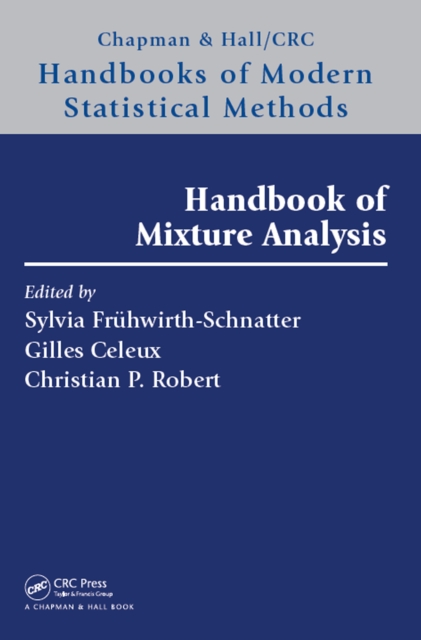
Handbook of Mixture Analysis
Mixture models have been around for over 150 years, and they are found in many branches of statistical modelling, as a versatile and multifaceted tool. They can be applied to a wide range of data: univariate or multivariate, continuous or categorical, cross-sectional, time series, networks, and much more. Mixture analysis is a very active research topic in statistics and machine learning, with new developments in methodology and applications taking place all the time.
The Handbook of Mixture Analysis is a very timely publication, presenting a broad overview of the methods and applications of this important field of research. It covers a wide array of topics, including the EM algorithm, Bayesian mixture models, model-based clustering, high-dimensional data, hidden Markov models, and applications in finance, genomics, and astronomy.
Features:
Provides a comprehensive overview of the methods and applications of mixture modelling and analysis
Divided into three parts: Foundations and Methods; Mixture Modelling and Extensions; and Selected Applications
Contains many worked examples using real data, together with computational implementation, to illustrate the methods described
Includes contributions from the leading researchers in the field
The Handbook of Mixture Analysis is targeted at graduate students and young researchers new to the field. It will also be an important reference for anyone working in this field, whether they are developing new methodology, or applying the models to real scientific problems.
Part I: Foundations and Methods
Introduction to Finite Mixtures - Peter J. Green
EM Methods for Finite Mixtures - Gilles Celeux
An Expansive View of EM Algorithms - David R. Hunter, Prabhani Kuruppumullage Don, and Bruce G. Lindsay
Bayesian Mixture Models: Theory and Methods - Judith Rousseau, Clara Grazian, and Jeong Eun Lee
Computational Solutions for Bayesian Inference in Mixture Models - Gilles Celeux, Kaniav Kamary, Gertraud Malsiner Walli, Jean-Michel Marin, and Christian P. Robert
Nonparametric Bayesian Mixture Models - Peter Müller
Model Selection for Mixture Models – Perspectives and Strategies - Gilles Celeux, Sylvia Frühwirth-Schnatter and Christian P. Robert
Part II: Mixture Modelling and Extensions
Model-based Clustering - Bettina Grün
Mixture Modelling of Discrete Data - Dimitris Karlis
Continuous Mixtures with Skewness and Heavy Tails - David Rossell and Mark F.J. Steel
Mixture Modelling of High-Dimensional Data - Damien McParland and Thomas Brendan Murphy
Mixtures of Experts Models - Isobel Claire Gormley and Sylvia Frühwirth-Schnatter
Hidden Markov Models in Time Series, with Applications in Economics - Sylvia Kaufmann
Mixtures of Nonparametric Components and Hidden Markov Models - Elisabeth Gassiat
Part III: Selected Applications
Applications in Industry - Kerrie Mengersen, Earl Duncan, Julyan Arbel, Clair Alston-Knox, Nicole White
Mixture Models for Image Analysis - Florence Forbes
Applications in Finance - John M. Maheu and Azam Shamsi Zamenjani
Applications in Genomics - Stéphane Robin and Christophe Ambroise
Applications in Astronomy - Michael A. Kuhn and Eric D. Feigelson
\"This is another handbook in the remarkable series by CRC Press, which now consists of 21 volumes. The book has 19 chapters, split in to three parts: Foundations and Methods, Mixture Modelling and Extensions, and Selected Applications. Many first-class statisticians have contributed to the book. The editors have taken their coordinating task seriously, even organizing a workshop in Vienna. The balance between the chapters is quite good and the notation is streamlined... To summarize, I can recommend this handbook... The technical quality of typesetting and printing is high.\" - Paul Eilers , Erasmus University Medical Centre, Netherlands, Appeared in ISCB News, January 2020
Sylvia Frühwirth-Schnatter is Professor of Applied Statistics and Econometrics at the Department of Finance, Accounting, and Statistics, Vienna University of Economics and Business, Austria. She has contributed to research in Bayesian modelling and MCMC inference for a broad range of models, including finite mixture and Markov switching models as well as state space models. She is particularly interested in applications of Bayesian inference in economics, finance, and business. She started to work on finite mixture and Markov switching models 20 years ago and has published more than 20 articles in this area in leading journals such as JASA, JCGS, and Journal of Applied Econometrics. Her monograph Finite Mixture and Markov Switching Models (2006) was awarded the Morris-DeGroot Price 2007 by ISBA. In 2014, she was elected Member of the Austrian Academy of Sciences.
Gilles Celeux is Director of research emeritus with INRIA Saclay-Île-de-France, France. He has conducted research in statistical learning, model-based clustering and model selection for more than 35 years and he leaded to Inria teams. His first paper on mixture modelling was written in 1981 and he is one of the co-organisators of the summer working group on model-based clustering since 1994. He has published more than 40 papers in international Journals of Statistics and wrote two textbooks in French on Classification. He was Editor-in-Chief of Statistics and Computing between 2006 and 2012 and he is the present Editor-in-Chief of the Journal of the French Statistical Society since 2012.
Christian P. Robert is Professor of Mathematics at CEREMADE, Université Paris-Dauphine, PSL Research University, France, and Professor of Statistics at the Department of Statistics, University of Warwick, UK. He has conducted research in Bayesian inference and computational methods covering Monte Carlo, MCMC, and ABC techniques, for more than 30 years, writing The Bayesian Choice (2001) and Monte Carlo Statistical Methods (2004) with George Casella. His first paper on mixture modelling was written in 1989 on radiograph image modelling. His fruitful collaboration with Mike Titterington on this topic spans two enjoyable decades of visits to Glasgow, Scotland. He has organised three conferences on the subject of mixture inference, with the last one at ICMS leading to the edited book Mixtures: Estimation and Applications (2011), co-authored with K. L. Mengersen and D. M. Titterington.
eBook
Feasibility of the expectation-maximization algorithm for assessing individuals with different sensory perceptions in discrimination of specialty coffees
The results of sensory evaluations of coffees are associated with latent factors, such as the particular subjectivity of each individual. Based on the foregoing, assessing the quality of a sensory panel for product discrimination basically depends on the statistical methodology to be used in data analysis. Following this argument, this study aimed to evaluate the feasibility of the EM - Expectation Maximization algorithm in discriminating groups of individuals, characterized by the degree of experience and knowledge in sensory analysis of coffees of different varieties, produced in the Serra da Mantiqueira micro-region, with different processing and altitudes. The main advantage of this algorithm is the fast convergence, when the current solution approaches the optimal solution with high precision. The disadvantage is because it is a deterministic optimization technique, which can only achieve a local optimization depending on the initialization, i.e., initial values input in the iterative procedure. It can be concluded that estimates of the correlation matrices obtained by the EM algorithm showed that the final grade has a greater influence of sweetness, in addition to discriminating groups of consumers with different sensory perceptions and in situations where the number of individuals in each group is unknown, the EM algorithm was accurate in estimating the proportion of individuals belonging to each group, assuming that the correlations of sensory responses follow a bivariate normal distribution.
Journal Article

Time series modelling to forecast the confirmed and recovered cases of COVID-19
Coronaviruses are enveloped RNA viruses from the Coronaviridae family affecting neurological, gastrointestinal, hepatic and respiratory systems. In late 2019 a new member of this family belonging to the Betacoronavirus genera (referred to as COVID-19) originated and spread quickly across the world calling for strict containment plans and policies. In most countries in the world, the outbreak of the disease has been serious and the number of confirmed COVID-19 cases has increased daily, while, fortunately the recovered COVID-19 cases have also increased. Clearly, forecasting the “confirmed” and “recovered” COVID-19 cases helps planning to control the disease and plan for utilization of health care resources. Time series models based on statistical methodology are useful to model time-indexed data and for forecasting. Autoregressive time series models based on two-piece scale mixture normal distributions, called TP–SMN–AR models, is a flexible family of models involving many classical symmetric/asymmetric and light/heavy tailed autoregressive models. In this paper, we use this family of models to analyze the real world time series data of confirmed and recovered COVID-19 cases.
Journal Article

CONVERGENCE OF LATENT MIXING MEASURES IN FINITE AND INFINITE MIXTURE MODELS
This paper studies convergence behavior of latent mixing measures that arise in finite and infinite mixture models, using transportation distances (i.e., Wasserstein metrics). The relationship between Wasserstein distances on the space of mixing measures and f-divergence functionals such as Hellinger and Kullback-Leibler distances on the space of mixture distributions is investigated in detail using various identifiability conditions. Convergence in Wasserstein metrics for discrete measures implies convergence of individual atoms that provide support for the measures, thereby providing a natural interpretation of convergence of clusters in clustering applications where mixture models are typically employed. Convergence rates of posterior distributions for latent mixing measures are established, for both finite mixtures of multivariate distributions and infinite mixtures based on the Dirichlet process.
Journal Article

Quasi-Monte Carlo methods for mixture distributions and approximated distributions via piecewise linear interpolation
We study numerical integration over bounded regions in$$\\mathbb {R}^s$$R s ,$$s \\ge 1$$s ≥ 1 , with respect to some probability measure. We replace random sampling with quasi-Monte Carlo methods, where the underlying point set is derived from deterministic constructions which aim to fill the space more evenly than random points. Ordinarily, such quasi-Monte Carlo point sets are designed for the uniform measure, and the theory only works for product measures when a coordinate-wise transformation is applied. Going beyond this setting, we first consider the case where the target density is a mixture distribution where each term in the mixture comes from a product distribution. Next, we consider target densities which can be approximated with such mixture distributions. In order to be able to use an approximation of the target density, we require the approximation to be a sum of coordinate-wise products and that the approximation is positive everywhere (so that they can be re-scaled to probability density functions). We use tensor product hat function approximations for this purpose here, since a hat function approximation of a positive function is itself positive. We also study more complex algorithms, where we first approximate the target density with a general Gaussian mixture distribution and approximate this mixture distribution with an adaptive hat function approximation on rotated intervals. The Gaussian mixture approximation allows us (at least to some degree) to locate the essential parts of the target density, whereas the adaptive hat function approximation allows us to approximate the finer structure of the target density. We prove convergence rates for each of the integration techniques based on quasi-Monte Carlo sampling for integrands with bounded partial mixed derivatives. The employed algorithms are based on digital ( t , s )-sequences over the finite field$$\\mathbb {F}_2$$F 2 and an inversion method. Numerical examples illustrate the performance of the algorithms for some target densities and integrands.
Journal Article