
Catalogue Search | MBRL


Are you sure you want to remove the book from the shelf?

{{itemTitle}}
18,946
result(s) for
"Modernism (Literature)"
Sort by:


Glamour in Six Dimensions
Glamour is an alluring but elusive concept. We most readily associate it with fashion, industrial design, and Hollywood of the Golden Age, and yet it also shaped the language and interests of high modernism. In Glamour in Six Dimensions, Judith Brown looks at the historical and aesthetic roots of glamour in the early decades of the twentieth century, arguing that glamour is the defining aesthetic of modernism. In the clean lines of modernism she finds the ideal conditions for glamour-blankness, polish, impenetrability, and the suspicion of emptiness behind it all. Brown focuses on several cultural products that she argues helped to shape glamour's meanings: the most significant perfume of the twentieth century, Chanel No. 5; the idea of the Jazz Age and its ubiquitous cigarette; the celebrity photograph; the staging of primitivism; and the invention of a shimmering plastic called cellophane. Alongside these artifacts, she takes up the development, refinement, and analysis of glamour in Anglo-American poetry, film, fiction, and drama of the period. Glamour in Six Dimensions thus asks its reader to see the proximity between the vernacular and elite cultures of modernism, and particularly how glamour was animated by artists working at the crossroads of the mundane and the extraordinary: Wallace Stevens, F. Scott Fitzgerald, Virginia Woolf, Josephine Baker, D. H. Lawrence, Gertrude Stein, Nella Larsen, and others.
eBook

Modernism : evolution of an idea
Modernism: Evolution of an Idea traces the development of the term \"modernism\" from cultural debates in the early twentieth century to the dynamic contemporary field of modernist studies. Rather than assuming and recounting the contributions of modernism's chief literary and artistic figures, this book focuses on critical formulations and reception through topics such as: the evolution of modernism from a pejorative term in intellectual arguments to its subsequent centrality to definitions of new art; new criticism and its legacies in the formation of the modernist canon in anthologies, classrooms, and literary histories; and shifting conceptions of modernism during the rise of gender and race studies, French theory, Marxist criticism, postmodernism, and more.
Book

The Great War and the language of modernism
In The Great War and the Language of Modernism, Vincent Sherry reopens long unanswered questions regarding the influence of the 1914 war on the verbal experiments of modernist poetry and fiction. Sherry recovers the political discourses of the British campaign and establishes the language to which literary modernism responds with its boldest initiatives. In its wholly new reading of Woolf, Eliot, and Pound, this book restores the historical content and depth of this literature and reveals its most daring import.
eBook

The Cambridge companion to modernism
\"This Companion has long been a standard introduction to the field. Now fully updated and enhanced with four new chapters, it addresses the key themes being researched, taught and studied in modernism today. Its interdisciplinary approach is central to its success as it brings together readings of the many varieties of modernism. Chapters address the major literary genres, the intellectual, religious and political contexts, and parallel developments in film, painting and music. The catastrophe of the First World War, the emergence of feminism, the race for empire, the conflict among classes: the essays show how these events and circumstances shaped aesthetic and literary experiments. In doing so, they explain clearly both the precise formal innovations in language, image, scene and tone, and the broad historical conditions of a movement that aspired to transform culture\"-- Provided by publisher.
Book

Trials of Arab Modernity
Challenging prevalent conceptualizations of modernity--which treat it either as a Western ideology imposed by colonialism or as a universal narrative of progress and innovation--this study instead offers close readings of the simultaneous performances and contestations of modernity staged in works by authors such as Rifa'a al-Tahtawi, Ahmad Faris al-Shidyaq, Tayeb Salih, Hanan al-Shaykh, Hamdi Abu Golayyel, and Ahmad Alaidy. In dialogue with affect theory, deconstruction, and psychoanalysis, the book reveals these trials to be a violent and ongoing confrontation with and within modernity. In pointed and witty prose, El-Ariss bridges the gap between Nahda (the so-called Arab project of Enlightenment) and postcolonial and postmodern fiction.
eBook


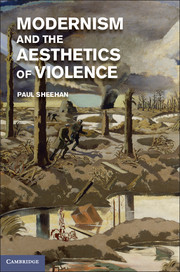
Modernism and the Aesthetics of Violence
The notion that violence can give rise to art - and that art can serve as an agent of violence - is a dominant feature of modernist literature. In this study Paul Sheehan traces the modernist fascination with violence to the middle decades of the nineteenth century, when certain French and English writers sought to celebrate dissident sexualities and stylized criminality. Sheehan presents a panoramic view of how the aesthetics of transgression gradually mutates into an infatuation with destruction and upheaval, identifying the First World War as the event through which the modernist aesthetic of violence crystallizes. By engaging with exemplary modernists such as Joyce, Conrad, Eliot and Pound, as well as lesser-known writers including Gautier, Sacher-Masoch, Wyndham Lewis and others, Sheehan shows how artworks, so often associated with creative well-being and communicative self-expression, can be reoriented toward violent and bellicose ends.
eBook