
Catalogue Search | MBRL


Are you sure you want to remove the book from the shelf?

{{itemTitle}}
211
result(s) for
"Monadology."
Sort by:

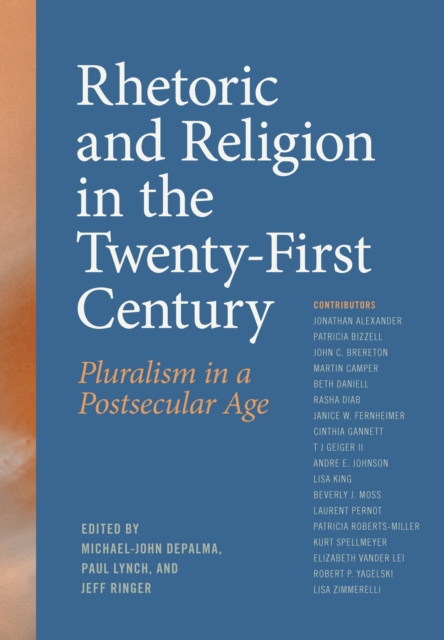
Rhetoric and Religion in the Twenty-First Century
Expanding the scope of religious rhetoric Over the past twenty-five years, the intersection of rhetoric and religion has become one of the most dynamic areas of inquiry in rhetoric and writing studies.
eBook

Nature, Spirit, and Spirituality in Husserl’s Phenomenology
This article deals with the relationship between Spirit (Geist) and Nature (Natur) in Husserl’s phenomenology and the potentially religious motifs involved in its treatment. I begin by outlining two different approaches that can be found in Husserl’s work regarding the dyad Nature-Spirit: firstly, a schematic opposition between the two, and secondly, the recognition of their fundamental intertwinement. I claim that, even in this second approach, there remains a sense of subordination of Nature to Spirit that is due to the transcendental character of Husserl’s phenomenology. I analyze this primacy in the context of Husserl’s monadological theory, bringing forward certain religious elements of his account in order to connect this notion of spirit to a more contemporary idea of spirituality.
Journal Article
Exploring Pluralism Issues: Language Policy and Cultural Diversity
This volume was first published by Inter-Disciplinary Press in 2015. This volume explores language policy and cultural diversity as areas which are influenced in multiple ways by pluralism, a field with an impact on all aspects of our lives.
eBook

KURT GÖDEL ON LOGICAL, THEOLOGICAL, AND PHYSICAL ANTINOMIES
This paper presents hitherto unpublished writings of Kurt Gödel concerning logical, epistemological, theological, and physical antinomies, which he generally considered as \"the most interesting facts in modern logic,\" and which he used as a basis for his famous metamathematical results. After investigating different perspectives on the notion of the logical structure of the antinomies and presenting two \"antinomies of the intensional,\" a new kind of paradox closely related to Gödel's ontological proof for the existence of God is introduced and completed by a compilation of further theological antinomies. Finally, after a presentation of unpublished general philosophical remarks concerning the antinomies, Gödel's type-theoretic variant of Leibniz' Monadology, discovered in his notes on the foundations of quantum mechanics, is examined. Most of the material presented here has been transcribed from the Gabelsberger shorthand system for the first time.
Journal Article

On Discrete Presheaf Monads
For a quantale I, which is a unit interval endowed with a continuous triangular norm and the Barr extension β¯I of the ultrafilter monad to I-Rel, a characterization of the discrete presheaf monad associated to β¯I is given. It is also proved that, when & is the Łucasiewicz triangular norm, the discrete presheaf monad is isomorphic to the saturated prefilter monad, and when & is the product triangular norm, the prime functional ideal monad is isomorphic to a submonad of the discrete presheaf monad.
Journal Article

The Binding Problem for Strong Experiential Monism
In this article, I explicate a new problem for a variant of panpsychism, strong experiential monism, that is the view that all being is experiential. I contrast the view with weak experiential monism, a softer variant that allows for non-experiential bare particulars to act as the carriers of properties. I argue that strong experiential monism can’t explain what works as the ontological commonality between the referents of one experience of something and another experience of that same thing; in other words, in virtue of what are those experiences about the same thing at all. If they aren’t about the same ontological existent at all, the apparent mutual coherence between these experiences (as manifest in our ability to discuss about them in a seemingly coherent way, for example) requires explanation. I argue that strong experiential monism necessitates a more or less brute kind of parallelism between the experiences to explain their mutual coherence. Alternatively, the strong experiential monist must either retreat to weak experiential monism and non-experiential bare particulars or to a more robust kind of property dualism or dual-aspect monism.
Journal Article

LEVELS OF TIME IN THE ZHUANGZI
In this article we investigate levels of time in the Zhuangzi, through a conceptual framework rooted in Leibniz’ philosophy of time. We begin by drawing three different levels of time in Leibniz: cognition-based, experience-based, and world-based. We then show that not only can parallel levels of time be identified in the Zhuangzi, but also a distinctively new, that is, fourth level of time can be distinguished, which pertains to bodily skill. We finally discuss the significance of this study in a contemporary context.
Journal Article

Jorge Luis Borges, la kenning, y la monadología lingüística
Este artículo explora la evolución de Jorge Luis Borges en cuanto al tema de la representación lingüística, y se centra en su transición que va de la complejidad metafórica a un uso más preciso y económico del lenguaje. A través de una lectura detallada de los textos de Borges, particularmente aquellos relacionados al uso de las kenningar, este estudio sostiene que Borges buscaba crear una “modesta y secreta complejidad” en su escritura, donde las mónadas lingüísticas pudieran encapsular profundas ideas filosóficas. Basado en las obras de Leibniz y Wittgenstein, el artículo rastrea cómo las preocupaciones metafísicas de Borges—especialmente las relacionadas con el tiempo, la identidad y el infinito—están intrínsecamente vinculadas a su exploración de las limitaciones y capacidades del lenguaje. Finalmente, el uso que hace Borges de las kenningar sirve como un puente entre la metáfora y la lógica, revelando su profundo compromiso filosófico con el problema de la representación. Esta investigación subraya la lucha constante de Borges por representar la realidad a través del lenguaje, reconociendo al mismo tiempo sus limitaciones inherentes.
This article explores Jorge Luis Borges’ evolving approach to linguistic representation, focusing on his transition from metaphorical complexity to a more precise, economic use of language. Through a close reading of Borges’ texts, particularly his engagement with kenning, this study argues that Borges sought to create a “modest and secret complexity” in his writing, where linguistic monads could encapsulate profound philosophical ideas. Drawing on the works of Leibniz and Wittgenstein, the article traces how Borges’ metaphysical concerns—especially those related to time, identity, and infinity—are intricately linked to his exploration of language’s limitations and capacities. Ultimately, Borges’ use of kenning serves as a bridge between metaphor and logic, revealing his deeper philosophical commitment to the problem of representation. This investigation underscores Borges’ enduring struggle to depict reality through language, while also acknowledging its inherent constraints.
Journal Article