
Catalogue Search | MBRL


Are you sure you want to remove the book from the shelf?

{{itemTitle}}
670
result(s) for
"Monastic life"
Sort by:


By Force and Fear
An unwilling, desperate nun trapped in the cloister, unable to gain release: such is the image that endures today of monastic life in early modern Europe. InBy Force and Fear, Anne Jacobson Schutte demonstrates that this and other common stereotypes of involuntary consignment to religious houses-shaped by literary sources such as Manzoni's The Betrothed-are badly off the mark.
Drawing on records of the Congregation of the Council, held in the Vatican Archive, Schutte examines nearly one thousand petitions for annulment of monastic vows submitted to the Pope and adjudicated by the Council during a 125-year period, from 1668 to 1793. She considers petitions from Roman Catholic regions across Europe and a few from Latin America and finds that, in about half these cases, the congregation reached a decision. Many women and a smaller proportion of men got what they asked for: decrees nullifying their monastic profession and releasing them from religious houses. Schutte also reaches important conclusions about relations between elders and offspring in early modern families. Contrary to the picture historians have painted of increasingly less patriarchal and more egalitarian families, she finds numerous instances of fathers, mothers, and other relatives (including older siblings) employing physical violence and psychological pressure to compel adolescents into \"entering religion.\" Dramatic tales from the archives show that many victims of such violence remained so intimidated that they dared not petition the pope until the agents of force and fear had died, by which time they themselves were middle-aged. Schutte's innovative book will be of great interest to scholars of early modern Europe, especially those who work on religion, the Church, family, and gender.
eBook

The name of the rose
In 1327, finding his sensitive mission at an Italian abbey further complicated by seven bizarre deaths, Brother William of Baskerville turns detective.
Book

Lives of the Anchoresses
In cities and towns across northern Europe in the twelfth and thirteenth centuries, a new type of religious woman took up authoritative positions in society, all the while living as public recluses in cells attached to the sides of churches. In Lives of the Anchoresses, Anneke Mulder-Bakker offers a new history of these women who chose to forsake the world but did not avoid it. Unlike nuns, anchoresses maintained their ties to society and belonged to no formal religious order. From their solitary anchorholds in very public places, they acted as teachers and counselors and, in some cases, theological innovators for parishioners who would speak to them from the street, through small openings in the walls of their cells. Available at all hours, the anchoresses were ready to care for the community's faithful whenever needed. Through careful biographical studies of five emblematic anchoresses, Mulder-Bakker reveals the details of these influential religious women. The life of the unnamed anchoress who was mother to Guibert of Nogent shows the anchoress's role as a spiritual guide in an oral culture. A study of Yvette of Huy shows the myriad possibilities open to one woman who eventually chose the life of an anchoress. The accounts of Juliana of Cornillon and Eve of St. Martin raise questions about the participation of religious women in theological discussions and their contributions to church liturgy. And the biographical study of Margaret the Lame of Magdeburg explores the anchoress's role as day-to-day religious instructor to the ordinary faithful.
eBook


Desert Christians
In the fourth century, the deserts of Egypt became the nerve center of a radical new movement, what we now call monasticism. Groups of Christians—from illiterate peasants to learned intellectuals—moved out to the wastelands beyond the Nile Valley and, in the famous words of Saint Athanasius, made the desert a city. In so doing, they captured the imagination of the ancient world. They forged techniques of prayer and asceticism, of discipleship and spiritual direction, that have remained central to Christianity ever since. Seeking to map the soul’s long journey to God and plot out the subtle vagaries of the human heart, they created and inspired texts that became classics of Western spirituality. These Desert Fathers were also brilliant storytellers, some of Christianity’s finest. This book introduces the literature of early Christian monasticism, examining all the best-known works, including Athanasius’ Life of Antony, the Lives of Pachomius, and the Sayings of the Fathers (Apophthegmata Patrum). Later chapters focus on two pioneers of monastic theology: Evagrius Ponticus, the first great theoretician of Christian mysticism; and John Cassian, who brought Egyptian monasticism to the Latin West. Along the way, readers are introduced to path-breaking discoveries—to new texts and recent archeological finds—that have revolutionized contemporary scholarship on monastic origins. Included are snippets from papyri and from little-known Coptic, Syriac, and Ethiopic texts. Interspersed in each chapter are illustrations, maps, and diagrams that help readers sort through the key texts and the richly textured world of early monasticism.
eBook

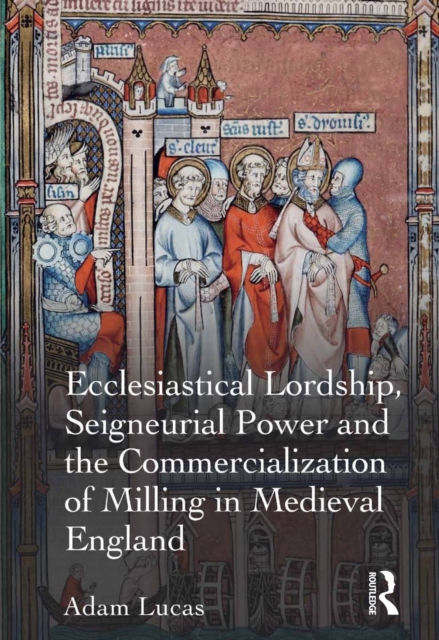
Ecclesiastical Lordship, Seigneurial Power and the Commercialization of Milling in Medieval England
This is the first detailed study of the role of the Church in the commercialization of milling in medieval England. Focusing on the period from the late eleventh to the mid sixteenth centuries, it examines the estate management practices of more than thirty English religious houses founded by the Benedictines, Cistercians, Augustinians and other minor orders, with an emphasis on the role played by mills and milling in the establishment and development of a range of different sized episcopal and conventual foundations. Contrary to the views espoused by a number of prominent historians of technology since the 1930s, the book demonstrates that patterns of mill acquisition, innovation and exploitation were shaped not only by the size, wealth and distribution of a house's estates, but also by environmental and demographic factors, changing cultural attitudes and legal conventions, prevailing and emergent technical traditions, the personal relations of a house with its patrons, tenants, servants and neighbours, and the entrepreneurial and administrative flair of bishops, abbots, priors and other ecclesiastical officials.
eBook

Embracing age : how Catholic Nuns became models of aging well
\"Embracing Age: How Catholic Nuns Became Models of Aging Well examines a community of individuals whose aging trajectories contrast mainstream American experiences. In mainstream American society, aging is presented as a \"problem,\" a state to be avoided as long as possible, a state that threatens one's ability to maintain independence, autonomy, control over one's surroundings. Aging \"well\" (or avoiding aging) has become a 21st century American preoccupation. Embracing Age provides a window into the everyday lives of American Catholic nuns who experience longevity and remarkable health and well-being at the end of life. Catholic nuns aren't only healthier in older age, they are healthier because they practice a culture of acceptance and grace around aging. Embracing Age demonstrates how aging in the convent becomes understood by the nuns to be a natural part of the life course, not one to be feared or avoided. Anna I. Corwin shows readers how Catholic nuns create a cultural community that provides a model for how to grow old, decline, and die that is both embedded in American culture and quite distinct from other American models\"-- Provided by publisher.
BOOK

The Garden of Delights
In The Garden of Delights, Fiona J. Griffiths offers the first major study of the Hortus deliciarum, a magnificently illuminated manuscript of theology, biblical history, and canon law written both by and explicitly for women at the end of the twelfth century. In so doing she provides a brilliantly persuasive new reading of female monastic culture. Through careful analysis of the contents, structure, and organization of the Hortus, Griffiths argues for women's profound engagement with the spiritual and intellectual vitality of the period on a level previously thought unimaginable, overturning the assumption that women were largely excluded from the \"renaissance\" and \"reform\" of this period. As a work of scholarship that drew from a wide range of sources, both monastic and scholastic, the Hortus provides a witness to the richness of women's reading practices within the cloister, demonstrating that it was possible, even late into the twelfth century, for communities of religious women to pursue an educational program that rivaled that available to men. At the same time, the manuscript's reformist agenda reveals how women engaged the pressing spiritual questions of the day, even going so far as to criticize priests and other churchmen who fell short of their reformist ideals.Through her wide-ranging examination of the texts and images of the Hortus, their sources, composition, and function, Griffiths offers an integrated understanding of the whole manuscript, one which highlights women's Latin learning and orthodox spirituality. The Garden of Delights contributes to some of the most urgent questions concerning medieval religious women, the interplay of gender, spirituality, and intellectual engagement, to discussions concerning women scribes and writers, women readers, female authorship and authority, and the visual culture of female communities. It will be of interest to art historians, scholars of women's and gender studies, historians of medieval religion, education, and theology, and literary scholars studying questions of female authorship and models of women's reading.
eBook