
Catalogue Search | MBRL


Are you sure you want to remove the book from the shelf?

{{itemTitle}}
622
result(s) for
"Monetary policy European Union countries."
Sort by:


The Great Eurozone Disaster
The last couple of years have seen the eurozone lurch from crisis to calamity. With Greece, Portugal and Ireland already driven to the brink of economic catastrophe, and the threat that a number of other EU countries are soon to follow, the consequences for the global economy are potentially dire. In The Great Eurozone Disaster, Heikki Patomäki dissects the current crisis, revealing its origins lie in the instability that has driven the process of financialisation since the early 1970s. Furthermore, the public debt crises in the European deficit countries have been aggravated rather than alleviated by the responses of the Commission and leaders of the surplus countries, especially Germany. Providing a captivating narrative about how Europe ended up in its present predicament, Patomäki presents a radical new vision for 'global economic democracy' as the only viable way out of the current crisis.
eBook

Making the European monetary union : the role of the Committee of Central Bank Governors and the origins of the European Central Bank
Europe's financial crisis cannot be blamed on the Euro, Harold James contends in this probing exploration of the whys, whens, whos, and what-ifs of European monetary union. The current crisis goes deeper, to a series of problems that were debated but not resolved at the time of the Euro's invention.
Book
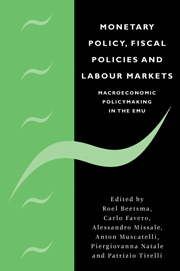
Monetary Policy, Fiscal Policies and Labour Markets
Following the birth of the European Monetary Union (EMU) economists are still divided in their assessment of the ability of its key institutions to provide macroeconomic stability and foster the reforms necessary to stimulate economic growth. In this collection, experts focus on issues of fiscal policy, monetary policy and labour markets and ask: Can the stability and growth pact provide an adequate framework for the conduct of national fiscal policies? Is the ECB reacting with competence and flexibility to a rapidly changing macroeconomic environment? How do national labour markets react to the macroeconomic institutions and what are the structural reforms needed in labour markets? Blending empirical and theoretical data, this book offers one of the most comprehensive surveys of research in macroeconomic policymaking within the EMU.
eBook

The crisis behind the Eurocrisis : the Eurocrisis as a multidimensional systemic crisis of the EU
The Crisis behind the Euro-Crisis encourages dialogue among scholars across the social sciences in an attempt to challenge the narrative that regarded the Euro-crisis as an exceptional event. It is suggested instead that the Euro-crisis, along with the subsequent crises the EU has come to face, was merely symptomatic of deeper systemic cracks. This book's aim is to uncover that hidden systemic crisis - the 'crisis behind the Euro-crisis'. Under this reading it emerges that what needs to be questioned is not only the allegedly purely economic character of the Euro-crisis, but, more fundamentally, its very classification as an 'emergency'. Instead, the Euro-crisis needs to be regarded as expressive of a chronic, dysfunctional, but 'normal' condition of the EU. By following this line of analysis, this book illuminates not only the causes of contemporary turbulences in the European project, but perhaps the 'true' nature of the EU itself.
Book

Europe's Crisis, Europe's Future
The eurozone crisis started in Greece in 2009-10, spread into Ireland and Portugal, and, from there, quickly spread to the larger economies of Spain and Italy. By the autumn of 2011, it threatened the entire global financial system. InEurope's Crisis, Europe's Future, an international group of economic analysts provides an insightful view of the crisis.
How did mismanagement of a crisis in a marginal economy spark such a wildfire? After all, Greece is responsible for only 2% of the eurozone's total GDP, yet the crisis in Athens threatened to grow into a worldwide contagion.
Individual chapters describe
• the onset, evolution, and ramifications of the euro crisis from the perspective of three countries especially hard hit-Greece, Italy, and Spain;
• the concerns, priorities, and impacts in continental leaders France and Germany;
• the effects and lessons in key policy contexts-national and international finance and social policies.
A concluding chapter by Kemal Dervi discusses the possibility of a renewed vision for the European Union in the 2020s, one that would accommodate the needs of greater political integration in the eurozone within a larger European Union where some countries, such as the United Kingdom, will keep their national currencies.
Contents
Introduction: Kemal Dervi and Jacques Mistral (Brookings)
Country Perspectives1. Greece, by Theodore Pelagidis and Michael Mitsopoulos (Brookings)
2. Spain, by Angel Pascual-Ramsay (Brookings and ESADE Business School)
3. Italy, by Domenico Lombardi (Centre for International Governance Innovation) and Luigi Paganetto (University of Rome)
4. France, by Jacques Mistral
5. Germany, by Friedrich Heinemann (Center for European Economic Research) Cross-Cutting Issues
6. The Financial Sector, by Douglas Elliott (Brookings)
7. Social Policies, by Jacques Mistral
Conclusion, by Kemal Dervi
eBook

Monetary policy transmission in the Euro area : a study by the Eurosystem Monetary Transmission Network
This is a systematic analysis of the impact of European Central Bank monetary policy on Euro-zone national economies.
Book

Making the European monetary union : the role of the Committee of Central Bank Governors and the origins of the European Central Bank
Intro -- Contents -- List of Figures -- Foreword by Mario Draghi and Jaime Caruana -- Abbreviations Used in Text -- Introduction: The Making of a Non-National Currency -- 1. A Napoleonic Prelude -- 2. The Origins of the Committee of Governors -- 3. The Response to Global Monetary Turbulence -- 4. The Snake and Other Animals -- 5. Negotiating the European Monetary System -- 6. The Malaise of the 1980s -- 7. The Delors Committee and the Relaunching of Europe -- 8. Designing a Central Bank -- 9. The EMS Crises -- Conclusion: The Euro and the Legacy of the Committee of Governors -- Appendix A: Maastricht Treaty Text and Committee of Governors' Draft of the Statute of the European Monetary Institute -- Appendix B: Maastricht Treaty Text and Committee of Governors' Draft of the Statute of the European Central Bank -- Appendix C: Dramatis Personae -- Appendix D: Members of the Committee of Governors -- Appendix E: Committee for the Study of Economic and Monetary Union (Delors Committee), 1988- 1989 -- Appendix F: Chairmen of the Monetary Committee of the European Community, 1958- 1998 -- Appendix G: European Commission Presidents and Commissioners for Economics and Finance, 1958- -- Appendix H: Chronology -- Appendix I: Interest Rates and Fiscal Balance -- Notes -- Acknowledgments -- Index.
eBook


From Convergence to Crisis
What explains Eurozone member-states' divergent exposure to Europe's sovereign debt crisis? Deviating from current fiscal and financial views,From Convergence to Crisisfocuses on labor markets in a narrative that distinguishes the winners from the losers in the euro crisis. Alison Johnston argues that Europe's monetary union was structured in a way that advantaged the corporatist labor markets of its northern economies in external trade and financial lending. Northern Europe's distinct economic advantage lay not with its fiscal capabilities, which were not that different from those of southern Eurozone countries, but with its wage-setting institutions. Through highly coordinated collective bargaining, the euro North persistently undercut the inflation performance of southern trading partners, destining them to a perpetual cycle of competitive decline and external borrowing. While northern Europe's corporatist labor markets were always low inflation performers, monetary union ultimately made their wage-setting institutions toxic for the South.
The euro's institutional predecessor, the European Monetary System, included economic and institutional mechanisms that facilitated macroeconomic adjustment and convergence between the common currency's corporatist and noncorporatist economies. Combining cross-national statistical analysis with detailed qualitative case studies of Denmark, Germany, Italy, Ireland, the Netherlands, and Spain, Johnston reveals that monetary union's removal of these mechanisms allowed external imbalances between these two blocs to grow unchecked, underpinning the crisis in which Europe currently finds itself. Rather than achieving the EU's goal of an ever-closer union, the common currency produced a monetary environment that destabilized the economic integration of its diverse labor markets.
eBook