
Catalogue Search | MBRL


Are you sure you want to remove the book from the shelf?

{{itemTitle}}
833,436
result(s) for
"Money"
Sort by:

Money madness
This beginning guide to economics will have readers thinking about the purpose, and not just the value, of money. From bartering, early forms of currency, credit cards, and digital payment, here is a clear and thorough introduction to money.
Book

A Monetary History of the United States, 1867-1960
Writing in the June 1965 issue of theEconomic Journal, Harry G. Johnson begins with a sentence seemingly calibrated to the scale of the book he set himself to review: \"The long-awaited monetary history of the United States by Friedman and Schwartz is in every sense of the term a monumental scholarly achievement--monumental in its sheer bulk, monumental in the definitiveness of its treatment of innumerable issues, large and small . . . monumental, above all, in the theoretical and statistical effort and ingenuity that have been brought to bear on the solution of complex and subtle economic issues.\"
Friedman and Schwartz marshaled massive historical data and sharp analytics to support the claim that monetary policy--steady control of the money supply--matters profoundly in the management of the nation's economy, especially in navigating serious economic fluctuations. In their influential chapter 7,The Great Contraction--which Princeton published in 1965 as a separate paperback--they address the central economic event of the century, the Depression. According to Hugh Rockoff, writing in January 1965: \"If Great Depressions could be prevented through timely actions by the monetary authority (or by a monetary rule), as Friedman and Schwartz had contended, then the case for market economies was measurably stronger.\"
Milton Friedman won the Nobel Prize in Economics in 2000 for work related toA Monetary Historyas well as to his other Princeton University Press book,A Theory of the Consumption Function(1957).
eBook


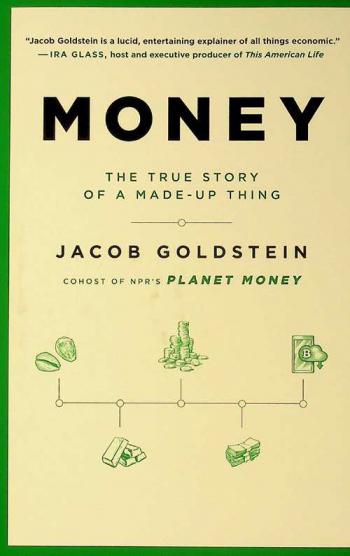
Money : the true story of a made-up thing
\"What is money anyway, and where and why did it originate? According to Jacob Goldstein, this made-up thing has evolved over centuries and takes different forms based on technological advances, the needs of society, and often the crazy ideas of outliers on the fringes. Told through witty, historical anecdotes, Goldstein demystifies this ever-evolving tool from the invention of the first coins in Mesopotamia, to how China invented paper money centuries before it appeared in the west, how at one point in Sweden men carried giant \"coins\" on their backs to pay for goods, to the gold standard, pound sterling, origins of the Euro, mutual funds, bitcoin and a cashless society. Money presents entertaining tales of fascinating characters who fundamentally changed our monetary systems such as Genghis Khan, John Law, a convicted murderer and professional gambler, the Luddites, and the anarchist cyberpunks who created bitcoin. Through these major movements we see the rise and fall of various financial institutions: central banks, the stock market, the Federal Reserve, and the shadow institutions like Lehman Brothers that helped create the financial crisis of 2008. Lively and accessible and full of interesting tidbits (the word \"banker\" comes from the Venetian \"bench sitters\"-or \"banchieri\"-of the 1600s who guarded the gold) Goldstein looks at the evolution of money (whose definition appears to be, if we all agree it's money, then it is money) and confronts its true purpose and who it is supposed to be for\"-- Provided by publisher.


Money
Examines, in text and photographs, the symbolic and material meaning of money, from shekels, shells, and beads to gold, silver, checks, credit cards, and smart cards. Also discusses how coins and banknotes are made, the value of money during wartime, and how to collect coins.
Book


Learn about money
\"Introduces young readers to different types of money and how people can use it to buy goods and services\"-- Provided by publisher.
Book
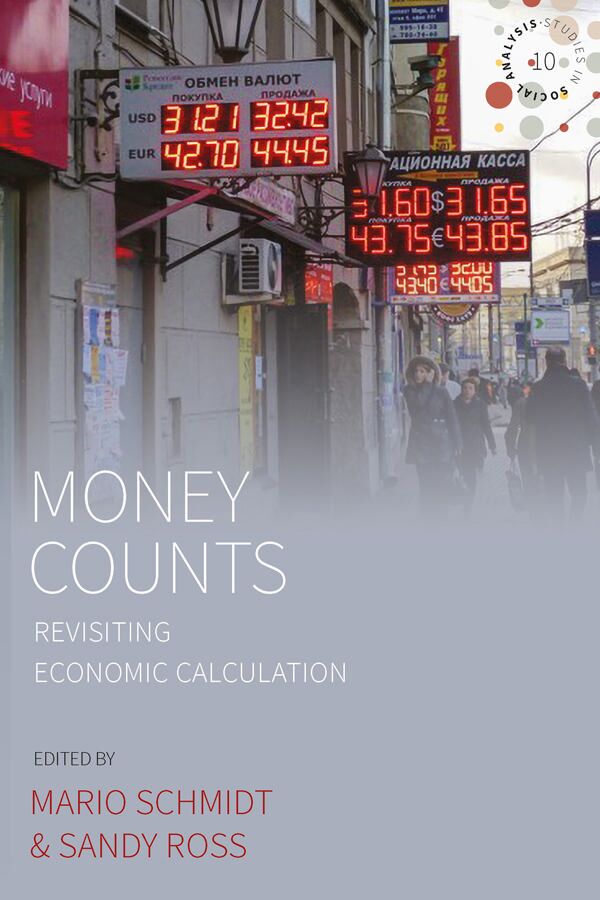
Money Counts
Traditionally viewed as an abstraction, the quantitative nature
of money is essential in evaluating the relationship between
monetary systems and society. Money Counts moves beyond
abstraction, exploring the conceptual diversity and everyday
enactment of money's quantity. Drawing from case studies including
British jewelers, blood-money payments in Germanic law codes, and
the quotidian use of money in cosmopolitical Moscow, a Western
Kenyan village, and socialist Havana, the chapters in this volume
offer new theoretical and empirical interpretations of money's
quantitative nature as it relates to abstraction, sociality,
materiality, freedom, and morality.
eBook