
Catalogue Search | MBRL


Are you sure you want to remove the book from the shelf?

{{itemTitle}}
9,554
result(s) for
"Money History."
Sort by:

Money madness
This beginning guide to economics will have readers thinking about the purpose, and not just the value, of money. From bartering, early forms of currency, credit cards, and digital payment, here is a clear and thorough introduction to money.
Book

A monetary history of the United States, 1867-1960
No detailed description available for \"A Monetary History of the United States, 1867-1960\".
eBook


Money in the German-speaking lands
Money is more than just a medium of financial exchange: across time and place, it has performed all sorts of cultural, political, and social functions. This volume traces money in German-speaking Europe from the late Renaissance until the close of the twentieth century, exploring how people have used it and endowed it with multiple meanings. The fascinating studies gathered here collectively demonstrate money's vast symbolic and practical significance, from its place in debates about religion and the natural world to its central role in statecraft and the formation of national identity.
eBook
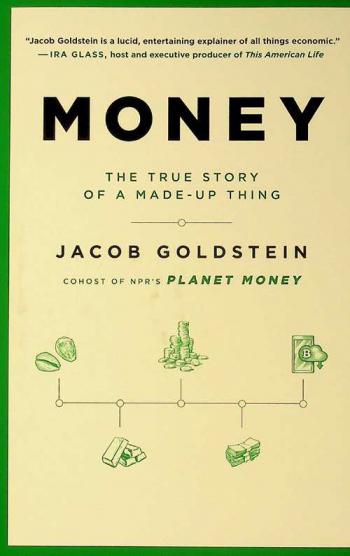
Money : the true story of a made-up thing
\"What is money anyway, and where and why did it originate? According to Jacob Goldstein, this made-up thing has evolved over centuries and takes different forms based on technological advances, the needs of society, and often the crazy ideas of outliers on the fringes. Told through witty, historical anecdotes, Goldstein demystifies this ever-evolving tool from the invention of the first coins in Mesopotamia, to how China invented paper money centuries before it appeared in the west, how at one point in Sweden men carried giant \"coins\" on their backs to pay for goods, to the gold standard, pound sterling, origins of the Euro, mutual funds, bitcoin and a cashless society. Money presents entertaining tales of fascinating characters who fundamentally changed our monetary systems such as Genghis Khan, John Law, a convicted murderer and professional gambler, the Luddites, and the anarchist cyberpunks who created bitcoin. Through these major movements we see the rise and fall of various financial institutions: central banks, the stock market, the Federal Reserve, and the shadow institutions like Lehman Brothers that helped create the financial crisis of 2008. Lively and accessible and full of interesting tidbits (the word \"banker\" comes from the Venetian \"bench sitters\"-or \"banchieri\"-of the 1600s who guarded the gold) Goldstein looks at the evolution of money (whose definition appears to be, if we all agree it's money, then it is money) and confronts its true purpose and who it is supposed to be for\"-- Provided by publisher.

Money in a human economy
A human economy puts people first in emergent world society. Money is a human universal and now takes the divisive form of capitalism. This book addresses how to think about money (from Aristotle to the daily news and the sexual economy of luxury goods); its contemporary evolution (banking the unbanked and remittances in the South, cross-border investment in China, the payments industry and the politics of bitcoin); and cases from 19th century India and Southern Africa to contemporary Haiti and Argentina. Money is one idea with diverse forms. As national monopoly currencies give way to regional and global federalism, money is a key to achieving economic democracy.
eBook

Sacred economics : money, gift, & society in the age of transition
\"Sacred Economics traces the history of money from ancient gift economies to modern capitalism, revealing how the money system has contributed to alienation, competition, and scarcity, destroyed community, and necessitated endless growth. Today, these trends have reached their extreme--but in the wake of their collapse, we may find great opportunity to transition to a more connected, ecological, and sustainable way of being. This book is about how the money system will have to change--and is already changing--to embody this transition. A broadly integrated synthesis of theory, policy, and practice, Sacred Economics explores avant-garde concepts of the New Economics, including negative-interest currencies, local currencies, resource-based economics, gift economies, and the restoration of the commons. Author Charles Eisenstein also considers the personal dimensions of this transition, speaking to those concerned with \"right livelihood\" and how to live according to their ideals in a world seemingly ruled by money. Tapping into a rich lineage of conventional and unconventional economic thought, Sacred Economics presents a vision that is original yet commonsense, radical yet gentle, and increasingly relevant as the crises of our civilization deepen\"-- Provided by publisher.
Book

Money Matters in European Artworks and Literature, c. 1400-1750
Money Matters in European Artworks and Literature, c. 1400-1750 focuses on coins as material artefacts and agents of meaning in early modern arts. The precious metals, double-sided form, and emblematic character of coins had deep resonance in European culture and cultural encounters. Coins embodied Europe's power and the labour, increasingly located in colonised regions, of extracting gold and silver. Their efficacy depended on faith in their inherent value and the authority perceived to be imprinted into them, guaranteed through the institution of the Mint. Yet they could speak eloquently of illusion, debasement and counterfeiting. A substantial introduction precedes essays by interdisciplinary scholars on five themes: power and authority in the Mint; currency and the anxieties of global trade; coins and persons; coins in and out of circulation; credit and risk. An Afterword on a contemporary artist demonstrates the continuing expressive and symbolic power of numismatic forms.
eBook

Symbols of power : ten coins that changed the world
Money makes the world. For millennia, currencies have brought order (and disorder) to human society, directing trade, building economies, developing national identities and religion--and spreading empires. More than ever, money's power to shape our character, our daily lives, and our universal condition is clear. This revelatory history of ten major currencies details the trajectory of world civilization tied to the movement of money. From the earliest measurements of precious metals to the global fiat currencies we use today, the evolution of these dominant money systems plots the rise and fall of influential rulers, governments, and imperial powers. These coins have acted as powerful symbols of political expression and continuity despite deeply disruptive social, economic, and political change. Rich with illustrations from the famous collections at the British Museum and elsewhere, this book charts the fascinating path of each coin as it has traveled through history.
Book

A Global History of Money
Looking from the 11th century to the 20th century, Kuroda explores how money was used and how currencies evolved in transactions within local communities and in broader trade networks. The discussion covers Asia, Europe and Africa and highlights an impressive global interconnectedness in the pre-modern era as well as the modern age.
Drawing on a remarkable range of primary and secondary sources, Kuroda reveals that cash transactions were not confined to dealings between people occupying different roles in the division of labour (for example shopkeepers and farmers), rather that peasants were in fact great users of cash, even in transactions between themselves. The book presents a new categorization framework for aligning exchange transactions with money usage choices.
This fascinating monograph will be of great interest to advanced students and researchers of economic history, financial history, global history and monetary studies.
eBook