
Catalogue Search | MBRL


Are you sure you want to remove the book from the shelf?

{{itemTitle}}
3,913
result(s) for
"Montréal"
Sort by:


Ways of belonging : undocumented youth in the shadow of illegality
Hart–SLSA Prize for Early Career Academics, Socio-Legal Studies Association Ways of Belonging examines the experiences of undocumented young people who are excluded from K–12 schools in Canada and are rendered invisible to the education system. Canadian law doesn't mention the existence of undocumented children, and thus their access to education rests on discretionary practices and is often denied altogether. This book brings the stories of undocumented young people vividly alive, putting them into conversation with the perspectives of the different actors in schools and courts who fail to include these young people. Drawing on long-term ethnographic fieldwork, Francesca Meloni shows how ambivalence shapes the lives of young people who are caught between the desire to belong and the impossibility of fully belonging. Meloni pays close attention to these young people's struggles and hopes, showing us what it means to belong and to endure in contexts of social exclusion. Ways of Belonging reveals the opacities and failures of a system that excludes children from education and puts their lives in invisibility mode. An interview with the author [https://www.qmul.ac.uk/clpn/news-views/book-interviews/items/interview-with-francesca-meloni-about-her-book-ways-of-belonging-undocumented-youth-in-the-shadow-of-illegality.html] (https://www.qmul.ac.uk/clpn/news-views/book-interviews/items/interview-with-francesca-meloni-about-her-book-ways-of-belonging-undocumented-youth-in-the-shadow-of-illegality.html)
eBook

The postman's fiancée
Tania moves from Bavaria to Montreal to fine-tune her French and fall in love. Finding work as a waitress at a low-key restaurant in a working-class area of the city, she meets Bilodo, a shy postman who writes haiku and who is passionate about calligraphy. The two hit it off but then one stormy day their lives take a dramatic turn, and as their destinies become increasingly entwined the two are led into a world where nothing is as it seems.
Book


Montreal, city of water : an environmental history
\"Built within an exceptional watershed, Montreal is intertwined with the waterways that ring its island and flow beneath it in underground networks. Montreal, City of Water focuses on water not only as a physical element - both shaping and shaped by urban development - but also as a sociocultural component of the life of the city. This unique study considers how water has produced and transformed urban space over two centuries. It traces the history of Montreal's urbanization, shining a light on current concerns about water pollution, rehabilitation, and public access to the riverfront - and on the power relations involved in addressing them.\"-- Provided by publisher.
Book

Wife to Widow
The diversity of women's lives as wives then as widows negotiating the law, patriarchy, family relationships, and the economy in 19th-century Montreal come alive in this first major study of widows in Canada.
eBook

Griffintown : identity and memory in an Irish diaspora neighbourhood
\"This vibrant biography of Griffintown, an inner-city Montreal neighbourhood, brings to life the history of Irish identity in the legendary enclave. As Irish immigration dwindled in the early twentieth century, Irish culture in the city became diasporic, reflecting an imagined homeland. Focusing on the power of memory to shape community, Matthew Barlow finds that, despite sociopolitical pressures and a declining population, the spirit of this ethnic quarter was nurtured by the men and women who grew up there. Today, as Griffintown attracts renewed interest from artists, scholars, and tourists, this textured analysis reveals how public memory defines our urban centres.\"-- Provided by publisher.
Book
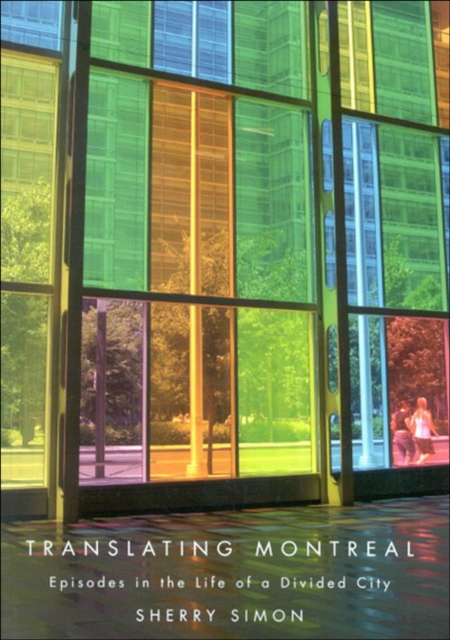
Translating Montreal
Translating Montreal follows the trajectories of adventurous cultural translators such as Malcolm Reid, F.R. Scott, and A.M. Klein - pioneers of the 1950s and 1960s - Pierre Anctil, whose translations from Yiddish to French are emblematic of the dramatic reroutings now occurring across the Montreal landscape, and contemporary writer-translators such as Gail Scott, Erin Mouré, Jacques Brault, Michel Garneau, Nicole Brossard, and Emile Ollivier. Simon argues that translation is a dynamic and subtle tool for analysing cultural contact. An original take on cultural relations in the city, Translating Montreal explores the emergence of the \"new\" Montrealer. No longer \"Franco-Québécois,\" \"Anglo-Québécois,\" \"immigrant,\" or \"ethnic,\" the new Montrealer is a citizen of a mixed and cosmopolitan city.
eBook

Making Public Pasts
Gordon shows that while individual memory is crucial to establishing and maintaining identity, public memory is contested terrain - official customs and traditions, monuments, historic sites, and the celebration of anniversaries and festivals serve to order individual and collective perceptions of the past. Public memory is therefore the product of competitions and ideas about the past that are fashioned in a public sphere and speak primarily about structures of power. It conscripts historical events in a bid to guide shared memories into a coherent narrative that helps individuals negotiate their place in broader collective identities. The contest over public memories involves an exclusiveness that packages \"others\" according to the ideological preferences of the dominant cultures. Gordon shows that in Montreal ethnic, class, and gender voices strove to stake their own claims to legitimacy. Rather than acknowledging a single past, Montreal's many publics made and celebrated many public memories.
eBook