
Catalogue Search | MBRL


Are you sure you want to remove the book from the shelf?

{{itemTitle}}
1,562
result(s) for
"Monuments Europe."
Sort by:

Designing memory : the architecture of commemoration in Europe, 1914 to the present
\"This innovative study of memorial architecture investigates how design can translate memories of human loss into tangible structures, creating spaces for remembering. Using approaches from history, psychology, anthropology and sociology, Sabina Tanoviâc explores purposes behind creating contemporary memorials in a given location, their translation into architectural concepts, their materialisation in the face of social and political challenges, and their influence on the transmission of memory. Covering the period from the First World War to the present, she looks at memorials such as the Holocaust museums in Mechelen and Drancy as well as memorials for the victims of terrorist attacks, to unravel the private and public role of memorial architecture and the possibilities of architecture as a form of agency in remembering and dealing with a difficult past. The result is a distinctive contribution to the literature on history and memory, and on architecture as a link to the past\"-- Provided by publisher.
Book

Monumental Times
Richard Bradley's latest thought provoking re-examination of familiar monumental archaeology drawing on latest discussions of multi-temporality and the implications of new levels of analysis afforded by developments in archaeological sciences such as DNA, radiocarbon dating and isotopes. This book is concerned with the origins, uses and subsequent histories of monuments. It emphasises the time scales illustrated by these structures, and their implications for archaeological research. It is concerned with the archaeology of Western and Northern Europe, with an emphasis on structures in Britain and Ireland, and the period between the Mesolithic and the Viking Age. It begins with two famous groups of monuments and introduces the problem of multiple time scales. It also considers how they influence the display of those sites today – they belong to both the present and the past. Monuments played a role from the moment they were created, but approaches to their archaeology led in opposite directions. They might have been directed to a future that their builders could not control. These structures could be adapted, destroyed, or left to decay once their significance was lost. Another perspective was to claim them as relics of a forgotten past. In that case they had to be reinterpreted. The first part of this book considers the rarity of monumental structures among hunter-gatherers, and the choice of building materials for Neolithic houses and tombs. It emphasises the difference between structures whose erection ended the use of significant places, and those whose histories could extend into the future. It also discusses 'megalithic astronomy' and ancient notions of time. Part Two is concerned with the reuse of ancient monuments and asks whether they really were expressions of social memory. Did links with an 'ancestral past' have much factual basis? It contrasts developments during the Beaker phase with those of the early medieval period. The development of monumental architecture is compared with the composition of oral literature.
eBook
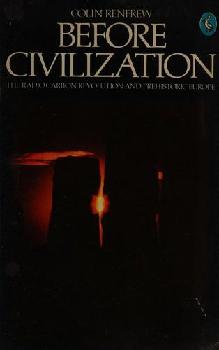
Before civilization : the radiocarbon revolution and prehistoric Europe
This is a re-examination of the more glaring inconsistencies in the old theory of dating. Renfrew shows how the monuments of prehistoric Europe, like Stonehenge and the megalithic temples of ancient Malta, could have been built without recourse to help from the \"more civilized\" near East.

Image and audience : rethinking prehistoric art
There have been many accounts of prehistoric ‘art’, but nearly all of them begin by assuming that the concept is a useful one. In this extensively illustrated study, Richard Bradley asks why ancient objects were created and when and how they were used. He considers how the first definitions of prehistoric artworks were made, and the ways in which they might be related to practices in the visual arts today. Extended case studies of two immensely popular and much-visited sites illustrate his argument: one considers the megalithic tombs of Western Europe, whilst the other investigates the decorated metalwork and rock carvings of Bronze Age Scandinavia.
eBook

Allies in memory : World War II and the politics of American commemoration in Europe, c. 1941-2001
\"Amidst the ruins of postwar Europe, and just as the Cold War dawned, many new memorials were dedicated to those Americans who had fought and fallen for freedom. Some of these monuments, plaques, stained-glass windows and other commemorative signposts were established by agents of the US government, partly in the service of transatlantic diplomacy; some were built by American veterans' groups mourning lost comrades; and some were provided by grateful and grieving European communities. As the war receded, Europe also became the site for other forms of American commemoration: from the sombre and solemn battlefield pilgrimages of veterans, to the political theatre of Presidents, to the production and consumption of commemorative souvenirs. With a specific focus on processes and practices in two distinct regions of Europe--Normandy and East Anglia--Sam Edwards tells a story of postwar Euro-American cultural contact, and of the acts of transatlantic commemoration that this bequeathed\"--From publisher's website.
Book

The significance of monuments : on the shaping of human experience in Neolithic and Bronze Age Europe
The Significance of Monuments is an indispensable text for all students of European prehistory. It is also an enlightening read for professional archaeologists and all those interested in this fascinating period.
eBook

The megalithic architectures of Europe
\"Megalithic monuments are among the most striking remains of the Neolithic period of northern and western Europe and are scattered across landscapes from Pomerania to Portugal. Antiquarians and archaeologists early recognised the family resemblance of the different groups of tombs, attributing them to maritime peoples moving along the western seaways. More recent research sees them rather as the product of established early farming communities in their individual regions. Yet the diversity of the tombs, their chronologies and their varied cultural contexts complicates any straightforward understanding of their origins and distribution. Megalithic Architectures provides new insight by focusing on the construction and design of European megalithic tombs--on the tomb as an architectural project. It shows how much is to be learned from detailed attention to the stages and the techniques through which tombs were built, modified and enlarged, and often intentionally dismantled or decommissioned. The large slabs that were employed, often unshaped, may suggest an opportunistic approach by the Neolithic builders, but this was clearly far from the case. Each building project was unique, and detailed study of individual sites exposes the way in which tombs were built as architectural, social and symbolic undertakings. Alongside the manner in which the materials were used, it reveals a store of knowledge that sometimes differed considerably from one structure to another, even between contemporary monuments within a single region. The volume brings together regional specialists from Scandinavia, Germany, Britain, France, Belgium and Iberia to offer a series of uniquely authoritative studies. Results of recent fieldwork are fully incorporated and much of the material is published here for the first time in English. It provides an invaluable overview of the current state of research on European megalithic tombs\"--From publisher's website.
Book

Sacrifice and rebirth
When Austria-Hungary broke up at the end of the First World War, the sacrifice of one million men who had died fighting for the Habsburg monarchy now seemed to be in vain. This book is the first of its kind to analyze how the Great War was interpreted, commemorated, or forgotten across all the ex-Habsburg territories. Each of the book's twelve chapters focuses on a separate region, studying how the transition to peacetime was managed either by the state, by war veterans, or by national minorities. This \"splintered war memory,\" where some posed as victors and some as losers, does much to explain the fractious character of interwar Eastern Europe.
eBook

Megalith : studies in stone
\"Following the success of Quadrivium, Sciencia, Designa, and Trivium in the acclaimed Wooden Books series, Megalith is a compendium of writings about stone structures throughout history. How do you predict eclipses at Stonehenge? Why were stone monuments built where they are? What is the meaning of the designs in ancient rock art? In this lavishly illustrated volume, eight expert authors guide readers through the history of rock structures from Stonehenge to the stone circles in France, Poland, America, and Africa. These monuments appear around the globe, connecting the modern world and ancient times. Packed with detailed information and rare and exquisite engravings, woodcuts, and drawings, Megalith is a timeless and valuable sourcebook for our world's oldest buildings and our earliest visual art.\"--provided by publisher.
Book

The Lives of Prehistoric Monuments in Iron Age, Roman, and Medieval Europe
This volume explores the pervasive influence exerted by some prehistoric monuments on European social life over thousands of years, and reveals how they can act as a node linking people through time, possessing huge ideological and political significance.
eBook