
Catalogue Search | MBRL


Are you sure you want to remove the book from the shelf?

{{itemTitle}}
2,335
result(s) for
"Moon Observations."
Sort by:

The telescopic tourist's guide to the Moon
\"Whether you're interested in visiting Apollo landing sites or the locations of classic sci-fi movies, this is the tourist guide for you! This tourist guide has a twist - it is a guide to a whole different world, which you can visit from the comfort of your backyard with the aid of nothing more sophisticated than an inexpensive telescope. It tells you the best times to view the Moon, the most exciting sights to look out for, and the best equipment to use, allowing you to snap stunning photographs as well as view the sights with your own eyes. Have you ever been inspired by stunning images from the Hubble telescope, or the magic of sci-fi special effects, only to look through a small backyard telescope at the disappointing white dot of a planet or faint blur of a galaxy? Yet the Moon is different. Seen through even a relatively cheap telescope, it springs into life like a real place, with mountains and valleys and rugged craters. With a bit of imagination, you can even picture yourself as a sightseeing visitor there - which in a sense you are.\"--Back cover.
Book
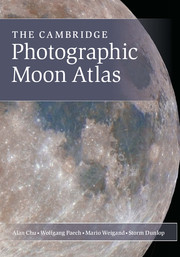
The Cambridge Photographic Moon Atlas
Using the latest methods in digital photography and image processing, The Cambridge Photographic Moon Atlas presents sixty-nine regions of the lunar landscape in large-format images with corresponding charts. Each two-page spread features a specific region in multiple lighting situations, allowing for direct comparisons of the same landscape at different lunar phases. Detailed descriptions of each region's location and topography accompany 388 high-resolution photographs, making the Moon's craters, mountains, valleys, rilles and other features easy to identify. Tracing the morphology of the Moon in unprecedented detail, this comprehensive and accessible visual atlas is an indispensable aid for amateur astronomers, astrophotographers and casual observers.
eBook

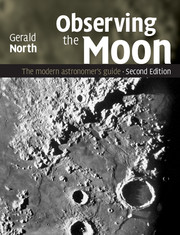
Observing the Moon
Written by an experienced and well-known lunar observer, this is a hands-on primer for the aspiring observer of the Moon. Whether you are a novice or are already experienced in practical astronomy, you will find plenty in this book to help you raise your game to the next level and beyond. In this thoroughly updated second edition, the author provides extensive practical advice and sophisticated background knowledge of the Moon and of lunar observation. It incorporates the latest developments in lunar imaging techniques, including digital photography, CCD imaging and webcam observing, and essential advice on collimating all common types of telescope. Learn what scientists have discovered about our Moon, and what mysteries remain still to be solved. Find out how you can take part in the efforts to solve these mysteries, as well as enjoying the Moon's spectacular magnificence for yourself!
eBook

Observing the solar system : the modern astronomer's guide
\"Written by a well-known and experienced amateur astronomer, this is a practical primer for all aspiring observers of the planets and other Solar System objects. Whether you are a beginner or more advanced astronomer, you will find all you need in this book to help develop your knowledge and skills and move on to the next level of observing. This up-to-date, self-contained guide provides a detailed and wide-ranging background to Solar System astronomy, along with extensive practical advice and resources. Topics covered include: traditional visual observing techniques using telescopes and ancillary equipment; how to go about imaging astronomical bodies; how to conduct measurements and research of scientifically useful quality; the latest observing and imaging techniques. Whether your interests lie in observing aurorae, meteors, the Sun, the Moon, asteroids, comets, or any of the major planets, you will find all you need here to help you get started\"-- Provided by publisher.
Book

Observing the Solar System
Written by a well-known and experienced amateur astronomer, this is a practical primer for all aspiring observers of the planets and other Solar System objects. Whether you are a beginner or more advanced astronomer, you will find all you need in this book to help develop your knowledge and skills and move on to the next level of observing. This up-to-date, self-contained guide provides a detailed and wide-ranging background to Solar System astronomy, along with extensive practical advice and resources. Topics covered include: traditional visual observing techniques using telescopes and ancillary equipment; how to go about imaging astronomical bodies; how to conduct measurements and research of scientifically useful quality; the latest observing and imaging techniques. Whether your interests lie in observing aurorae, meteors, the Sun, the Moon, asteroids, comets, or any of the major planets, you will find all you need here to help you get started.
eBook

Simulation Study of the Lunar Spectral Irradiances and the Earth-Based Moon Observation Geometry
As a radiant light source within the dynamic range of most spacecraft payloads, the Moon provides an excellent reference for on-orbit radiometric calibration. This research hinges on the precise simulation of lunar spectral irradiances and Earth-based Moon observation geometry. The paper leverages the Hapke model to simulate the temporal changes in lunar spectral irradiances, utilizing datasets obtained from the Lunar Reconnaissance Orbiter Camera (LROC). The research also details the transformation process from the lunar geographic coordinate system to the instantaneous projection coordinate system, thereby delineating the necessary observational geometry. The insights offered by this study have the potential to enhance future in-orbit spacecraft calibration procedures, thereby boosting the fidelity of data gathered from satellite observations.
Journal Article

Influence of Topography on the Site Selection of a Moon-Based Earth Observation Station
The Moon provides a long-term, stable, and unique location for Earth observation. Several space agencies, such as NASA, ESA, and CNSA, have conducted lunar explorations. To build a Moon-based observation station, site selection is the first step. The time coverage of Earth observation, e.g., the whole Earth disc observation or Earth-related plasmasphere and magnetosphere, the duration of sunlight coverage, and topography (i.e., slope) are the three major factors influencing site selection, especially in the Moon’s south pole region. In this study, we used the Chang’E digital elevation model (DEM) together with Earth, Moon, and Sun positions deduced from JPL ephemeris for site selection. Two craters, Faustini and Shoemaker, were chosen for the fuzzy evaluation of these three factors based on a multiple-input single-output (MISO) model during a 19-year period. The results show that the edge regions of craters and small hills, potholes, or uplifts inside craters are unsuitable for a Moon-based observation station. The south pole area, including these two craters, has relatively low time coverage of sunlight and some unevenly distributed, permanent shadow areas. This indicates a low thermal environment for radiation protection, whereas the relatively flat topography and the ability to cover a field of view several times the Earth’s radius enable observations of the plasmasphere and magnetosphere.
Journal Article

The Clementine atlas of the moon
The highly successful Clementine mission gave scientists their first global look at the Moon. Based on information gathered from this mission combined with data from recent missions, this unique atlas contains 144 maps covering the entire lunar surface, along with colour plates showing the Moon's composition and physical properties. The first part of the atlas describes the origin and geological evolution of the Moon and gives a brief history of lunar science and exploration, while the second features double-page spreads consisting of Clementine images paired with newly created shaded-relief maps generated from LROC topography data. This edition has been fully revised and extended to cover the armada of new missions that have launched since 2004. With one of the most complete and up-to-date lunar nomenclature databases, this is an indispensable reference for professional planetary and space scientists, amateur astronomers, and lunar enthusiasts.
eBook
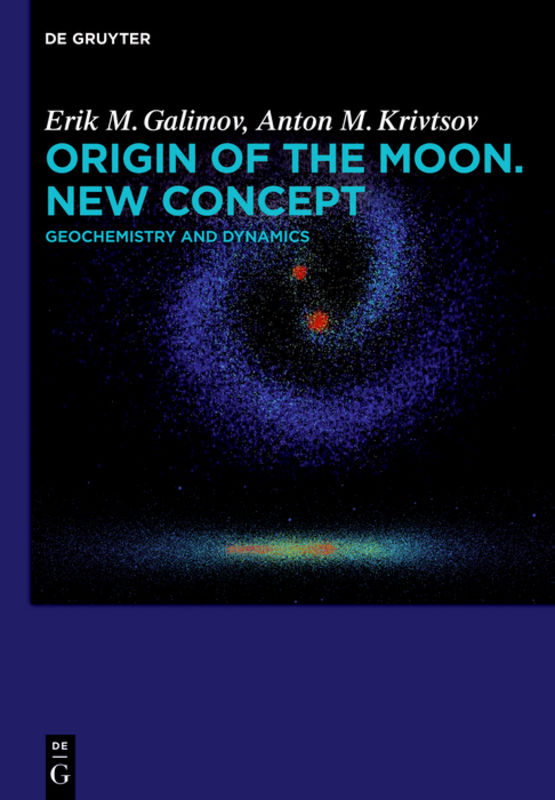
Origin of the Moon. New Concept
The origin of the Moon remains an unsolved problem of the planetary science. Researchers engaged in celestial dynamics, geophysics, and geochemistry are still discussing various models of creation of our closest cosmic neighbour. The most popular scenario, the impact hypothesis involving a collision early in the Earth's history, has been substantially challenged by the new data. The birth and development of a planet-moon system always plays a role in the formation of an entire planetary system around our Sun or around another star. This way, the story of our Moon acquires broader ramifications for one of the hottest topics of the modern scholarship. All this has motivated the authors of this book to consider a new concept and to compare the currently discussed theories, analyzing their advantages and shortcomings in explaining the experimental data.
eBook